
The CLARITY Act Fails in the Senate: A 49–50 Defeat
The CLARITY Act is officially blocked after a tense 49–50 Senate vote. We break down the historic collapse, the market dip, and exclusive insights from industry experts at GenLayer Labs and LO:TECH.
The Bright Recap
Despite addressing 126 Democratic requests, the updated CLARITY Act failed to clear the 60-vote filibuster threshold after four Republicans broke ranks.
From unpatched insider ethics loopholes to fierce pushback from 18 state attorneys general, we break down why the bill collapsed, what it means for the future of decentralized AI agents, and why market experts say U.S. crypto development isn't stopping anytime soon.
To know more about this topic, read our related articles:
- CLARITY Act: Why the New Draft Still Doesn’t Satisfy Democrats
- CLARITY Act: The Vote on the Final Text is Near, but Ethics Provisions Could Derail It
- Warren CLARITY Act Forum: An Ethics Adviser Confirms the Bill Does Not Reach Licensing Fees
- CLARITY Act Senate Vote: The Police Union Switched Sides and the Seven Votes Did Not Move
- CLARITY Act Ethics Provision: The Conflict Ban Written to Expire in 2029
- CLARITY Act Bankruptcy Protection: What Custody Rules Cover and What the House Declined to Vote On
- CLARITY Act Ethics Provision: The House Made One Amendment in Order Out of Fifty-One
- CLARITY Act Stalls Over the One Conflict It Never Assigned a Regulator
- The CLARITY Act and the Symbolism of Independence: When Supporting a Bill Becomes an Act of National Purpose
- CLARITY Act: Lummis's Dollar Argument Hasn't Changed in Two Years
- Trump Delays the CBDC Ban for a Vote His Own Senate Already Rejected
- Senate Passes the CBDC Ban: America's Digital Dollar Will Be a Private Product
- CBDC Ban Through 2030 Comes With an Explicit Stablecoin Shield
- CLARITY Act Odds Fell Twice in June for Two Unrelated Reasons
- Crucial Senate Vote Looming for CLARITY Act Amid Major Crypto Reform Revisions
- Financial technology explained
- Cantica Reports
Bright Answers
Why did the CLARITY Act vote fail on the Senate floor?
The bill failed to secure the required 60 votes to break the filibuster, finishing with a 49–50 tally. Four Republicans broke ranks to vote "no" alongside a unified Democratic caucus, leaving the legislation completely stalled ahead of the midterms.
What do industry experts think about the future of crypto regulation after this CLARITY Act deadlock?
GenLayer Labs CEO Albert Castellana notes that while the failure is disappointing, regulation must eventually distinguish between actual financial control and open-source software development, especially as autonomous AI agents begin transacting at scale. Meanwhile, LO:TECH Lead Researcher Adam Morgan McCarthy emphasizes that the vote settles nothing but pushes uncertainty forward, though the U.S. remains the most dominant digital asset market regardless of this delay.
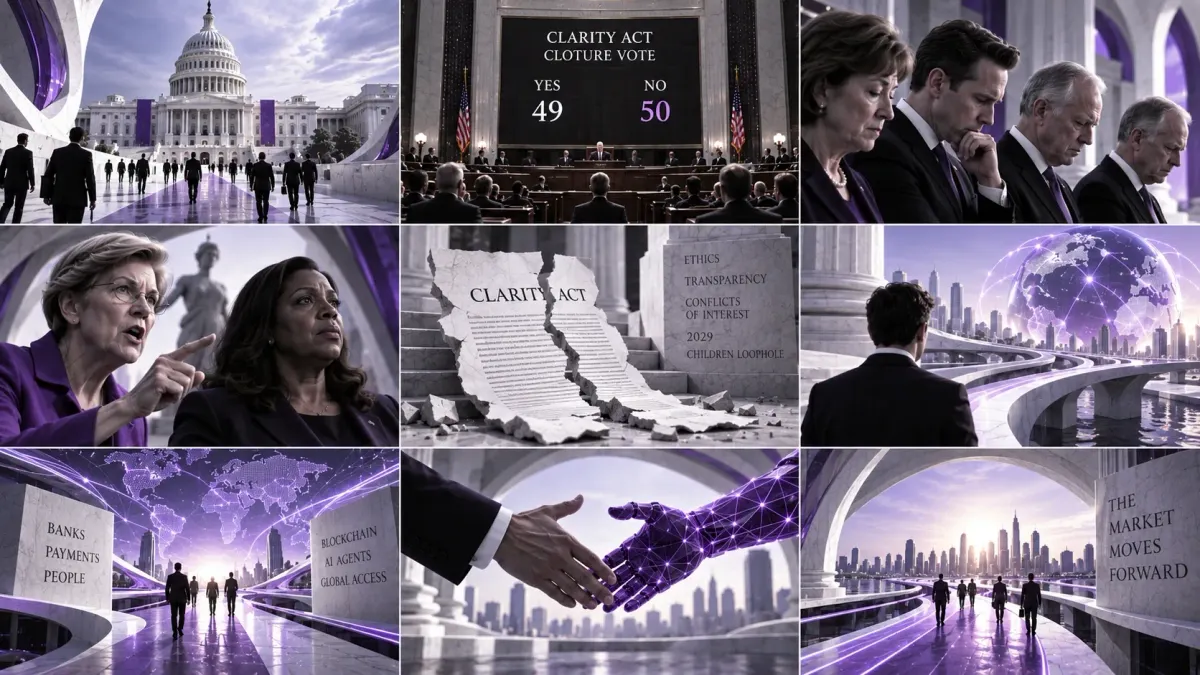
In a tense roll call on the Senate floor, the updated draft of the CLARITY Act completely broke down, failing to secure the required 60 votes to break the filibuster.
The final 49–50 tally delivers a severe blow to a multi-billion-dollar cryptocurrency lobbying group that viewed this specific text as its golden ticket to permanent federal legitimacy.
While the unified Democratic caucus held a firm wall against the bill, the true surprise came from within Republican ranks. Four GOP lawmakers—Senators Susan Collins, Josh Hawley, Jerry Moran, and Thom Tillis—broke ranks to vote against the procedural cloture motion.
In a calculated tactical move right before the roll call closed, Senator Tillis shifted his vote to a procedural "no," using a Senate rule that allows him to enter a motion to reconsider the bill down the line. But for now, the structural machinery has ground to a complete halt, leaving the administration’s grand digital asset agenda stranded in a deep legislative gridlock less than two months before the crucial midterm elections.
The Ethics Backlash: Warren and James Expose the Insider Loopholes
Yesterday’s defeat marks a massive triumph for the coordinated defensive campaign engineered by Senator Elizabeth Warren (D-MA), the Ranking Member of the Senate Banking Committee, and New York Attorney General Letitia James.
Throughout the lead-up to the vote, Warren relentlessly slammed the text's revised ethics language as a corporate "fig leaf." According to preparatory notes obtained exclusively by CNBC, Warren explicitly warned colleagues that the updated text "will do nothing to stop him [President Trump] from making his next $1.4 billion in crypto profits."
The core vulnerabilities centered on two specific loopholes exposed by The Bright Minded: the 2029 Sunset Clause and the Children Loophole.
Critics successfully argued that these provisions left a wide-open back door for high-ranking institutional actors to legally profit from the very digital asset markets they were tasked with regulating.
Further complicating the path for supporters was a fierce public assault led by AG Letitia James and a bipartisan coalition of 18 state attorneys general. In a joint letter delivered to Senate Banking leadership on September 14, 2026, the prosecutors warned that the bill's broad federal preemption clauses would effectively disarm local states.
Pointing to public data showing billions of dollars evaporating annually into online scams, James made the case that the text's lopsided handouts to the SEC would strip away local police powers to investigate and prosecute crypto fraud, leaving everyday investors entirely unprotected.
The Industry View: The Dangerous Illusion of the Middleman
Inside the blockchain ecosystem, the reaction to the Senate's gridlock is a mix of disappointment and deeper concern about the direction federal regulation is taking. Albert Castellana, CEO and co-founder of GenLayer Labs, viewed the legislative failure as a missed opportunity to establish a fundamental baseline for open-source tech.
"Yesterday’s CLARITY vote was disappointing," Castellana observed. "The bill wasn’t perfect, but it was moving toward a distinction I think matters: regulation should reflect who actually has control."
According to Castellana, federal regulators risk breaking the foundational architecture of the technology if they fail to distinguish between companies managing user funds and developers writing open-source protocols. "Controlling someone’s money or determining who can transact is fundamentally different from building software for an open network," he argued.
The danger of ambiguous, overly broad federal rules is that they inadvertently force decentralized projects to behave exactly like legacy financial systems. Castellana warns that when clear boundaries aren't established by law, "companies tend to protect themselves by adding intermediaries. A custodian here, a permissioned layer there. Individually, those choices can seem reasonable. Collectively, they can recreate the structures crypto was meant to move beyond."
Autonomous Agents and the Future of Decentralized Judgment
This structural need for clear, non-custodial regulation becomes even more acute as artificial intelligence increasingly collides with blockchain networks. The next generation of digital commerce will not just be driven by human traders, but by software programs executing complex financial transactions independently.
"AI agents will make this distinction even more important," Castellana noted. "They will negotiate and transact with one another at a scale that humans cannot, and their agreements will inevitably encounter situations that could not all have been anticipated in code."
For these autonomous ecosystems to thrive without human or corporate oversight, the legal framework must accommodate true decentralization. This is where the concept of a trustless system becomes critical. For Castellana, trustlessness does not mean removing human interpretation or fairness from a transaction; rather, it means removing the reliance on a centralized gatekeeper.
"I don’t think a trustless system is one without judgment," Castellana explained. "It is one where the parties do not have to rely on a single judge. Two agents that have never met should be able to reach an agreement, consider evidence from the real world, resolve ambiguity and settle disputes without a company deciding the outcome for them."
If the legislative push continues to favor centralized oversight, the core value proposition of blockchain technology risks being erased. As Castellana concluded, "Crypto has decentralized money and execution. The next step is decentralizing judgment. Otherwise, autonomous agents could still depend on centralized intermediaries when it matters most."
The Macro Reality: Pushing the Uncertainty Forward
Despite the intense political theater and the dramatic market dip, institutional researchers point out that the legislative standstill changes very little about the day-to-day commercial reality of the asset class. The underlying development of digital assets remains tightly anchored to U.S. markets, regardless of congressional inertia.
"A failed cloture vote settles nothing and pushes the uncertainty forward," stated Adam Morgan McCarthy, Lead Researcher at London-based digital asset liquidity and market data firm LO:TECH. "The debate on a federal framework carries on, and depending on how the midterms land, this bill could be dead within two months."
McCarthy stressed the real economic battlegrounds . "The fight that actually matters here is stablecoin rewards—whether exchanges and platforms can pay users on the balances they hold—and that question doesn't disappear because this vote failed," McCarthy observed.
Ultimately, the failure of the CLARITY Act delays a standardized regulatory roadmap, but it does not diminish the dominance of American digital infrastructure. The commercial momentum is simply too massive for a single congressional stalemate to disrupt.
"What doesn't change is where the market already is," McCarthy concluded. "The US remains the most competitive digital asset market, and USD stablecoins are still the only stablecoin market that matters. Yesterday's result delays the easier path this bill would have created, but the activity and development were already happening here."
With Congress grinding to a halt ahead of the midterms, the CLARITY Act is effectively shelved for the remainder of the legislative session. The industry will continue to operate under a fragmented framework of piecemeal regulatory enforcement—proving once again that while Capitol Hill bickers over the rulebook, the actual market moves regardless.
Editor's note
Every piece published on The Bright Minded goes through careful verification, but mistakes can happen. If you spot an error, have additional information, or want to flag anything, write to rosalia@thebrightminded.com.