
CLARITY Act Bankruptcy Protection: What Custody Rules Cover and What the House Declined to Vote On
Lummis says the CLARITY Act keeps customer crypto out of a bankruptcy pool. The protection runs through custody rules, and one amendment never got a vote.

The Bright Recap
Senator Cynthia Lummis argued publicly on 20 July 2026 that the CLARITY Act would keep customer holdings out of a bankruptcy estate, citing the Celsius and Voyager insolvencies. The bill delivers that through custody, with Section 402 requiring futures commission merchants to use qualified digital asset custodians and Section 405 setting the standards those custodians meet.
To know more about this topic, read our related articles:
- One amendment out of fifty-one
- Criminal liability for writing code
- The committee vote and its caveats
- Every fight that got it here
- The argument that never changed
- The retirement risk unions raised
- Two unrelated reasons for delay
- When a bill becomes symbolism
- A bank chief against his own bank
- How to check your own platform
- Blockchain explained
- Financial technology explained
Bright Answers
How would the CLARITY Act protect customer crypto if a platform fails?
Through custody. Registered intermediaries would have to keep customer holdings separate from their own and place them with a qualified digital asset custodian, and that separation is what keeps the holdings identifiable as customer property.
Which sections cover custody?
Section 402 requires futures commission merchants to use qualified digital asset custodians, and Section 405 sets the requirements applying to those custodians.
Was a stronger version proposed?
Yes. An amendment providing bankruptcy-remote custody, withdrawals within twenty-four hours, monthly audited reserve attestations and insurance coverage modelled on securities investor protection was denied a vote in the House Rules Committee on 14 July 2025 by 4–8.
The CLARITY Act bankruptcy protection that Senator Cynthia Lummis put in front of the public on 20 July 2026 operates through custody requirements imposed on registered intermediaries. Knowing which mechanism is on offer tells a customer whether their own platform sits inside it. The committee record holds both the protection that survived and the stronger version that never reached the floor.
Protection in legislation is a mechanism before it is a promise, and the mechanism decides who it reaches.
What an app balance turns out to be
A balance displayed in an application is a claim against the company displaying it, and the strength of that claim depends on how the company held the underlying asset. The Celsius and Voyager insolvencies settled that question for a large number of people at once, in the direction most of them had not expected.
Customers discovered that the legal character of their holdings had been decided long before the filing, by arrangements they never saw. That discovery is the reference point for the argument now being made for the bill, and it sits alongside one amendment out of fifty-one as the second thing the House record explains about this legislation.
What Lummis said
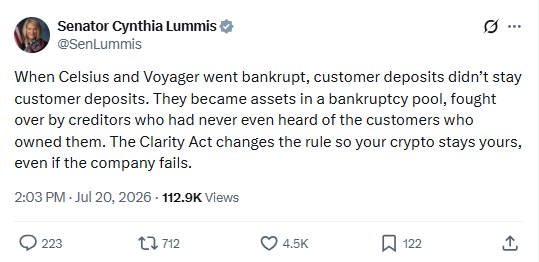
Lummis set out the case publicly on 20 July 2026, and her argument arrives at a single destination, which is that a customer's holdings would remain the customer's when a firm collapses. She gets there through the two insolvencies, where balances people regarded as their own were absorbed into the estate and became something claimants could divide, including claimants with no connection to the account holders whose assets they were reaching. The post passed 112,000 views. Placing the value of a bill in a completed harm is durable argument, because the harm itself cannot be contested.
The machinery behind the claim
The protection runs through custody and separation. The House Financial Services Committee's section-by-section summary of the House text describes segregation and commingling restrictions, and requires customer digital assets to sit with a qualified digital asset custodian. Section 402 obliges futures commission merchants to use such custodians and Section 405 sets out what qualifies one. Assets that were never mixed with a firm's own holdings are harder to characterise as belonging to that firm, which is the whole of the protective logic.
Registration is the boundary
Those obligations attach to intermediaries inside the regime, which makes registration the line that decides who benefits. A customer of a registered firm using a qualified custodian is covered by the arrangement Lummis describes, and a customer of a firm outside it is covered by whatever that firm has chosen to do. The committee vote count in the Senate carried this framework forward without altering it.
The version that never reached the floor
Representative Waters filed a consumer package containing custody built to survive an insolvency, withdrawals completed within twenty-four hours, monthly reserve attestations verified by auditors and insurance coverage modelled on securities investor protection. The Rules Committee record shows Record Vote No. 151 denying it a place on the floor by 4–8 on 14 July 2025, with every Republican present opposed and every Democrat in favour. The custody requirements in the bill therefore stand on segregation and custodian qualification, and the explicit insolvency language that amendment proposed sits outside the text.
What else that session settled
The same meeting disposed of the bill's ethics question by the same margin and admitted one substantive amendment out of fifty-one. Reading the two votes together shows a committee resolving a long list of consumer and conflict questions in a single afternoon through procedure rather than debate. Those decisions form part of every fight that got the bill here, and several have since resurfaced in Senate negotiations.
The same pattern in the developer fight
Our reporting in May followed Lummis making a structurally identical argument about software developers. She warned that failure of the bill would expose American developers to prosecution for publishing code, citing the Roman Storm conviction of August 2025 and pointing to the Blockchain Regulatory Certainty Act inside CLARITY as the correction, which would place non-custodial developers outside money-transmitter classification in statute rather than in guidance an agency can override.
The complication came from the same markup. The amendment package that preserved that developer protection removed a separate shield covering developers who write software and hold no control over it after deployment, leaving them open to classification as securities intermediaries where regulators argue governance arrangements amount to control. CoinDesk contacted Lummis's office days later and received no response on the point. One protection was secured and another disappeared inside a single negotiation.
Why custody works differently here
Custody of a traditional security means an intermediary holding a register entry on a customer's behalf. Custody on a distributed ledger means control of the keys that move an asset, and whoever holds those keys can move it whatever the platform's records say. Segregation rules exist precisely because the technical ability to move customer assets and the legal right to do so are separate things.
What someone holding assets on a platform can do now
The question that matters for an individual is which category their account falls into. Both regulators have 360 days from enactment to write the joint rules that give this financial technology framework its operating detail, which puts practical effect well beyond passage itself. Anyone who wants to act before then can establish where their platform is registered and who holds the keys to the assets in it.
What the record actually shows
Every protection in the CLARITY Act arrived through negotiation, and the same committee documents that record what survived also record what was traded to get it there.
Editor's note
Every piece published on The Bright Minded goes through careful verification, but mistakes can happen. If you spot an error, have additional information, or want to flag anything, write to rosalia@thebrightminded.com.