Blockchain Explained: What It Is, How It Works, and What Industries Are Doing With It Now
What is blockchain? A complete guide to how the technology works, the types of blockchain networks, and what enterprises and institutions are doing with it now.
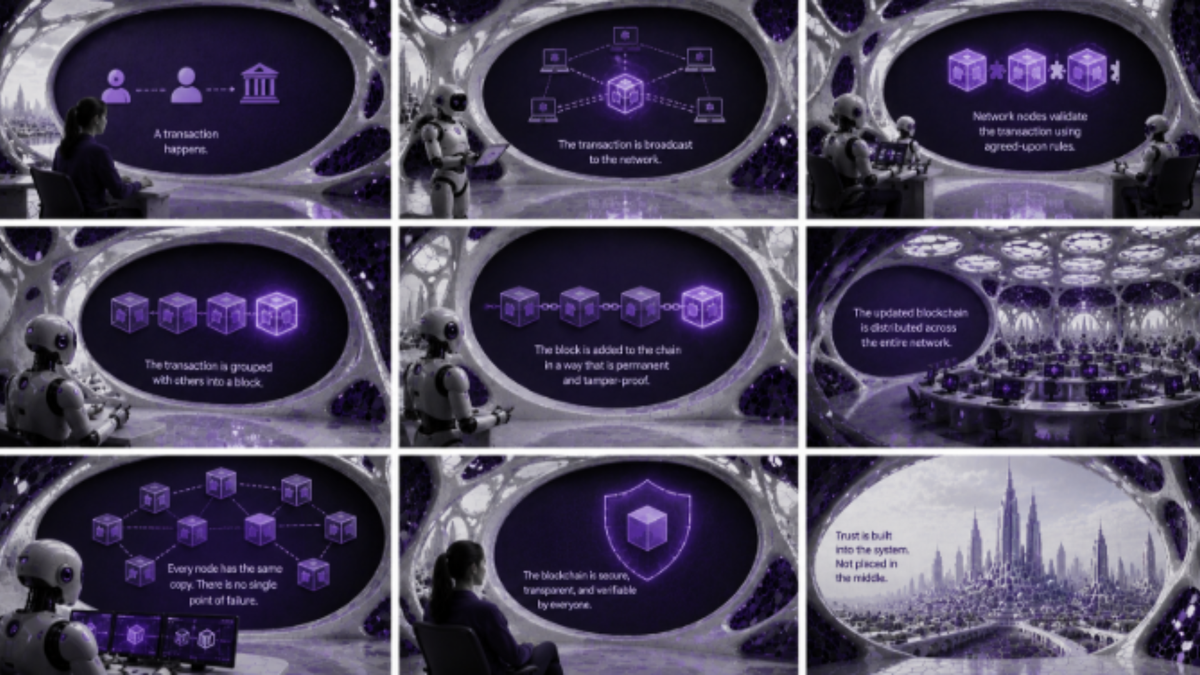
Banks, property registries, and securities clearing houses share a single operational purpose: confirming that a transaction happened, that the record of it is correct, and that neither party can quietly revise it afterward. Blockchain is the technology that performs that confirmation without any of those institutions present.
The global blockchain market was valued at approximately $31 billion in 2024 and is projected by MarketsandMarkets to reach $393 billion by 2030, at a compound annual growth rate of 64.2%. This guide covers what blockchain is, how it works at a technical level, what types of network exist, and how industries are applying it today.
What blockchain is
Blockchain is a database with three properties that separate it from conventional alternatives. Data is stored in sequential cryptographically linked blocks rather than rows and tables, identical copies of the complete ledger are distributed across every network participant rather than held by a central authority, and any attempt to alter a record already added to the chain is immediately detectable by every participant without requiring any authority to announce it. These three properties, structural linkage, distribution, and verifiable integrity, are what make blockchain useful wherever parties need to share a record that no single one of them can be trusted to maintain alone.
The formal category name is Distributed Ledger Technology, or DLT. Blockchain is the most widely deployed form of DLT, and the two terms appear interchangeably in most commercial contexts, though they are not identical: every blockchain is a distributed ledger, and not every distributed ledger follows the sequential block architecture. The distinction matters in enterprise contexts, where some implementations use alternative ledger structures that retain the distribution and integrity properties without the block-and-chain format.
Blockchain is a foundational technology within the broader fin-tech ecosystem and a component of digital finance infrastructure that has extended well beyond finance into supply chains, healthcare, government record systems, and identity verification. The two properties that attract institutional attention across all those contexts are consistent: records added to the chain cannot be altered retroactively, and no single entity controls the ledger. Any situation where those two guarantees carry commercial or legal value is a potential deployment context.
How a blockchain works
A blockchain is built from linked data blocks. Each block contains a batch of validated transactions, an exact timestamp, and two cryptographic identifiers: a hash representing the block's own contents, and the hash of the block directly before it in the chain.
The hash is produced by running the block's data through a cryptographic algorithm that outputs a fixed-length alphanumeric string. The algorithm is deterministic: identical inputs always produce identical outputs. It is also highly sensitive to change: any modification to the input data, however minor, produces an entirely different output string. Altering any historical block therefore changes its hash, which invalidates the hash reference held in the next block, cascading through every subsequent block in the chain. Reversing that cascade across every copy of the ledger held by every participant simultaneously is, on a sufficiently large network, computationally infeasible. That is what makes blockchains tamper-evident rather than simply tamper-resistant.
Each block also contains a Merkle root, which is a single hash summarising the full set of transactions the block holds. The structure is built by hashing each transaction individually, then repeatedly combining and hashing adjacent pairs of transaction hashes upward through a tree until one root hash remains. Any participant can use this structure to verify the integrity of any individual transaction without processing the block's complete dataset.
Nodes are the computers that maintain the network. Full nodes hold a complete copy of the ledger and independently verify every incoming transaction against the network's rules before accepting it. Lightweight nodes verify that transactions have reached the network but do not maintain the full ledger, making them suitable for mobile wallets and applications where storage is limited. Supernodes operate as redistribution points between full nodes, maintaining consistent connectivity to keep the broader network synchronised across geographies.
Consensus mechanisms
The consensus mechanism is the rule set that determines how a network of independent participants reaches agreement on which transactions are valid and in what order they enter the chain, without a central authority making that call.
Proof of Work operates through competitive computation. Participants called miners race to find a specific numerical input that, combined with the block's data, produces a hash meeting the network's current difficulty target. Finding that input demands enormous computational work; verifying that the correct one has been found requires almost none. The miner who succeeds first adds the next block and collects a reward from the network. Bitcoin has operated on this mechanism since 2009. Its security derives from economics: controlling more than half the network's total computational power to rewrite the chain would cost an attacker more than any realistic gain could justify.
Proof of Stake replaces computational competition with committed economic collateral. Participants called validators lock up a quantity of the network's cryptocurrency. The protocol selects validators to produce new blocks proportionally to that committed stake, and a validator that attempts to endorse fraudulent transactions loses the deposited collateral through a penalty mechanism called slashing. Ethereum migrated from Proof of Work to Proof of Stake in September 2022, an event known as the Merge, and the Ethereum Foundation reported that the migration reduced the network's energy consumption by approximately 99.95%.
Private and consortium blockchains typically use mechanisms suited to known, pre-approved participant sets rather than open competition. Variants of Practical Byzantine Fault Tolerance reach consensus through a structured voting process among a defined group. These mechanisms are faster and more energy-efficient than the open-network alternatives, but they require that all participants are identified before the network begins operating, which makes them well-suited to enterprise environments and incompatible with anonymous public networks.
Types of blockchain network
Four distinct network types exist, defined by who can read the ledger, who can submit transactions, and who can participate in adding blocks.
Public blockchains are open without restriction. Access requires no approval from any authority, and network rules apply identically to every participant regardless of identity or jurisdiction. Bitcoin and Ethereum are the two largest public blockchains by network size and total value transacted. This openness is also the primary regulatory challenge: participant pseudonymity makes compliance with identity-based financial regulations incompatible with the base protocol, which is why regulated financial applications tend to operate on separate layers or on different network types entirely.
Private blockchains are operated by a central authority that determines who may join and participate. The ledger is distributed across multiple nodes, which provides operational resilience, but governance is centralised. Regulated enterprises and financial institutions use private blockchains where counterparty identity verification is a legal requirement. Hyperledger Fabric and R3 Corda are the most widely deployed frameworks in this category, in production use by banks, insurance companies, and logistics operators globally.
Hybrid blockchains combine public and private elements within a single deployment. Organisations control access to sensitive data through a private layer while making specific records publicly verifiable. Research from Webisoft found that hybrid architectures accounted for approximately 42% of the global blockchain market by 2025, most prevalent in banking, healthcare, and supply chain applications where partial transparency is commercially or regulatorily required.
Consortium blockchains distribute governance among a defined group of organisations rather than a single controlling authority. Participation is pre-approved, but each member holds equivalent decision-making power over network rules and operation. Hyperledger Besu is the most common framework for consortium deployments, used in financial market infrastructure and industrial supply chain contexts where participants know each other but cannot rely on any single party to maintain the authoritative record.
Smart contracts
Smart contracts are programs stored on a blockchain that execute automatically when specified conditions are met, with no human intervention required to trigger the outcome. The concept was described by computer scientist Nick Szabo in 1994, but practical deployment became possible only with Ethereum's launch in 2015, which provided the programmable infrastructure those contracts require.
A payment released when a delivery confirmation is recorded on the chain, a loan position liquidated automatically when collateral value falls below a defined ratio, a royalty distributed each time a digital asset changes hands: all of these can be encoded in a smart contract and executed without any party needing to authorise the outcome afterward. The defining property is determinism. The same inputs always produce the same outputs, and no party can alter the result once execution begins.
SQ Magazine recorded more than 6.1 million smart contracts being deployed monthly across major blockchain networks as of mid-2025. The limitation that accompanies their rigidity is significant: code errors cannot be corrected after deployment without specific upgrade mechanisms built into the original design, and exploiting those errors has been the primary attack vector against decentralised finance protocols. Smart contract auditing by specialist security firms has become standard practice for any protocol holding significant capital, and protocols with the longest uninterrupted operating histories under adversarial conditions carry the most institutional credibility.
Financial services
Banking and financial services account for approximately 39% of total enterprise blockchain activity globally, according to Precedence Research, making it the largest single sector by deployment share. The applications in production span payment settlement, trade finance, compliance, and post-trade infrastructure.
Cross-border institutional payment settlement is the most active current application. JPMorgan's Kinexys network, built on a permissioned blockchain, settles institutional transfers at 1,500 transactions per second with finality under 30 seconds. Enterprise deployment data reported a 25% reduction in foreign exchange rail costs compared to correspondent banking routes. Conventional SWIFT-based settlement typically takes between one and five business days and passes through multiple correspondent institutions, each adding cost and latency. For the securities settlement layer of global capital markets, the DTCC is integrating distributed ledger technology into its post-trade infrastructure across a market processing $114 trillion annually.
More than 90% of banks in the US and Europe had initiated blockchain-related projects by 2025, according to DemandSage. Asset tokenization, the representation of financial instruments as digital tokens on blockchain rails, is the application attracting the most institutional capital. More than 48% of institutional investors were exploring tokenized asset custody solutions across multiple asset classes, according to Global Market Statistics. BlackRock launched a tokenized treasury fund on blockchain infrastructure in 2024, and VanEck followed with a tokenized product available across four major blockchain networks in May 2025, according to Precedence Research.
Stablecoin settlement is developing in parallel as an institutional payment mechanism. Conventional payment networks are extending into blockchain rails for specific settlement use cases, and the onchain banking infrastructure being built around these rails represents a structural addition to financial settlement rather than a replacement of what exists.
Decentralised finance
Decentralised finance covers lending, borrowing, trading, and yield-earning delivered entirely through smart contracts on public blockchains, with no bank, broker, or central intermediary involved at any stage. Participation requires a cryptocurrency wallet and internet access.
The number of wallets actively interacting with DeFi protocols grew from under one million in 2021 to more than 20 million by 2025, according to CoinLaw. Monthly trading volume across decentralised exchanges reached $462 billion in 2025. Aave, one of the sector's largest lending protocols, held approximately $25 billion in total value locked in its smart contracts as of mid-2025. The DeFi sector is projected to reach $256 billion in market value by 2030.
Security has been the primary constraint on broader adoption. Immunefi's 2025 security data found that failures in access control mechanisms, the code determining which addresses can call which protocol functions, accounted for approximately 59% of total DeFi losses across the sector, with separately identified code vulnerabilities responsible for a further $263 million in losses. Protocols that have maintained uninterrupted operation through multiple market cycles and independent security reviews have accumulated a track record that institutional participants are beginning to treat as meaningful evidence of reliability.
Financial privacy is an active dimension of public blockchain adoption. Shielded adoption data from privacy-focused blockchain networks shows users actively choosing transactional privacy as a design feature rather than accepting full ledger transparency as a given. Government responses to decentralised financial infrastructure vary sharply by jurisdiction: the Russia crypto law of 2026 illustrates one approach, legalizing what state infrastructure can absorb and restricting activity it cannot bring within its oversight perimeter.
Supply chain management
Supply chain management is the non-financial blockchain application with the largest body of documented enterprise deployments. The problem it addresses is provenance: confirming that a product came from where it claims to come from, is what it claims to be, and passed through the conditions it was supposed to maintain at each stage of its journey.
Walmart's food traceability system, built on IBM's Hyperledger Fabric platform, compressed the time required to trace a product's full supply chain path from seven days to 2.2 seconds, operating across more than 2,100 stores. Maersk ran TradeLens, a blockchain-based logistics platform, from 2018 to 2022, recording more than 30 million container shipments on the ledger before retiring the platform due to industry-wide adoption challenges. De Beers built a custody-tracking system called Tracr that records the chain of ownership for individual diamonds, giving buyers cryptographically verifiable provenance without relying on seller-supplied paperwork.
The global blockchain supply chain market is projected to reach $25 billion by 2032. Kings Research projects the supply chain management segment will grow at 49.1% annually through the forecast period, the fastest rate of any enterprise blockchain application category. The technical development that makes these deployments substantively useful rather than expensive shared databases is the integration of IoT sensor data directly into smart contracts: temperature, GPS coordinates, and humidity measurements update the chain automatically at each custody handoff, without manual data entry that could be falsified or delayed.
Healthcare
Healthcare blockchain applications address three structurally distinct problems: patient record portability across institutions, pharmaceutical supply chain integrity, and clinical trial data management. Adoption has moved more cautiously than in finance and logistics, primarily because of the regulatory complexity surrounding patient data under HIPAA, GDPR, and their regional equivalents in different markets.
Pharmaceutical traceability is the most mature healthcare application. Counterfeit and diverted medications represent an established problem in global drug distribution, and an immutable blockchain record of a drug's movement from manufacturer to patient allows each participant in the distribution chain to verify authenticity and correct storage conditions without depending on documentation that can be forged. Patient record portability is a second active area: blockchain-based systems allow patients to control access to their own medical data through a private key, granting providers selective access without surrendering custody of the underlying records to any single institution.
Clinical trial data management represents a third application with significant implications for research credibility. The immutability of blockchain records allows trial protocols and results to be registered in a way that makes retroactive revision detectable, addressing a documented reproducibility problem in published medical research where outcome measures have been quietly changed after data collection. Blockchain penetration of the global healthcare market is projected to reach 15% by 2030.
Digital identity and credentials
Digital identity verification is among the most consequential blockchain applications outside finance. Confirming that someone is who they claim to be, without depending on a central registry that can be breached, corrupted, or simply absent in certain geographies, is a challenge shared by virtually every institutional system operating across borders.
Blockchain-based identity systems assign each individual a cryptographic identifier recorded on a distributed ledger that no single institution controls. The holder manages their own identity data through a private key and discloses specific verified attributes, including age, nationality, or professional qualification, selectively to parties requesting them, without exposing the underlying personal data in the process. Global Market Statistics estimates that digital identity pilots built on this model now cover approximately one billion individuals across government, financial services, and education applications globally.
India's Digital Locker programme, now blockchain-enabled, stores more than 5 billion documents for public access and credential verification. South Korea mandated blockchain certification for specific financial technology and digital identity applications from Q2 2025. Universities in multiple countries now issue blockchain-verified degree certificates that graduates share directly with employers, replacing third-party verification services with a cryptographic proof the issuing institution signed directly.
The integration of artificial intelligence with blockchain identity infrastructure is developing as a complementary operational layer. AI-driven identity assessment processes that use blockchain-verified credentials have compressed financial account verification from days to hours in documented deployments, while maintaining the audit record that compliance functions and regulators require.
Real estate and asset tokenization
Tokenization is the representation of ownership rights in a real-world asset as a digital token on a blockchain. The token carries the same legal and economic claim on the underlying asset as a conventional ownership document, but it can be transferred, subdivided, and traded on blockchain rails continuously rather than through the slow, paper-intensive conveyancing processes that govern most conventional asset classes.
Tokenized assets crossed $5 trillion in total market value in 2025, led by tokenized real estate and carbon credits. The tokenization market, covering the platforms and services that enable this conversion, was valued at $4.02 billion in 2025 and is projected to reach $24.13 billion by 2035. Sweden's national land registry completed a successful trial of blockchain-based property title transfers, replacing paper conveyancing records with a shared immutable ledger accessible to all parties to a transaction simultaneously. Georgia deployed a blockchain system to confirm government property registrations, reducing fraud and improving the speed of ownership transfers.
The mechanism converts assets that are structurally illiquid into instruments where fractional ownership and continuous trading become available at thresholds unavailable in conventional markets. A property previously requiring a single buyer can, when tokenized, be held across many investors at lower individual entry points with verifiable, transferable ownership for each. Whether regulators in each jurisdiction recognise that token as a legally binding ownership instrument is the primary constraint on how quickly real estate tokenization extends beyond pilot programmes into mainstream commercial practice.
Government and public records
Government blockchain deployments focus on public record management, procurement transparency, and digital identity infrastructure. Production deployments with measurable outcomes exist across multiple regions.
Public procurement systems using blockchain across several EU member states recorded a 38% reduction in fraud and processing delays. The EU's eIDAS 2.0 framework, governing digital identity across member states, incorporates provisions for blockchain-based credential verification. The US Department of Defense has run pilots using blockchain for secure data transmission and logistics tracking across military supply chains. Latin America leads in public-sector deployment volume: Brazil, Colombia, and Mexico have each run active programmes for digital currency infrastructure and blockchain-based identity verification.
Central Bank Digital Currencies represent the most consequential government blockchain application currently in development. More than 130 CBDC pilot programmes were active globally by 2025, spanning both wholesale models used for interbank settlement and retail models that would give central banks a direct digital relationship with individual citizens. The design decisions embedded in each programme, particularly around transaction privacy, intermediary involvement, and whether spending can be programmatically restricted, carry direct implications for the future relationship between states and their populations' financial lives. Municipal governments in Canada and Australia have issued tokenized green bonds on blockchain rails to fund local sustainability projects, giving retail investors access to instruments previously restricted to institutional buyers.
The global market
Estimating the global blockchain market precisely is complicated by significant variation in how research firms define what the market includes. Conservative estimates covering pure blockchain infrastructure and platform revenue put the market at approximately $31 billion in 2024. Broader estimates incorporating associated services and enterprise deployments produce figures reaching $50 billion for the same year.
MarketsandMarkets projects the enterprise blockchain market will reach $393 billion by 2030 at a 64.2% compound annual growth rate. DemandSage cites projections placing the total business value added by blockchain across the global economy above $3.1 trillion by 2030.
North America accounts for approximately 38% to 46% of global blockchain market share across research methodologies, driven by capital concentration, technology infrastructure, and the highest number of active blockchain enterprises. Europe holds approximately 27%, with the EU's MiCA regulation providing legal clarity for blockchain-based financial products not yet matched in most other jurisdictions. Asia-Pacific accounts for approximately 24% of current market value and is projected to grow fastest through the forecast period, with China, India, Japan, and Singapore the leading markets by deployment volume.
Financial services account for approximately 39% of total blockchain market value, with banking the single largest sub-sector at 29.7%, according to SQ Magazine. Blockchain as a Service, where cloud providers supply managed blockchain infrastructure that organisations deploy without building the underlying network themselves, is projected by Fortune Business Insights to account for approximately 52% of the total market by component by 2026. Blockchain developer employment in the US grew 29% year-on-year in 2025, with Solidity and Rust the most in-demand technical skills, and over 35,000 active enterprise deployments now operate across more than 100 countries.
Limitations and challenges
Scalability is the most discussed technical constraint. The average transaction throughput across major public blockchains reached approximately 17,000 transactions per second in 2025, compared to around 4,000 for permissioned enterprise networks, according to SQ Magazine. Visa's payment infrastructure handles approximately 65,000 transactions per second at peak load. The gap between public blockchain throughput and conventional payment infrastructure throughput means that consumer payment applications built directly on public chains remain bounded by underlying network capacity rather than by demand.
Interoperability is the second structural challenge. More than 35,000 blockchain networks operate globally and most cannot exchange data or assets with each other natively. The same SQ Magazine research found that 43% of enterprises cited interoperability as their primary concern when expanding blockchain deployments. Cross-chain protocols including Polkadot, Cosmos, and Chainlink's Cross-Chain Interoperability Protocol are reducing this problem by enabling assets and data to move between separate chains, though they introduce their own complexity and security considerations in the process.
Regulatory uncertainty has slowed enterprise adoption where the legal treatment of blockchain-based assets and smart contracts remains unresolved. Business Research Insights found that approximately 60% of organisations cited regulatory uncertainty and interoperability as the leading barriers to broader deployment. The EU's MiCA regulation reduced that uncertainty for European markets and is being studied as a reference model by regulators in the US, UK, and Asia-Pacific. Energy consumption remains a relevant concern for Proof of Work blockchains, though Ethereum's 2022 migration to Proof of Stake removed the second-largest public network from that category.
Where the technology sits
Blockchain's deepest commercial traction has accumulated in applications where the integrity of a shared record is contested between parties that share no common authority to resolve the dispute: food safety systems tracing custody across dozens of handlers, property registries that must be trusted simultaneously by buyers, sellers, and government departments, and post-trade settlement infrastructure where institutions in different jurisdictions each maintain their own version of the same transaction record.
The value blockchain provides in each of those contexts is relational before it is technical. The parties involved needed a version of the record that no single participant could alter unilaterally, and building that guarantee reliably, at scale, and across institutional boundaries had not been achievable through other available means. The financial privacy research The Bright Minded tracks, including the shielded adoption data from privacy-focused public networks, reflects one specific dimension of that same problem: who should be able to read the shared record, and under what conditions, is as consequential as who is permitted to write it.
Blockchain's value is proportional to the degree to which the parties who need to share a record cannot or will not trust a single keeper of it. That condition appears more frequently across commercial and civic life than the technology's original financial framing suggested. The industries where blockchain has found durable operational deployments, including finance, supply chains, government registries, and healthcare records, are those where the cost, unreliability, or absence of a trusted intermediary was already a documented operational problem before distributed ledger technology existed. The technology's spread across those sectors is, in that sense, a map of where institutional trust has historically been insufficient.
Editor's note
Every piece published on The Bright Minded goes through careful verification, but mistakes can happen. If you spot an error, have additional information, or want to flag anything, write to rosalia@thebrightminded.com.