CLARITY Act Passes Senate Banking Committee 15-9: What the Vote Count and the Caveats Mean for the Floor
The CLARITY Act passed the Senate Banking Committee 15-9 on May 14, with two Democrats voting yes. Here is what the result means for the Senate floor.
The Bright Recap
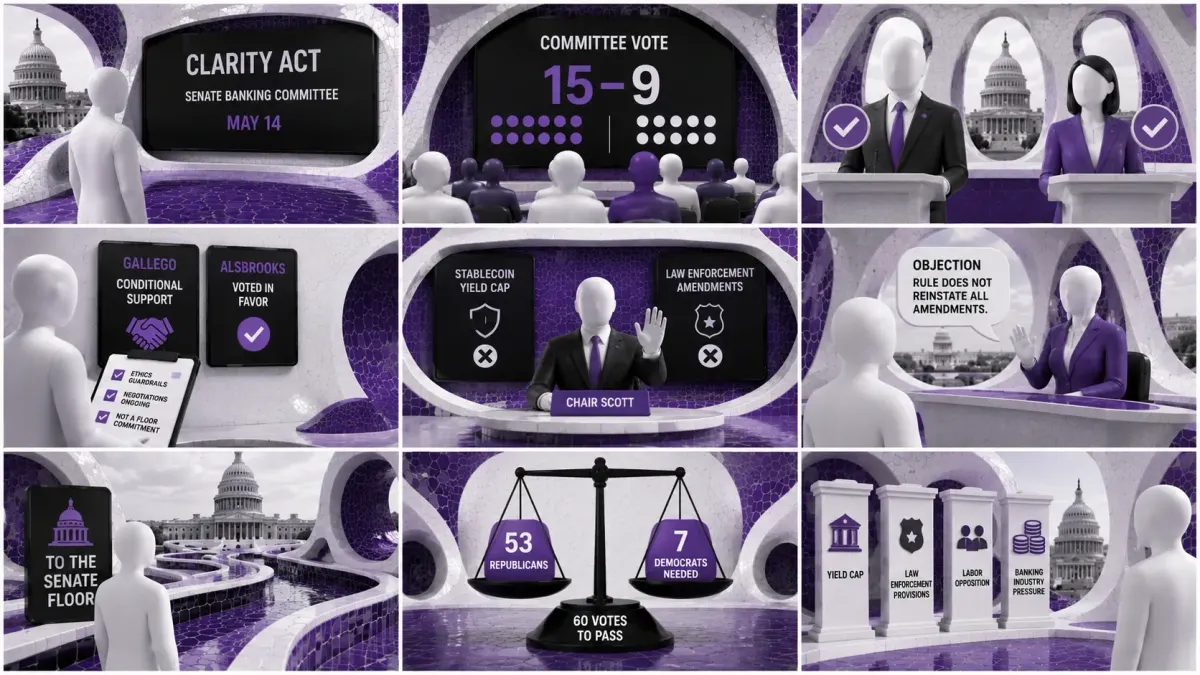
The Senate Banking Committee advanced the CLARITY Act 15-9 on 14 May 2026. Ruben Gallego and Angela Alsobrooks were the two Democratic votes, and Gallego stated afterwards that his committee vote did not extend to the Senate floor while ethics guardrail negotiations remained open.
To know more about this topic, read our related articles:
- How the markup was announced
- The lobbying behind Section 404
- Where the Senate drew its line
- One battle in two places
- When a bank lobby fractures
- The retirement risk unions raised
- Every fight that got it here
- Criminal liability for writing code
- A bank chief against his own bank
- The argument that never changed
- Two unrelated reasons for delay
- When a bill becomes symbolism
- One amendment out of fifty-one
- What custody rules actually cover
- Financial technology explained
Bright Answers
Who were the two Democrats who voted for the CLARITY Act in committee?
Ruben Gallego of Arizona and Angela Alsobrooks of Maryland joined the Republican majority to produce the 15-9 result on 14 May 2026.
Does a 15-9 committee vote mean the CLARITY Act will pass the Senate?
No. Ending debate on the Senate floor takes 60 votes and Republicans hold 53 seats, so seven Democratic votes are needed. The committee delivered two, and Gallego said his did not carry over to the floor.
Which provisions did the committee decline to vote on?
A stablecoin yield cap backed by the banking industry and a set of amendments requested by law enforcement. Both remain among the conditions Democratic senators have named for their floor support.
The CLARITY Act cleared the Senate Banking Committee on May 14, advancing to the full Senate on a 15-9 vote. Two Democrats joined the Republican majority: Ruben Gallego of Arizona and Angela Alsobrooks of Maryland. The result, reported live from the markup by journalist Eleanor Terrett, moves the central piece of US fintech legislation to the Senate floor. The conditions Gallego attached to his support define what that path looks like from here.
Two Democratic votes and what they came with
Gallego stated after the committee result that his vote in favor did not carry over to the Senate floor, pointing to ethics guardrails negotiations he said had not yet produced a final agreement. Alsobrooks also voted in favor.
Chair Scott, as journalist Brendan Pedersen reported live from the markup, declined to hold votes on two provisions Democratic senators had requested: a stablecoin yield cap backed by the banking industry and amendments sought by law enforcement. Pedersen noted the decision would shield Republican members from politically difficult votes. Senator Warren objected on procedural grounds, arguing the ruling did not reinstate all the amendments that had been struck earlier. Scott agreed to restore some of them, but the committee did not vote on the yield or law enforcement provisions.
What the Senate floor requires
A full Senate vote requires 60 votes to clear the filibuster threshold, and the Republican caucus holds 53 seats. Seven Democratic votes are needed, and the committee produced two, one of them conditional on issues the markup left unresolved. The provisions the committee declined to vote on today, the yield cap and the law enforcement language, are among the conditions several Democratic senators have named publicly for their floor support. The labor union opposition filed before today's vote and the stablecoin yield fight the banking industry pursued in parallel remain part of the public record the bill carries into the next stage.
The committee result gives the CLARITY Act a bipartisan label and a path to the floor. The 60-vote threshold will be decided by the same questions the markup did not resolve.
Editor's note
Every piece published on The Bright Minded goes through careful verification, but mistakes can happen. If you spot an error, have additional information, or want to flag anything, write to rosalia@thebrightminded.com.