Anthropic's First National Survey: What 52,000 Americans Actually Think About AI
Anthropic surveyed 52,000 Americans on AI in late 2025. Job loss topped every fear list. Only 15% trust AI companies.
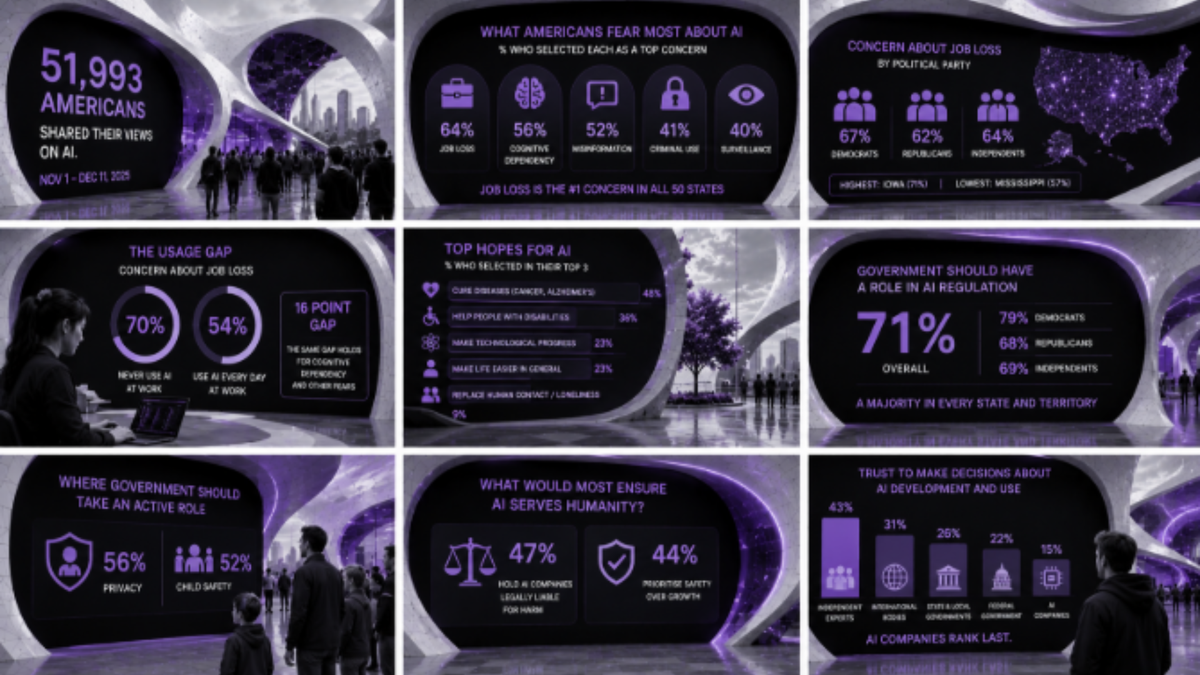
Six months ago, 51,993 Americans told Anthropic what they thought about AI. The company published those results today, 12 June 2026, under the name Anthropic Public Record — its first nationally representative survey on public attitudes toward artificial intelligence. The survey closed in December 2025. In the months since, Intuit eliminated 3,000 jobs citing AI, Cloudflare cut 20% of its workforce while growing at 34%, and AI-attributed job cuts reached 4.5% of all recorded US layoffs. The fears Americans described in late 2025 have been accumulating evidence ever since.
The survey was conducted online by YouGov between 1 November and 11 December 2025, covering a nationally representative sample across all 50 states, the District of Columbia, and Puerto Rico. State samples ranged from 232 respondents in Alaska to 1,902 in New York.
What Americans fear most
Job loss was the most common AI-related concern in every US state, held by 64% of respondents. Cognitive dependency — the worry that relying on AI will erode independent thinking — came second at 56%, with misinformation third at 52%. The fears that ranked highest were near-term and concrete rather than speculative, with criminal use and surveillance cited more frequently than scenarios in which AI acts autonomously against human interests.
The job loss concern crossed every demographic line that typically divides American opinion. It was the leading fear among Democrats at 67% and Republicans at 62%, and concern was evenly distributed across households with and without children. Iowa recorded the highest rate at 71%, Mississippi the lowest at 57%. Education sharpened rather than softened the worry: Americans with postgraduate degrees were nearly 10 percentage points more concerned about displacement than those with a high school education or less. That finding aligns with what AI's impact on professional and knowledge work already shows in practice — exposure is highest precisely where educational attainment is highest.
The usage gap that matters most
The survey's most revealing data sits in the relationship between daily AI use and reported concern. Americans who use AI every day at work were 16 percentage points less worried about job loss than those who never use it, at 54% versus 70%. The same 16-point gap held for cognitive dependency. Across every fear category tested, more intensive use correlated with lower worry.
Anthropic does not draw a causal conclusion from this pattern. Hands-on experience may reveal AI's limitations, or build skills that make displacement feel less immediate, or both. What the gap establishes is that the 64% headline figure is not fixed: as daily use becomes more common, the fear profile is likely to move with it. About 6% of Americans used AI daily for both work and personal purposes as of late 2025. Anthropic calls these integrated users. They skew younger, more urban, and towards early technology adoption. Their support for government oversight of AI runs at 74%, almost exactly matching the national rate of 71%.
What Americans hope AI will deliver
When asked to name their top three hopes for AI from a list of 17 options, 48% of respondents chose curing diseases including cancer and Alzheimer's, placing it 12 percentage points ahead of the second most selected option, helping people with disabilities at 36%. Making technological progress and making life easier in general tied at 23%. The options that ranked lowest were those involving AI as a substitute for human contact, including therapy and reducing loneliness.
The same public that ranks job displacement as its leading concern ranks medical research as its leading hope. Those two positions sit without contradiction. The appetite for AI expanding access to guidance and services that people could not previously access reflects the same underlying logic: AI as a tool for problems that have resisted other solutions, not as a replacement for the humans addressing them.
What Americans want from governance
71% of respondents said the government should play a role in AI development and regulation. That figure held across party lines — 79% of Democrats, 68% of Republicans, and 69% of Independents — and was a majority in every state and territory surveyed. Privacy and child safety were the two domains where respondents most wanted government to take an active role, at 56% and 52% respectively. When asked what action would most ensure AI serves humanity, 47% of respondents chose holding AI companies legally liable for harm, and 44% chose prioritising safety over growth.
On institutional trust, AI companies ranked last among every institution Anthropic tested. Only 15% of respondents said they trust AI companies to make decisions about how the technology is developed and used — a lower figure than the federal government, state and local governments, international bodies, and far below independent experts at 43%. The legal accountability debate already moving through US courts reflects exactly the gap this trust deficit describes: a public that wants binding liability, not voluntary commitments.
What the data lands into
The fintech sector sits at the centre of several of the governance questions this survey surfaces. Financial services is among the industries where AI adoption is furthest advanced and where the liability, privacy, and displacement questions the public is raising are most immediately consequential. The integrated users who are least worried about AI's risks are, in many cases, the same professionals deploying the systems generating those risks for everyone else.
Anthropic Public Record will be repeated regularly and plans to expand outside the United States in future waves. The next survey will land in a world where the fears measured in this one have had considerably more time to be tested against evidence.
Editor's note
Every piece published on The Bright Minded goes through careful verification, but mistakes can happen. If you spot an error, have additional information, or want to flag anything, write to rosalia@thebrightminded.com.