
Meta America's Workforce Academy (AWA): Meta Guaranteed Jobs for Trade Workers Three Weeks After Cutting 8,000 of Its Own
Meta is paying workers to train for trades, guaranteeing them jobs, and funding it with AI capex. Three weeks after cutting 8,000 staff, the strategy shift is visible.
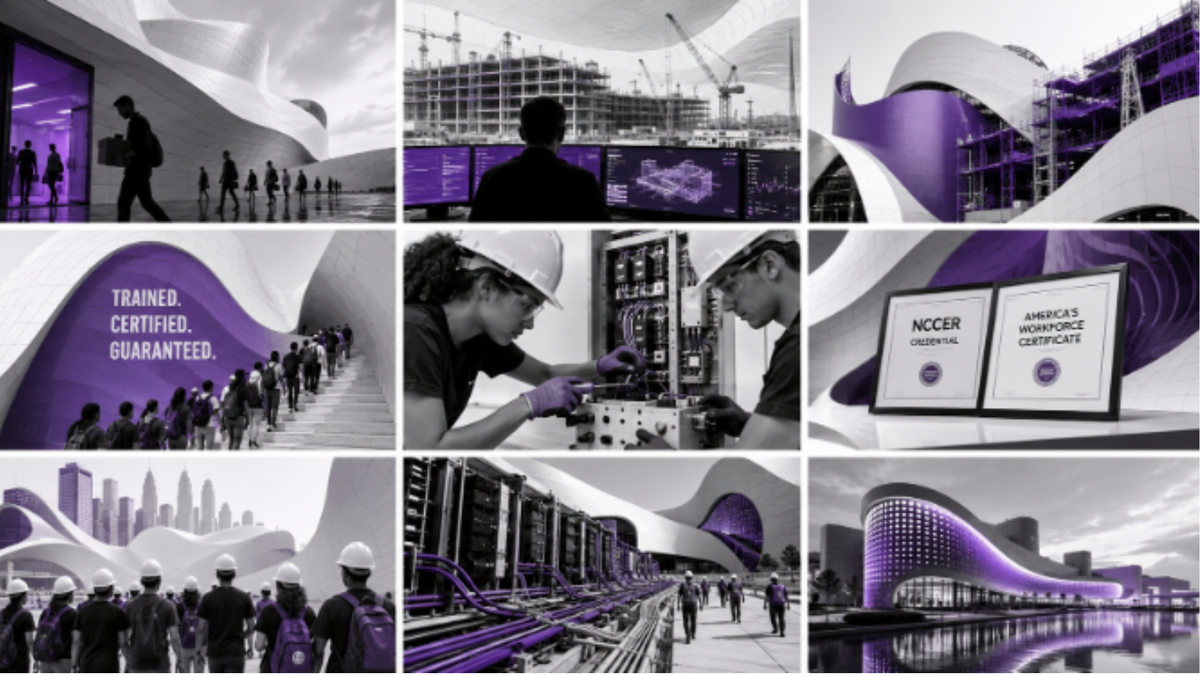
Three weeks before Meta announced America's Workforce Academy (AWA), it was cutting 8,000 people from its own payroll and citing AI efficiency as the reason. The two decisions are not contradictory. They are the same strategy read at different layers of the company's infrastructure problem, and together they reveal something specific about where AI's labour market impact is actually landing in 2026.
AWA, announced June 8, 2026, launches with a $115 million first-year investment across four pilot states — Louisiana, Ohio, Indiana, and Texas. Participants are supported financially while they train, pay nothing, and are guaranteed a job upon graduation.
Graduates receive both the National Centre for Construction Education and Research (NCCER) credential and an America's Workforce Certificate, both portable across employers and sectors. Meta describes this as the largest private-sector commitment to skilled trades with a job guarantee in American history.
Meta's layoff logic and its limits
TBM documented the May 2026 Meta layoffs as they happened, and the broader management pattern behind them. The conclusion was consistent with what the data showed: Meta is an advertising business reallocating headcount toward AI positions, not a company being reshaped by AI productivity. The Q1 2026 earnings call confirmed it. Of $56.31 billion in total revenue, advertising accounted for $55.02 billion — roughly 97.7% of the total. Capital expenditure for 2026 was revised upward to a range of $125–145 billion.
That capex number is the bridge between the two announcements. Meta is not cutting people because AI has made them redundant. It is cutting people to fund the infrastructure AI requires, and AWA is a direct investment in the workforce that will build that infrastructure. The company spending more on data centre construction than any other single budget line cannot afford a skilled trades market that cannot staff it.
The shortage behind the announcement
The construction industry's labour gap is not new, but the AI investment surge has concentrated demand in specific trades at a pace the market has not absorbed. According to the Associated Builders and Contractors (ABC) January 2026 workforce analysis, the construction industry needed to attract an estimated 349,000 net new workers in 2026 to meet demand for construction services.
ABC chief economist Anirban Basu was explicit: demand for electricians capable of precision wiring has surged specifically because of data centre construction, and the industry is swimming upstream. In 2027, ABC projects that figure rises to 456,000 as spending growth resumes.
Meta's own preceding programme made the scale of unmet demand concrete. Level-Up, its fibre installation training initiative run with CBRE, received 35,000 applications in its first seven days. AWA is the structured answer to that result.
What a job guarantee actually changes
Corporate training programmes have historically placed the employment risk with the participant. The worker invests time, foregoes income, completes the programme, and enters a labour market with no placement commitment from anyone.
AWA inverts that structure. Meta and its implementation partners — the Associated Builders and Contractors and CBRE — absorb the placement commitment before the worker has trained. The partners already engaged, including the National Urban League and the US Hispanic Chamber of Commerce alongside regional workforce organisations across the four pilot states, signal a deliberate targeting of communities that have historically been excluded from trades through access barriers rather than aptitude.
The credential architecture reinforces this. The NCCER certification is the industry standard for construction craft professionals across the United States, recognised by contractors in every state. The America's Workforce Certificate is designed to remain valid beyond any single employer relationship. Both are structured to avoid the portability trap common in corporate training schemes, where qualifications earned inside one company's ecosystem have limited market value outside it.
The strategy shift this makes visible
Meta's $125–145 billion capex commitment for 2026 is larger than the company's entire revenue in 2022. The physical infrastructure it is funding — data centres, fibre runs, power systems, mechanical and electrical fit-out — requires trades workers at a scale that no existing training pipeline was built to supply. AWA is not a workforce programme with AI infrastructure as its context. It is an infrastructure investment with a workforce component, and the job guarantee is the mechanism that makes it function as supply chain management rather than philanthropy.
Reading the layoffs and AWA together produces a clearer picture of what Meta is actually doing in 2026: reducing headcount in functions where AI tools can absorb the work, and investing directly in the physical workforce that makes AI infrastructure possible.
Both moves serve the same capex strategy. The difference is that one was reported as a story about AI replacing people, and the other will be reported as a story about Meta creating jobs. Neither framing captures what the two announcements have in common.
Editor's note
Every piece published on The Bright Minded goes through careful verification, but mistakes can happen. If you spot an error, have additional information, or want to flag anything, write to rosalia@thebrightminded.com.