
AI Is Creating Manufacturing Jobs. The Workers Making Fibre Optic Cable Are the Proof.
Amazon's multibillion-dollar deal with Corning creates 1,000 manufacturing jobs in North Carolina. What AI's physical supply chain reveals about where its workforce impact actually lands.
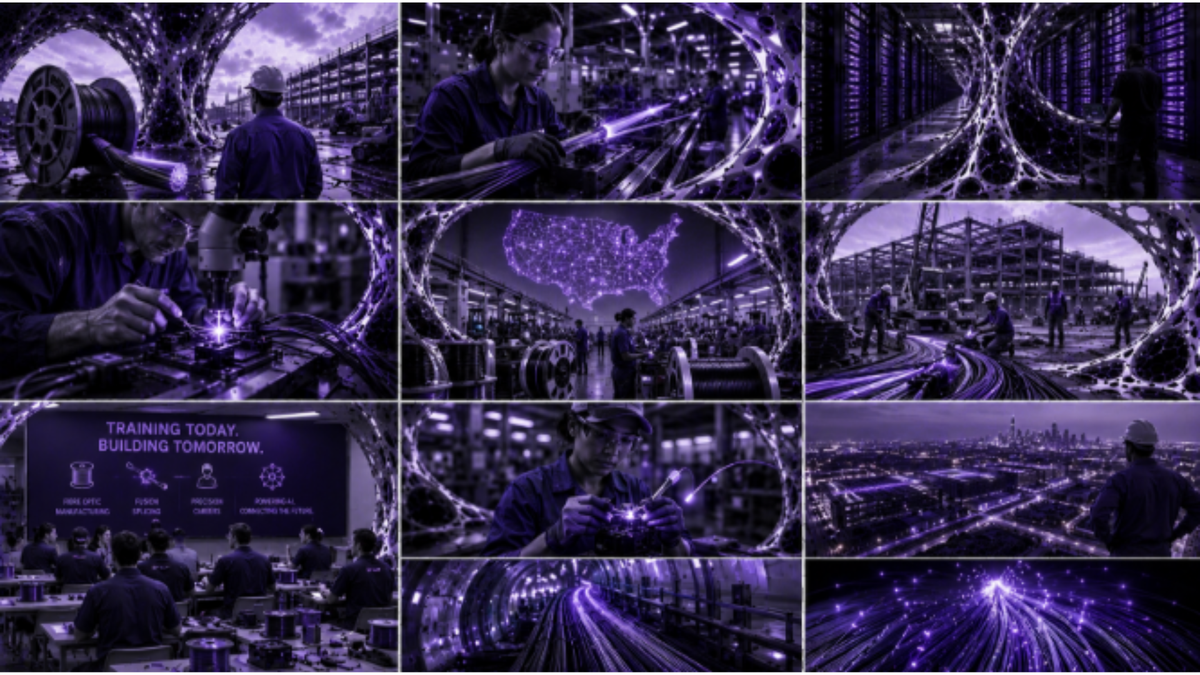
On June 8, 2026, Amazon announced a multibillion-dollar, multiyear agreement with Corning Incorporated — a 175-year-old manufacturer of advanced glass and fibre optic technology — to supply the optical fibre, cable, and connectivity solutions powering Amazon's expanding data centre infrastructure across the United States.
The deal creates 1,000 advanced manufacturing jobs at Corning's North Carolina facilities, hundreds of additional construction roles, and a new workforce training programme with Catawba Valley Community College covering fibre optic manufacturing and fusion splicing. Amazon has invested more than $20 billion in North Carolina since 2010, creating over 26,000 jobs. This agreement comes on top of the $10 billion data centre investment the company announced in the state last year.
The workers being hired are not software engineers. They inspect cable, splice fibre, and run manufacturing lines for the physical infrastructure that AI requires to function. Corning, headquartered in Corning, New York, invented low-loss optical fibre in 1970 and makes the glass that carries the light that moves the data. Amazon needs more of it because AI needs more of it.
What Corning makes and why AI needs it
Corning Incorporated is one of the world's primary manufacturers of optical fibre and specialty glass. Its products are embedded in data centre connectivity, telecommunications networks, and the physical wiring that connects server racks inside the facilities where AI models are trained and deployed. Optical fibre carries data at the speed of light across the distances that cloud-scale data centres require to function. Every AI model query, every training run, every inference call passes through glass.
Data centre construction in the United States is accelerating at a pace that has strained the domestic fibre supply chain. Amazon's agreement with Corning is a direct response to that constraint — a technology company signing a long-term contract with a glass manufacturer because the bottleneck in AI scaling has moved from software to physical materials.
The workforce story everyone is missing
The public debate about AI and employment has concentrated almost entirely on white-collar displacement — software developers, analysts, writers, compliance officers. The Developer Paradox analysis published on TBM in May documented how AI has created a structural shortage of the technical workers it was supposed to replace. The Amazon-Corning deal points to a different and largely unreported dimension of the same phenomenon: AI is generating demand for skilled manufacturing employment at scale, in communities that have no obvious connection to the technology sector.
Catawba Valley Community College in North Carolina will now train students for careers in fibre optic manufacturing. These are precision manufacturing positions — fibre optic technicians, fusion splicers, cable assembly workers — that require hands-on technical training, carry competitive wages, and exist because AI infrastructure requires physical construction that no model can perform for itself.
The Anthropic data point that makes this legible
Four days before the Amazon-Corning announcement, Anthropic published a detailed report on AI's progress toward recursive self-improvement. The findings are precise: as of May 2026, more than 80% of the code merged into Anthropic's codebase was authored by Claude. The typical Anthropic engineer was merging eight times as much code per day in the second quarter of 2026 as they were in 2024. Claude Opus 4.6 can complete software tasks that take a skilled human twelve hours. The direction the data describes is one where AI systems handle a growing share of their own development, with human researchers increasingly in a supervisory rather than executive role.
The same report is unambiguous about what that acceleration requires: compute, and the physical infrastructure to run it. Every step toward recursive self-improvement is a step that demands more data centres, more fibre, more power, more physical construction. The smarter AI gets at building itself, the more it depends on people who work with glass, cable, and concrete.
The question this raises
The Amazon-Corning training programme is a useful lens for examining what happens to this manufacturing employment wave if AI capabilities continue to advance.
The historical analogy is instructive. Electrification created demand for electricians — a skilled trade category that did not exist at scale before the technology arrived. As electrical systems matured and spread, demand for electricians did not contract. It became permanent and distributed across every sector of the economy that used electricity. Fibre optic technicians and data centre construction workers occupy a structurally similar position. The physical infrastructure of AI requires ongoing installation, maintenance, and expansion regardless of how capable the models running on it become.
The AI skills infrastructure that governments and technology companies are building — apprenticeships, sovereign compute funds, university programmes — addresses the software and research labour shortage. The Amazon-Corning training programme at Catawba Valley Community College is the manufacturing equivalent: a direct investment in the workforce that builds the physical layer AI runs on. Both are responses to the same underlying reality. AI's labour market impact is not concentrated in one place. It is distributed across every layer of the economy required to make AI work.
Editor's note
Every piece published on The Bright Minded goes through careful verification, but mistakes can happen. If you spot an error, have additional information, or want to flag anything, write to rosalia@thebrightminded.com.