
Claude Corps: Anthropic Puts $150 Million on the Acknowledgement That AI Disrupts the Workers Who Built It
Anthropic confirmed Claude Corps, a $150M fellowship placing 1,000 workers in US nonprofits. What the programme structure reveals about AI's unresolved labour debt.
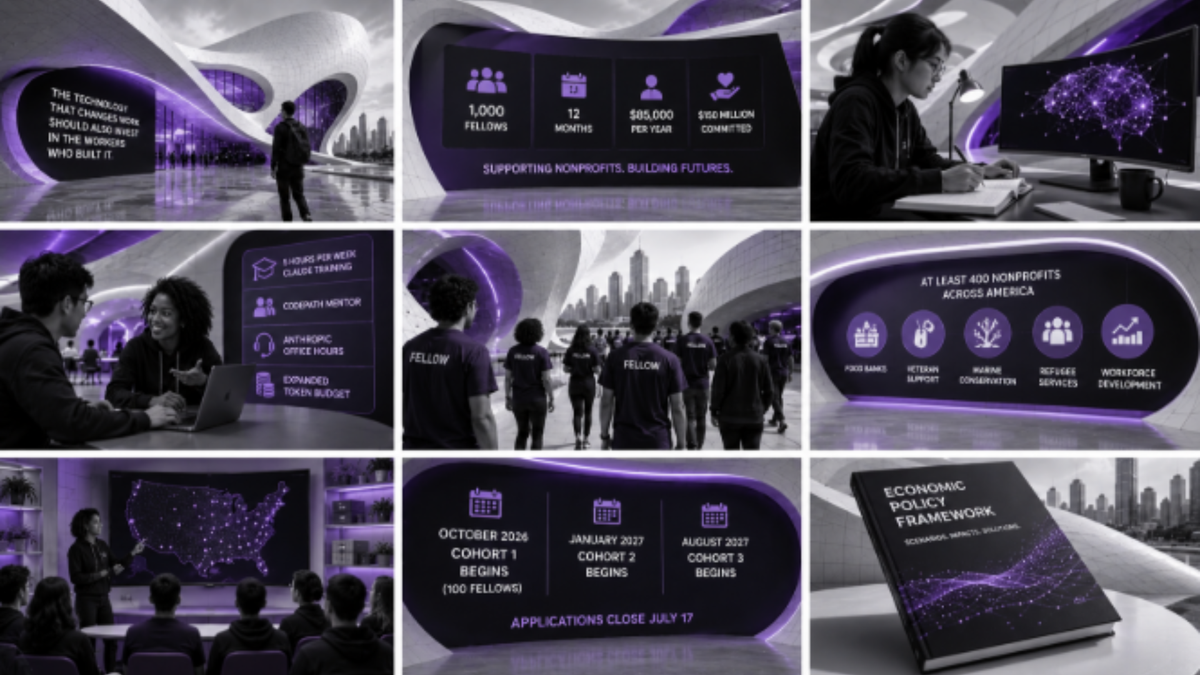
The easiest read of Claude Corps is a tech company doing something good. Anthropic confirmed the programme today: 1,000 fellows, placed full-time in nonprofits across America, paid $85,000 a year, for twelve months each, backed by $150 million in committed funding. It is well-structured, well-intentioned, and arrives alongside a published economic policy framework that is more candid about AI's labour market impact than anything a major AI lab has made public before.
The programme also arrives alongside a document that models three scenarios of AI-driven unemployment — 5%, 10%, and levels described only as unprecedented — and recommends policies for each. Claude Corps is not separate from that document. It is its first deliverable.
What the programme actually does
Each fellow receives 12 months of full-time, in-person placement at a host nonprofit, five hours of ongoing Claude training per week, a CodePath mentor, Anthropic office hours, and an expanded token budget. The fellows are employed formally by CodePath, the US's largest provider of collegiate computer science education and an existing Anthropic nonprofit partner.
Social Finance, a registered investment advisor and nonprofit, leads measurement and will build a financial vehicle designed to let the programme scale beyond its initial cohort. At least 400 nonprofits will participate in the first 12 months. The first cohort of 100 fellows begins in October 2026; applications close July 17. Two further cohorts start in January and August 2027.
The host organisations span food banks, veteran support services, marine conservation, refugee resettlement, and workforce development. They share one characteristic: each is doing analytically intensive work with teams too small to carry dedicated technical infrastructure.
Montgomery County Food Bank cites distribution forecasting. StriveTogether needs data analysis across 70 communities. REEF manages large marine datasets with a small team. The common thread across every host statement is the same: the fellow will do work the organisation needed but could not resource. The distinction between giving them a tool and giving them a person who can use it is exactly what makes the programme structurally significant.
The document it was released alongside
Claude Corps was confirmed on the same day as Anthropic's Economic Policy Framework, a detailed policy proposal addressed to the US government. The framework explicitly models three unemployment scenarios — roughly 5%, 10%, and what it calls unprecedented levels — and recommends calibrated policy responses for each, including expanded unemployment insurance, sector transition support, wage insurance, and at the most severe end, sovereign wealth models and equity-sharing mechanisms.
It also states, in direct terms, that AI could act as a general substitute for labour and that the resulting reduction in demand for human work may be difficult or impossible for many workers to absorb. The $150 million commitment to Claude Corps is named inside that document as one of the things Anthropic is willing to fund directly, alongside a $200 million Economic Futures Research Fund. Together they constitute a $350 million private investment in the proposition that disruption is already happening and cannot be waited out. The connection between the real AI layoff numbers circulating this year and this kind of institutional response is no longer theoretical.
What the fellowship model borrows and what it invents
The Peace Corps comparison is visible in the name and the structure. National fellowship programmes that place early-career workers in underserved institutions have strong empirical backing — AmeriCorps, Teach For America, and the Peace Corps itself all operate on the same basic mechanic: subsidise the labour cost of placing a capable person somewhere that needs the capability but cannot afford it at market rates.
What Claude Corps adds is technical specificity and training continuity. Fellows are not generalists placed to fill a gap; they are trained weekly on a specific tool and embedded in organisations where that tool solves a named operational problem. The programme is also explicitly designed to produce AI skills that persist in the fellows' careers, which means the workforce-development logic runs in both directions. The host gains infrastructure. The fellow gains credentials.
The Meta workforce programme confirmed three weeks after that company cut 8,000 of its own staff showed the same structural instinct: route displaced or at-risk workers through AI-adjacent programmes and present the result as investment. The mechanics differ. The underlying admission is identical.
The liability question underneath the announcement
Anthropic's Economic Policy Framework states explicitly that the company takes no satisfaction in contributing to labour disruption and is not working to make it more likely. That kind of institutional language, placed in a policy document rather than a marketing brief, carries a different weight. It is the language of a company that has internally resolved that it is causing something, accepted that the resolution is not sufficient, and decided that the more defensible position is to name it and fund a response. Claude Corps at $150 million is a large programme by nonprofit sector standards and a rounding error against the capital flows Anthropic is operating within.
The $65 billion valuation Anthropic reached in its most recent round makes the arithmetic clear. The question the programme raises is not whether $150 million is enough. It is whether the fellowship model is the right unit of intervention at all, given the scale of the disruption the accompanying document describes.
Anthropic has not answered that question. It has, however, made it impossible for any serious observer of fintech and AI economics to treat the workforce displacement debate as abstract. A programme with a specific salary, a specific employer of record, a specific measurement partner, and a specific application deadline is not a position paper. It is an institution, and institutions can be held to account.
Editor's note
Every piece published on The Bright Minded goes through careful verification, but mistakes can happen. If you spot an error, have additional information, or want to flag anything, write to rosalia@thebrightminded.com.