Meta Layoffs May 20, 2026: The Teams Cut Today and What Research Shows About Automating Their Work
Meta cut 8,000 jobs today. The specific teams affected, what they have in common, and what the research says about replacing them with AI.
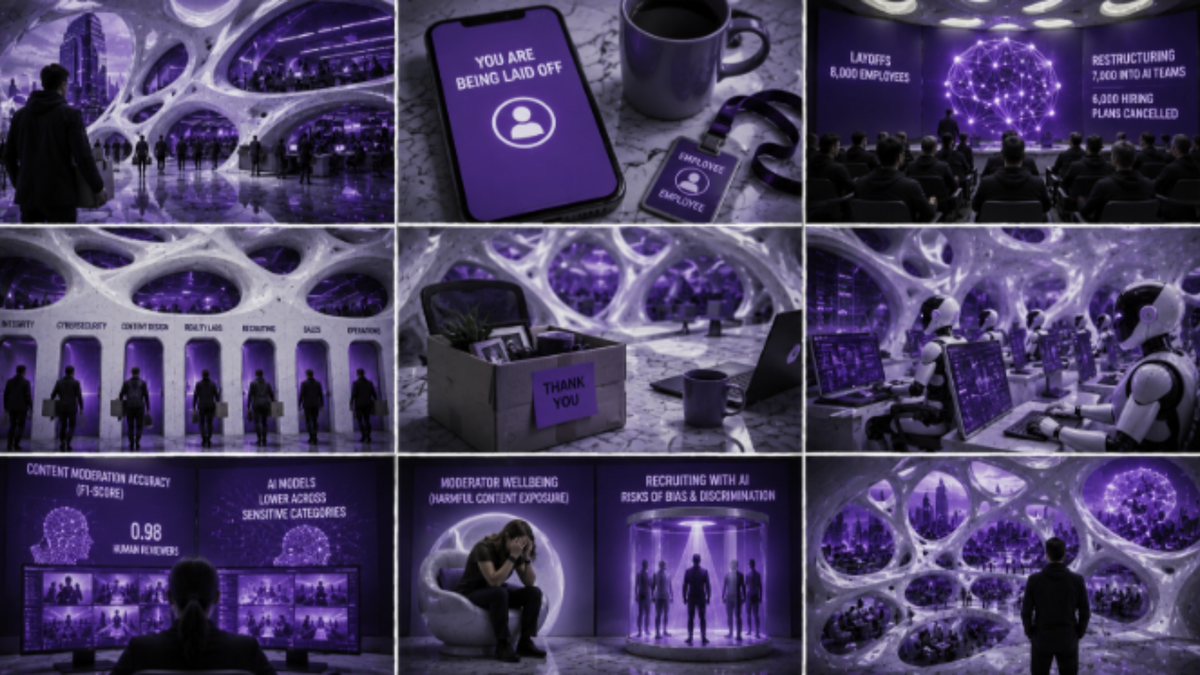
The teams Meta cut today are not the same kind of teams it cut in January or March. Starting at 4am local time, Meta's latest round of layoffs sent notifications to roughly 8,000 employees in three sequential waves: Singapore first, then the UK, then North America. The cuts landed across the integrity division, cybersecurity teams, content design division, Reality Labs, the Facebook social group, recruiting, sales, and global operations, confirmed by Al Jazeera citing Business Insider reporting.
The 8,000 cuts represent roughly 10% of Meta's global workforce of 78,865 people. WARN Act filings confirm at least 124 positions at Meta's Burlingame office effective May 22 and 74 at its Sunnyvale facility effective May 29. US workers receive 16 weeks of base severance pay plus two additional weeks per year of service. More than 1,000 employees signed internal petitions this week against the company's performance monitoring tools, including the mouse-tracking measures examined in our analysis.
The restructuring announced separately
A separate announcement came three days before the layoffs executed. On May 18, an internal document obtained by Reuters described a concurrent reorganisation in which 7,000 workers would be moved into new AI-focused teams, including Applied AI Engineering and Agent Transformation Accelerator XFN, while managerial layers would be removed in favour of flatter, faster-moving team structures.
The company also cancelled hiring plans for 6,000 open roles. These reassigned workers will operate within Meta Superintelligence Labs, led by Chief AI Officer Alexandr Wang, who joined Meta in June 2025 after the company invested $14.3 billion in his startup Scale AI. The two announcements share a rationale but have different timelines and different implications.
The May round is Meta's largest companywide restructuring since the 2022-2023 Year of Efficiency, which eliminated roughly 21,000 positions, and additional cuts are confirmed for the second half of 2026. The January round removed roughly 1,000 to 1,500 Reality Labs employees from a division that had lost $73 billion; the March round cut 700 positions across operational functions.
The cuts do not stand alone across technology and fintech: more than 140 companies have eliminated over 111,000 positions in 2026, with Intuit, one of the sector's largest fintech platforms, announcing a 17% workforce reduction this same week.
Why the teams cut today are a specific category
The January and March rounds removed roles in a failing hardware bet and back-office functions. Today's round reached the teams whose work sits directly between Meta's platforms and the people using them.
The integrity team reviews hate speech and removes malicious content before it reaches users; the cybersecurity division protects user accounts and data from external threats; content designers write the language users encounter when a policy decision is made about their account, when they receive a warning, or when access is restricted. These are not efficiency functions. They are the human layer of the platform.
Replacing the integrity team raises a documented accuracy problem. Research found human reviewers achieved an F1-score of 0.98 on complex content moderation tasks, with every AI model tested performing measurably lower across sensitive categories including violent content and hate speech, where cultural context determines the call.
A parallel observation sits alongside the accuracy data: a 2024 cross-sectional study published in Cyberpsychology, Behavior, and Social Networking found that content moderators exposed to harmful material experience secondary traumatic stress and significant impacts on mental health and wellbeing. The people cut today were doing work the research shows damages them, and the system taking their place has not been shown to do it as well.
The recruiting cut carries a different set of documented risks. The SHRM Benchmarking Survey found that both the average cost and the average time to hire a new employee rose across the same three years in which generative AI adoption in recruiting grew, with SHRM research noting that the process has left candidates without any human contact throughout their application.
MIT Sloan research concluded that AI hiring tools encode existing structural inequities because the underlying problem in hiring is how organisations define merit, not how efficiently they process candidates. A 2025 review published in Frontiers found systematic discrimination risks based on ethnicity, age, and gender in AI recruiting systems, with candidates having no visibility into how their applications were evaluated and no clear mechanism to contest the outcome.
Today's round differs from the January and March cuts. Those rounds removed a failed technology investment and operational overhead. Today's cuts removed the teams that stood between the platform and the people using it. The research on automating each of those functions carries warnings Meta has not publicly addressed.
Editor's note
Every piece published on The Bright Minded goes through careful verification, but mistakes can happen. If you spot an error, have additional information, or want to flag anything, write to rosalia@thebrightminded.com.