
The Quadrillion-Token Day: The New Economics of AI and the Race to Power It
AI is creating an entirely new consumption economy measured in tokens. As autonomous agents, coding assistants and multimodal models drive demand, the next big opportunities may lie not just in AI software, but in chips, electricity, financial infrastructure and enterprise cost management.
The Bright Recap
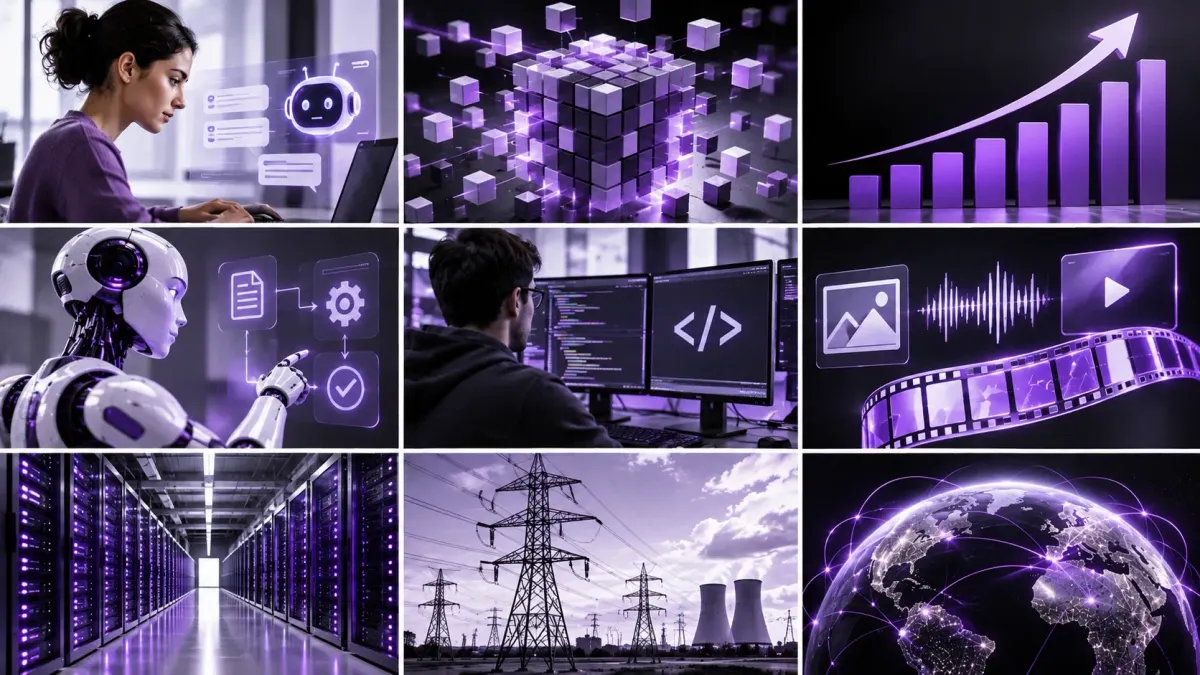
AI token consumption is growing faster than the number of AI users, since reasoning models, autonomous agents, coding assistants and video generation all need more computing for each task. Public disclosures put global volume at hundreds of trillions of tokens a day, and some projections reach 1.5 quadrillion a day as early as 2027.
Electricity delivery is the main constraint on that growth. The International Energy Agency projects data-centre consumption rising from about 485 terawatt-hours in 2025 to 950 terawatt-hours in 2030, while TrendForce estimates roughly 491 gigawatts of data-centre demand against about 223 gigawatts of grid-deliverable capacity by 2030. The fintech opportunities lie in token-based billing, AI cost management, infrastructure financing and measuring the cost of each completed task.
To know more about this topic, read our related articles:
- AI's hidden cost problem
- An AI campus with its own power plant
- SoftBank's bet on France's grid
- What a data centre bond costs
- Financial technology explained
- Cantica business reports
Bright Answers
How many AI tokens does the world process each day?
No central authority measures it, and companies count tokens in different ways. Public disclosures from major technology companies and national authorities point to hundreds of trillions a day, and some projections reach 1.5 quadrillion a day by 2027.
Why could cheaper AI tokens increase total AI spending?
Because of the Jevons paradox. A lower cost per token makes it affordable to automate tasks that used to be too expensive, so total consumption can grow faster than prices fall. Goldman Sachs Research expects agentic AI to drive a 24-fold increase in token consumption between 2026 and 2030.
Every time someone asks an AI chatbot a question, generates an image, writes software with an AI assistant or delegates a task to an autonomous agent, something is being consumed in the background: tokens.
A token is a small unit of information that an AI model processes. In English text, one token represents roughly three-quarters of a word, although images, audio and video are also converted into tokens or equivalent model-specific units.
Tokens are becoming an important way to measure and price AI computing. Much as barrels of oil became a familiar measure of the industrial economy, tokens are emerging as a unit of activity in the AI economy.
The scale is already enormous. Public disclosures from major technology companies and national authorities point to hundreds of trillions of tokens being processed daily. Some projections suggest that the world could reach 1.5 quadrillion tokens a day as early as 2027.
There is, however, an important qualification: no central authority measures global token consumption, and companies use different definitions and counting methods. The precise global total remains uncertain. What is unmistakable is the direction of travel.
Meet Cantica, the Fin-Tech intelligence system for custom reports to strategise your next business move.
Why AI consumption is growing so quickly
The growth in token consumption is not simply the result of more people using AI. It is increasingly driven by the amount of computing required to complete each task.
Four developments are particularly important.
First, AI models are learning to reason.
Traditional chatbots generally generate responses directly from a prompt. Newer reasoning models spend additional computing resources breaking down problems, evaluating possible answers and checking their work before responding. Users might receive a short answer, but the underlying model may have processed thousands of additional tokens.
Second, AI agents are changing how software works.
An AI agent does more than respond to a question. It can read documents, search databases, call software tools, examine the results and repeat those steps until a task is complete.
A request that previously required one interaction might now trigger dozens of model interactions. As agents become capable of handling longer workflows, token consumption increases substantially.
Third, software development is becoming an important market for AI.
Coding assistants increasingly inspect entire repositories, generate code, run tests, identify errors and suggest corrections. OpenAI reported in June 2026 that Codex had exceeded five million weekly active users, illustrating how AI-assisted work is expanding beyond its original developer audience.
Fourth, AI is moving beyond text.
Image generation, voice processing and video creation require significantly more computing than many ordinary text interactions. A single second of high-definition AI-generated video can involve tens of thousands of tokens, depending on the model and representation.
Together, these developments are creating a fundamental change: AI is moving from answering individual questions towards performing increasingly complex, continuous tasks.
Cheaper AI could mean greater consumption
One might expect falling AI computing costs to reduce overall spending. Economics suggests otherwise.
When a resource becomes cheaper and more efficient, people often find additional ways to use it. This phenomenon is known as the Jevons paradox, originally associated with improvements in coal efficiency during the Industrial Revolution.
The same pattern may be emerging in AI.
As inference costs decline, businesses can afford to automate tasks that were previously too expensive. Applications that once required human intervention can be delegated to AI agents. More sophisticated workflows become commercially viable.
Goldman Sachs Research expects agentic AI adoption to drive a 24-fold increase in token consumption between 2026 and 2030, reaching approximately 120 quadrillion tokens per month.
The implication is significant: lower costs per token do not necessarily mean lower overall AI spending. They could create an entirely new market for AI-powered services.
Can the infrastructure keep up?
Behind every AI interaction is a significant physical infrastructure requirement.
AI models need specialised processors, high-bandwidth memory, networking equipment, cooling systems and data centres. The enormous investment being made by technology companies reflects expectations that demand will continue growing.
Hardware efficiency is improving as well. In July 2026, cloud infrastructure provider CoreWeave published testing results showing that NVIDIA's Vera Rubin platform achieved approximately ten times the token throughput per megawatt of its Blackwell predecessor under a specific reasoning workload.
Although individual benchmarks should not be treated as universal performance guarantees, they demonstrate the industry's progress towards delivering more AI computing with less electricity.
The more difficult challenge may be electricity itself.
According to the International Energy Agency, global data-centre electricity consumption is projected to increase from approximately 485 terawatt-hours in 2025 to 950 terawatt-hours in 2030. Electricity consumption by AI-focused data centres is expected to grow even faster, roughly tripling over the same period.
The challenge is not simply generating more electricity. It is delivering it to the locations where data centres are being built.
TrendForce estimates that global data-centre power demand capacity could reach approximately 491 gigawatts by 2030, while grid-deliverable capacity may be closer to 223 gigawatts. This projected gap highlights the importance of transmission infrastructure, grid connections and alternative power arrangements. It does not necessarily represent an unavoidable electricity shortage, since on-site generation can also contribute.
The next phase of the AI race will therefore involve energy companies, utilities, semiconductor manufacturers, construction firms and technology providers working together.
Where does fintech fit into the token economy?
For the financial industry, the token economy presents opportunities that extend well beyond investing in AI companies.
At a hypothetical blended wholesale price of $0.25 to $1 per million tokens, processing 1.5 quadrillion tokens every day would represent an annualised inference-spending opportunity of roughly $140 billion to $550 billion.
This is an illustrative calculation rather than a revenue forecast. Actual spending will depend on model pricing, discounts, free usage, internal workloads and the proportion of tokens that are commercially billed.
Nevertheless, it highlights the potential scale of the market.
Several business opportunities are emerging.
Token-based billing and consumption models
AI services are increasingly priced according to consumption rather than conventional software subscriptions. Businesses may eventually purchase defined amounts of AI capacity just as they currently purchase cloud resources or telecommunications data plans.
This creates opportunities for billing platforms, payment providers and infrastructure marketplaces that help customers purchase and manage AI services.
Token FinOps and financial management
Enterprises adopting autonomous agents face a new challenge: controlling unpredictable AI expenditure.
An agent might perform hundreds of interactions to complete a single business process. Without appropriate monitoring, an organisation could incur substantial costs without realising it.
This creates demand for platforms that track token consumption, allocate budgets, monitor individual workflows, compare model costs and identify inefficient usage.
The opportunity resembles the cloud FinOps market that developed as enterprises moved their infrastructure to cloud platforms.
AI infrastructure financing
The expansion of data centres creates substantial demand for capital. Semiconductor manufacturing, power generation, battery storage, cooling infrastructure and electricity transmission all require long-term investment.
Banks, infrastructure funds and institutional investors could play an increasingly important role in financing these projects.
AI-powered financial services
Financial institutions are also adopting AI agents for customer service, compliance checks, document processing, research and operational automation.
As these applications mature, the economics of each completed transaction or business process will become increasingly important. Financial institutions will need to evaluate not just how many tokens their systems consume, but what measurable business value those tokens deliver.
The risks behind the opportunity
The rapid expansion of the token economy does not guarantee sustainable profitability.
The first risk is confusing activity with value. A system that consumes more tokens is not necessarily more intelligent or productive. An inefficient agent might make repeated attempts at a task that a better-designed system completes with fewer interactions.
The second risk is infrastructure investment. Technology companies are committing enormous amounts of capital to chips and data centres. These investments must eventually produce sufficient revenue and operating returns.
The third is the availability of electricity. Delayed grid connections, shortages of transformers and local infrastructure constraints could slow data-centre expansion even when computing hardware is available.
There is also a geopolitical dimension. Semiconductor export restrictions, supply-chain concentration and the development of separate technology ecosystems could influence where AI computing capacity is built and how much it costs.
For businesses, the immediate lesson is to introduce financial controls before AI agents become deeply embedded in everyday operations.
Budgets should be allocated at the workflow level, and performance should be measured through cost per completed task, accuracy, processing time and business outcomes rather than token consumption alone.
Beyond the quadrillion-token milestone
The arrival of a quadrillion-token day would be an important milestone, but it is not the most important measure of the AI economy's success.
The real question is whether the value created by AI grows faster than the cost of delivering it.
Three indicators deserve particular attention: the growth in reported AI usage, the expansion of data-centre electricity infrastructure, and the revenue generated by AI-powered products and services.
If these three indicators advance together, the token economy could become one of the defining industrial markets of the coming decade.
For fintech, this opens a new frontier. The opportunity is not simply to build more AI applications. It is to develop the financial systems, payment models, cost-management tools and investment infrastructure required to support an economy increasingly powered by machine intelligence.
The world may soon learn to count its digital progress in quadrillions of tokens. The businesses that succeed will be those that learn how to turn that consumption into measurable economic value.
Editor’s note
Every piece goes through careful verification, but mistakes can happen. Readers who spot an error or have additional information can write to rosalia@thebrightminded.com.