
Galaxy Digital's 9.875% Data Centre Bond Costs More Than Its Tenant's Debt
Galaxy priced $3.507bn of secured notes at 9.875% against CoreWeave rent. CoreWeave itself borrows near 5.9%. The four-point gap is what a name costs.
The Bright Recap
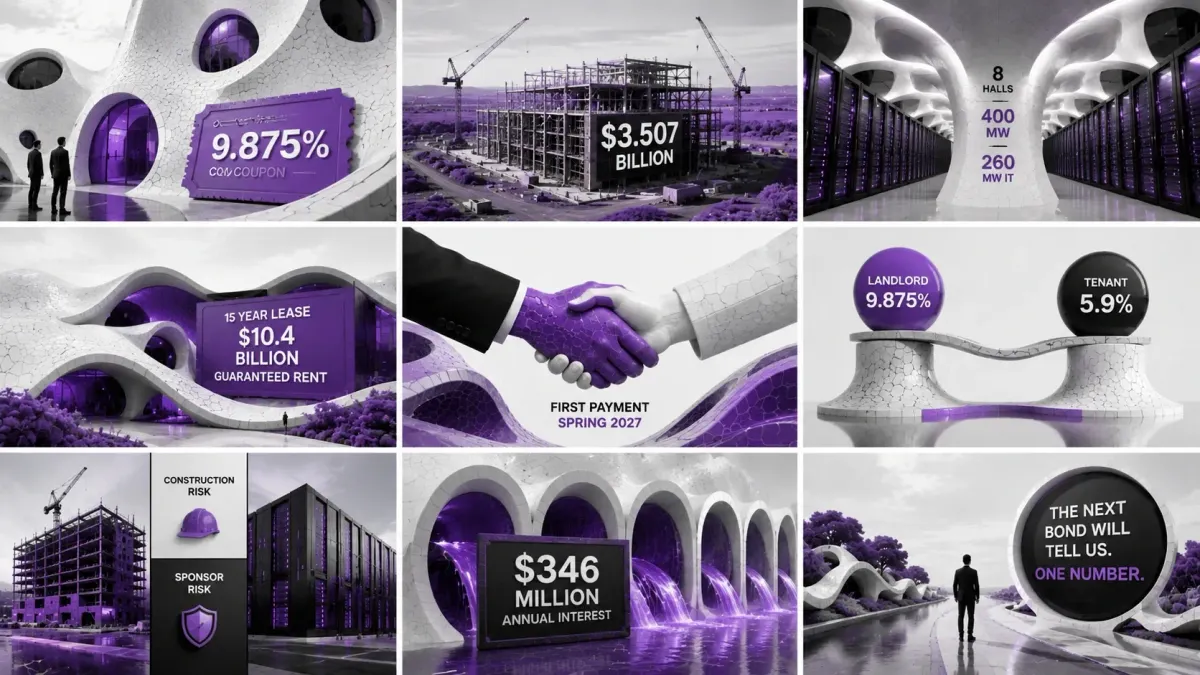
Galaxy Digital borrowed $3.507 billion at 9.875 per cent on 23 July 2026 to build a data centre in Dickens County, Texas. CoreWeave has already signed a fifteen year lease on the whole site, with $10.4 billion of rent guaranteed across the term.
CoreWeave, the tenant whose payments cover that interest, borrows at roughly 5.9 per cent. The landlord pays four points more than the tenant on money that comes from the same place, and a coupon is the one figure in finance a company cannot present favourably.
To know more about this topic, read our related articles:
- Where fintech's capital actually went this summer
- The Fin-Tech intelligence data behind this story
- Loans priced as if AI did not exist
- The loans banks cannot price
- Financial technology explained
Bright Answers
Why did Galaxy pay 9.875 per cent when the debt is secured?
The building does not exist yet and no rent arrives until spring 2027, so lenders funded a construction site. Galaxy is also a digital asset company rather than an established infrastructure operator, and lenders charge more for borrowers they cannot compare to anything.
Does the project still make money at that rate?
Galaxy's filing expects the rent to return about 13.7 per cent a year against what the site costs to build, roughly four points above the interest bill, with rent rising 3 to 5 per cent annually in step with inflation.
A coupon is a price that strangers agreed on. Galaxy Digital priced $3.507 billion of senior secured notes at 9.875 per cent on 23 July, borrowing against a Texas data centre that CoreWeave has already agreed to rent for fifteen years.
CoreWeave, the tenant whose payments will service that debt, borrows at roughly 5.9 per cent. The company paying the rent gets money four points cheaper than the company building the walls.
Strategise your next business move with Cantica, the Fin-Tech intelligence system for original data and custom business reports.
That gap does something a funding round never does. A valuation is a figure one investor agreed to in a private room. A coupon is a figure every lender who looked at the deal settled on before parting with cash, which makes it a rare number the borrower cannot present favourably.
What the money is actually building
The site sits on roughly 260 acres in Dickens County, in the flat country east of Lubbock. Galaxy is putting up two buildings that will hold eight server halls, drawing 400 megawatts from the grid, of which 260 megawatts reach the computers themselves. The notes pay interest twice a year in cash from February 2027 and mature in August 2031.
CoreWeave has taken the entire computing capacity on a fifteen year lease, with options to extend twice by five years each. Galaxy's filing puts the guaranteed rent at $10.4 billion across that initial term, rising between 3 and 5 per cent a year in step with inflation, and expects the first payment in the spring of 2027.
Rent should return about 13.7 per cent a year against what the site costs to build. A building with a signed tenant, a decade of contracted income and a return well above its interest bill is close to the textbook definition of financeable, and it still priced at 9.875 per cent.
The tenant borrows cheaper than the landlord
CoreWeave closed an $8.5 billion loan in March against its own computing hardware and a customer contract. Moody's graded it A3 and DBRS graded it A (low), which put it in investment grade territory, and the fixed portion carries a rate of about 5.9 per cent. Lenders in both deals are ultimately relying on CoreWeave's ability to pay, and financial technology rarely offers a comparison this clean.
One group charged 5.9 per cent for it. The other charged 9.875 per cent. The electricity, the concrete and the tenant are identical on both sides of that difference.
Where the four points come from
Two things explain most of the gap, and neither is a mark against the project. The first is that Galaxy's building does not exist yet, so lenders were asked to fund a construction site instead of an operating one, and no rent arrives until spring 2027. Construction risk carries a price in every market on earth.
The second is whose name is on the deed. Galaxy is a digital asset company that also builds data centres, and lenders have a long pricing history for infrastructure sponsors and almost none for this kind of borrower. Anyone who spent the past two years reading about software loans priced wrong has learned to charge more for categories they cannot compare to anything. The coupon is what that caution costs once it is written down as a number.
Why this matters past one bond
Fintech borrowed more than it raised this summer. Verified capital this summer came to $6.11 billion of debt and preferred stock against $2.55 billion of venture and growth equity, a ratio of 2.4 to one. Galaxy's single bond raised more than every disclosed funding round in the sector outside the largest five put together, which came to $253.6 million.
The reordering has a practical consequence for anyone who buys financial technology from a supplier. A company funded by equity answers to a board that can absorb a difficult year. A company funded by bonds answers to an interest payment, and 9.875 per cent on $3.507 billion works out at roughly $346 million a year in cash that leaves the building regardless of how trading goes. Suppliers financed that way tend to firm up on pricing, contract length and renewal terms, and customers usually notice in year two.
The encouraging reading is that a sector nobody would lend to has become a sector people will lend to at a price, and prices move. Galaxy's expected return on the site sits about four points above what it pays to borrow, so the sums work at 9.875 per cent and would work considerably better at seven. The next bond from the same balance sheet will show whether lenders have changed their minds about digital asset infrastructure, and it will show it in one number nobody can dress up.
Galaxy is paying 9.875 per cent to borrow against rent from a tenant who borrows at 5.9 per cent. Four points is what a name on the deed costs when the market has no history to price it against.
Editor's note
Every piece published on The Bright Minded goes through careful verification, but mistakes can happen. If you spot an error, have additional information, or want to flag anything, write to rosalia@thebrightminded.com.