
Microsoft Pecos Datacenter: Why a 2 Gigawatt AI Campus Comes With Its Own Power Plant
Microsoft announced a 2 gigawatt datacenter in Pecos, Texas today, funding its own natural gas plant rather than drawing from the public grid.
The Bright Recap
Microsoft announced a 2 gigawatt datacenter campus in Pecos, Texas today, funded with its own behind the meter natural gas power plant rather than drawing from the public grid. The decision shows electricity, not capital or chips, is now the main constraint on AI infrastructure growth, and concentrating that infrastructure carries its own resilience risk.
To know more about this topic, read our related articles:
- SoftBank's grid-driven bet on France
- Europe's new AI supercomputer buildout
- Italy's outage and AI concentration risk
- Financial technology explained
Bright Answers
What is a behind the meter power plant?
It is a power facility built to serve a single customer directly, independent of the public electricity grid, so the demand it creates does not draw from shared grid capacity.
Why is Microsoft building its own power plant for a datacenter?
Microsoft says funding its own natural gas facility lets it bring capacity online at the pace AI and cloud customer demand requires, without straining the public grid the surrounding community relies on.
How much water will the Pecos datacenter use?
Microsoft says the facility's closed loop cooling system will need only an initial water charge at startup, with no additional consumption during steady-state operation, putting total lifecycle water use below that of a typical fast-food restaurant.
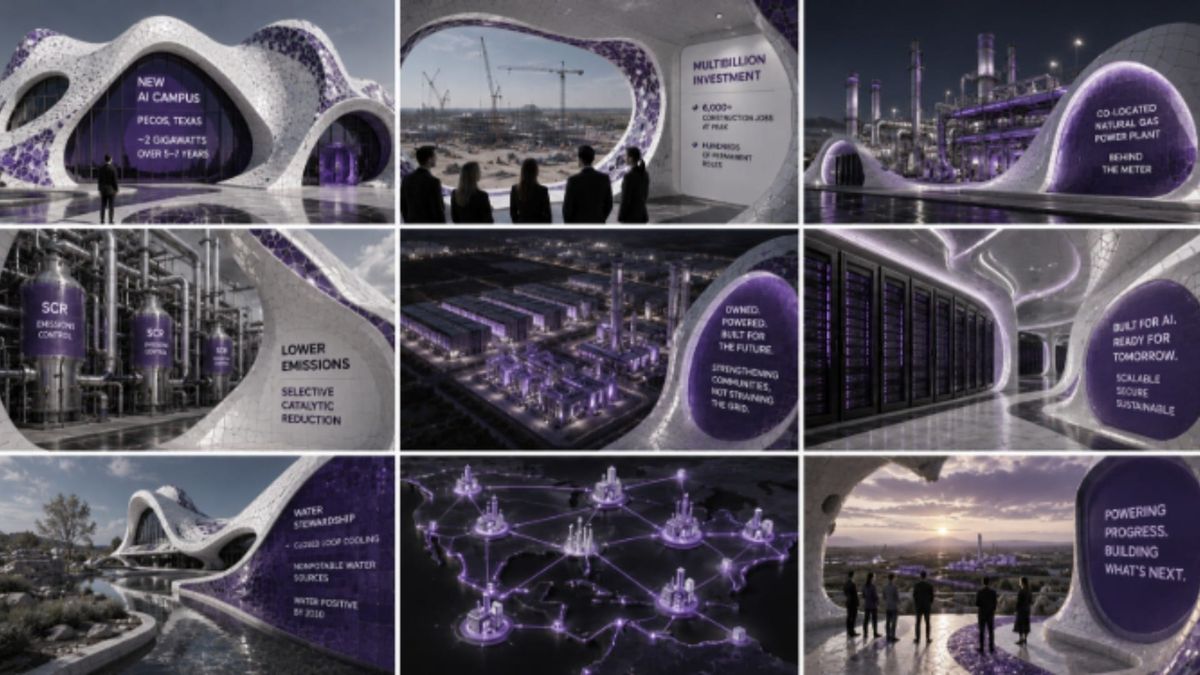
Microsoft announced one of the largest single capacity additions in its history today, a new datacenter campus in Pecos, Texas that will add approximately 2 gigawatts (GW) to its global capacity over the next five to seven years. The campus will launch with a co-located natural gas power facility that Microsoft is funding and operating directly, an arrangement the company calls behind the meter, meaning the plant serves the datacenter independently of the public electricity grid. Microsoft detailed the full scope of the project today, stating that this structure ensures its growth strengthens, rather than strains, the energy resources the surrounding community relies on.
The decision to build a private power plant alongside a datacenter, rather than drawing capacity from existing infrastructure, signals where the actual bottleneck in artificial intelligence (AI) buildout now sits. Microsoft is building the capacity itself, on its own balance sheet, rather than waiting for grid capacity elsewhere to become available, because waiting was no longer a viable option at the scale its customers are demanding.
What Microsoft is actually building in West Texas
The Pecos campus represents a multibillion-dollar investment over five to seven years, with Microsoft projecting over 6,000 construction jobs at peak build-out and hundreds of permanent operational roles once the facility is running. Reeves County Judge Leo Hung, the county's top elected official, welcomed the investment, saying it reflects the region's ability to support innovation at a global scale.
The natural gas facility's design will integrate Selective Catalytic Reduction systems to lower nitrogen oxide emissions, and Microsoft states it expects to eventually connect the power facility and the datacenter to the broader grid, becoming part of the regional energy system over time. Until that point, the plant exists to serve Microsoft's own operations exclusively, a deliberate sequencing that lets the company bring capacity online at the pace its AI and cloud customers require without negotiating for space on a grid already under pressure elsewhere.
Why behind the meter has become the default answer
Pairing dedicated, self-funded energy supply with new datacenter infrastructure is becoming the standard playbook for AI infrastructure at scale, not an exception to it. The same constraint shaped SoftBank's €75 billion commitment to French datacenters earlier this year, where the deciding factor was not incentives or talent but the speed and reliability of France's existing nuclear-backed grid. Microsoft's approach in Pecos solves the same problem from the opposite direction: rather than seeking out a region with surplus grid capacity already in place, Microsoft is building that capacity from scratch and keeping it under its own control from day one.
Both strategies point to the same underlying shift. Capital and chips are no longer the binding constraint on how fast AI infrastructure can scale. Electricity availability is, and companies large enough to fund their own power generation are now doing exactly that rather than competing for space on grids that are already saturated in established markets.
The water and emissions commitments attached to the deal
Microsoft says the Pecos campus will use closed loop cooling systems that require only an initial water charge at startup, with no additional consumption during steady-state operation, putting the facility's total lifecycle water use below what a typical fast-food restaurant consumes annually. The company also plans to rely on nonpotable water sources where possible to limit pressure on local freshwater supplies.
These commitments echo Microsoft's existing water stewardship work near San Antonio, where the company has helped fund permanent protection of more than 1,500 acres in the Edwards Aquifer recharge zone, a water source serving more than two million Texans, as part of a broader corporate commitment to become water positive by 2030. Microsoft is applying that same playbook, developed over nearly a decade of Texas operations, to a community that has no prior experience hosting datacenter infrastructure at this scale.
What this means for the next wave of AI infrastructure decisions
The pattern emerging across both the Pecos and France announcements, and visible in Europe's parallel buildout of 35 new AI supercomputers announced earlier today, is that site selection for AI infrastructure increasingly starts with a single question: can enough power be delivered here fast enough. Talent pools, tax incentives, and fibre connectivity still matter, but they no longer lead the decision. Microsoft choosing to fund and build its own natural gas plant rather than wait for grid expansion is the clearest evidence yet that the companies driving AI's growth have concluded the public grid cannot move at the speed they need, and have decided to stop waiting for it to catch up.
That same logic of concentration carries its own risk, one already visible in Italy's infrastructure outage earlier this year, where a single telecom failure took a third of the country offline because too much critical infrastructure ran through too few points of control. Concentrating AI's physical infrastructure inside a small number of companies solves the speed problem. It creates a different one, where the resilience of the entire system depends on decisions made inside a handful of corporate balance sheets.
For fintech and every other sector now dependent on cloud-based AI capacity, that trade-off has a direct consequence. The infrastructure underneath the services people use daily is being built in places selected for their electrical headroom, not their proximity to anything else, and the companies capable of funding their own power plants are the ones setting the pace, and the risk profile, for everyone else.
Editor's note
Every piece published on The Bright Minded goes through careful verification, but mistakes can happen. If you spot an error, have additional information, or want to flag anything, write to rosalia@thebrightminded.com.