Anthropic's IPO Filing Starts the Clock on AI's Hidden Cost Problem
Anthropic filed a confidential S-1 with the SEC on June 1, 2026. The margin gap between what AI costs to run and what businesses pay is about to become public information.
Every large enterprise signing AI contracts today is operating on a pricing assumption: the companies providing those contracts, Anthropic included, are privately held, which means their cost structure, their margins, and the gap between the two are visible only to the investors who chose to fund them. On June 1, 2026, Anthropic filed a confidential S-1 with the SEC. That changes when the listing completes.
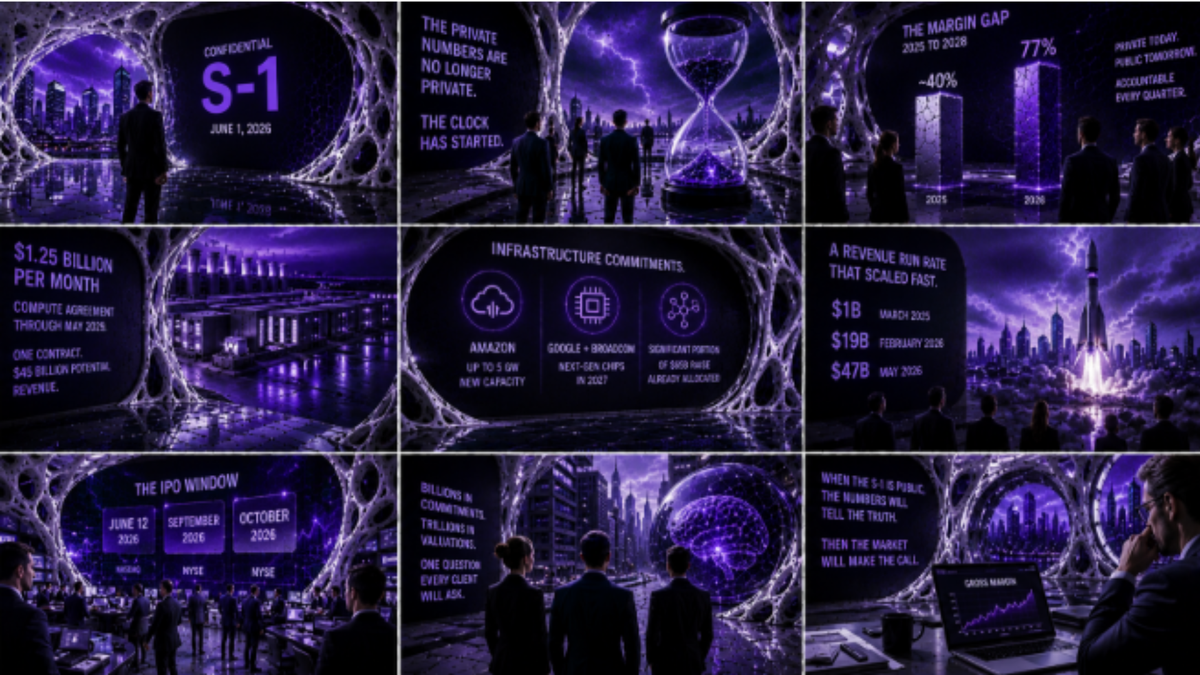
Anthropic's gross margins sat at approximately 40% in 2025, already 10 percentage points below its own internal projections, as reported by The Information. The company projects reaching 77% margins by 2028. Private investors can hold that gap quietly across multiple years. A public company reports every 90 days, and its margin trajectory is visible to every analyst, client, and competitor who reads the filing. The distance between 40% and 77% will not stay private once Anthropic is listed.
What it costs to run the product
The SpaceX S-1, filed publicly with the SEC on May 20, disclosed the most concrete number yet on Anthropic's cost structure: a $1.25 billion per month compute agreement for access to the Colossus and Colossus II data centers in Memphis and Southaven through May 2029. As The Bright Minded's SpaceX S-1 analysis showed, that single contract represents approximately $45 billion in potential revenue for SpaceX across its full term.
Anthropic's Series H announcement adds capacity agreements with Amazon for up to five gigawatts of new infrastructure and with Google and Broadcom for next-generation chips coming online in 2027. A significant portion of the $65 billion raised last week covers commitments already signed.
The revenue side has been growing fast enough to make this structure look manageable. Anthropic's run rate was $1 billion in March 2025, $19 billion at the February 2026 Series G close, and $47 billion in May 2026, per its own Series H announcement.
Investors in the current round, including Altimeter Capital, Sequoia, and Greenoaks, are betting that trajectory continues long enough to close the margin gap before listing. Our Anthropic's funding round analysis laid out what that bet requires: margin projections landing on schedule, infrastructure costs stabilising, and enterprise demand compounding without interruption.
What listing means for the contracts already signed
Anthropic is targeting an October 2026 listing window. OpenAI filed its own confidential S-1 on May 22, targeting September, at a valuation between $852 billion and $1 trillion. SpaceX filed its public S-1 on May 20 and is targeting a June 12 Nasdaq debut. Three companies with a combined implied valuation near $3 trillion are entering public markets in the same quarter, competing for the same institutional capital pool.
When Anthropic lists and begins reporting quarterly, its gross margin becomes a public benchmark. The enterprises that signed AI deals at current rates, including the companies that cut jobs to fund them, will be able to read each quarter whether that margin is moving toward 77% through cost efficiencies alone or whether the pricing side needs to move too.
The full S-1, which must be made public at least 15 days before the roadshow, will contain audited financials, infrastructure spend, and the complete picture of the gap. The gross margin line in that document will tell the fintech and professional services operators already running Claude in production more about the durability of current pricing than any contract they signed.
Editor's note
Every piece published on The Bright Minded goes through careful verification, but mistakes can happen. If you spot an error, have additional information, or want to flag anything, write to rosalia@thebrightminded.com.