
SoftBank's €75 Billion Bet on France Is Really a Bet on Its Grid
SoftBank committed up to €75 billion to build AI data centers in France. What France sold to get it was not incentives or talent. It was its electricity grid.
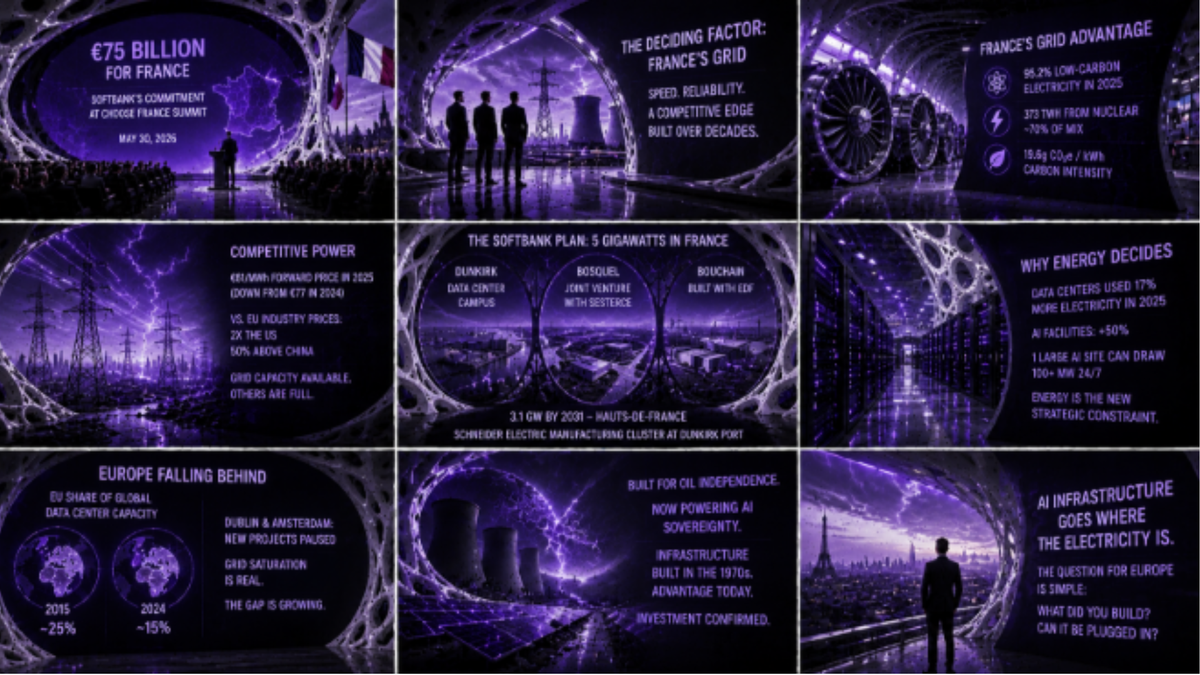
Every major AI infrastructure decision now runs into a question that did not exist five years ago: where can you actually plug it in? SoftBank's announcement on May 30, 2026 at the Choose France Summit, a commitment of up to €75 billion to build 5 gigawatts of AI data center capacity in France, is the clearest answer to that question so far, and it points directly at a national asset that predates artificial intelligence by decades.
France's Minister of Economy and Digital Sovereignty, Roland Lescure, identified the decisive factor in SoftBank's official statement: the country's grid access, specifically its speed and reliability. A €75 billion capital commitment, the largest AI infrastructure investment in Europe, came down to what France built underground and overhead starting in the 1970s.
France's grid advantage, in numbers
In 2025, 95.2% of electricity generated in mainland France came from low-carbon sources, according to RTE, the national transmission system operator. Nuclear provided 373 terawatt-hours of that total, close to 70% of the national mix, with hydro, solar, and wind covering the rest. France's electricity carbon intensity reached 19.6 grams of CO₂ equivalent per kilowatt-hour in 2025, among the lowest recorded anywhere in the world. The forward price for annual electricity delivery fell from €77 per megawatt-hour in 2024 to €61 in 2025, as nuclear availability improved and gas futures softened.
The contrast with the broader European market is structural. The IEA's Electricity 2026 report found that EU electricity prices for energy-intensive industries in 2025 ran at more than double US levels and around 50% above China. Grid saturation has become a real constraint: Dublin and Amsterdam, two of Europe's most established data center markets, have each paused new projects because local infrastructure cannot absorb additional demand. France's nuclear fleet, assembled over roughly four decades as an energy sovereignty response to the 1973 oil crisis, now places the country in a position that cannot be replicated on a short timeline.
Why energy has become the deciding factor
The IEA's 2026 analysis on energy and AI puts the scale of the demand shift in concrete terms. Electricity consumption across data centers rose 17% in 2025, with AI-specific facilities accounting for a 50% increase in the same year. The IEA's central projection sees total data center electricity consumption reaching around 950 terawatt-hours by 2030, roughly 3% of all global electricity demand at that point. A single large AI facility today can draw more than 100 megawatts of continuous power, a load comparable to a mid-size city district. At that scale, grid capacity has moved from a logistics consideration to a strategic one.
SoftBank's site choices reflect exactly that shift. The first phase of the French commitment covers 3.1 gigawatts of capacity in the Hauts-de-France region by 2031, with data centers in Dunkirk, Bosquel, and Bouchain. A joint venture with Sesterce will develop the Bosquel campus. The Bouchain site is being built with EDF, which described the project in the official announcement as proof of France's capacity to host large-scale infrastructure on competitive, sovereign, and low-carbon electricity. Schneider Electric is anchoring a manufacturing cluster at the Port of Dunkirk. Each location was selected for what its grid can carry.
The broader European picture
Europe's share of global data center capacity stood at around 25% in 2015. By 2024 it had fallen to 15%, as markets in the United States and China expanded considerably faster. The European Commission launched an AI Continent Action Plan in April 2025 in direct response, but policy frameworks and physical infrastructure operate on different timescales. The risks of concentrating digital infrastructure too narrowly, whether in networks or energy supply, are already visible across the continent. Even the SpaceX IPO filing framed the energy problem as fundamental enough to propose space-based solar as a long-term solution, precisely because terrestrial grids are failing to keep pace with AI compute demand.
France did not build its nuclear fleet to attract fintech or AI investment. The strategic logic in the 1970s was oil independence, full stop. That infrastructure is now a measurable competitive advantage in a race the country never anticipated running, and the €75 billion arriving in Hauts-de-France is the market's confirmation of that fact.
What the SoftBank announcement makes plain is that AI infrastructure is going where the electricity already is. The question for every other European country is simpler than any industrial policy document makes it look: what did you build, and can it be plugged in?
Editor's note
Every piece published on The Bright Minded goes through careful verification, but mistakes can happen. If you spot an error, have additional information, or want to flag anything, write to rosalia@thebrightminded.com.