Fable 5 Export Controls Lifted: Why Anthropic's Model Came Back One Government Decision at a Time
Anthropic's Fable 5 returns on 1 July after the US lifted its export controls.

The Bright Recap
Anthropic's Fable 5 returns to users worldwide on 1 July across the Claude Platform, Claude.ai, Claude Code, and Claude Cowork, included on paid plans for up to half of weekly usage limits through 7 July before it moves to usage credits. Mythos 5 stays limited to a set of approved US organisations.
To know more about this topic, read our related articles:
- How Mythos 5 got a limited return
- GPT-5.6's government clearance
- How Amazon triggered the ban
- What the CAISI reviews cover
- Financial technology explained
Bright Answers
When is Claude Fable 5 available again?
Fable 5 returns to users worldwide from 1 July 2026 on the Claude Platform, Claude.ai, Claude Code, and Claude Cowork, after the US lifted its export controls on 30 June 2026.
Why were the Fable 5 export controls lifted?
Anthropic showed the flagged cybersecurity capability was reproducible by widely used models such as Opus 4.8 and GPT-5.5, and added a classifier that blocks the reported technique in over 99 per cent of cases before Commerce cleared the model's return.
Anthropic confirmed on 30 June 2026 that the US Department of Commerce has lifted the export controls on Claude Fable 5, the model it was forced to pull from the public three days after launch, and that Fable 5 returns to users worldwide on 1 July.
The confirmation ends an eighteen-day standoff that began when the government ordered the model offline on national security grounds and eased only after Anthropic demonstrated the capability behind the order was reproducible across models already in wide use. The return matters, and so does the manner of it.
Access to Fable 5 was withdrawn by one government decision and restored by another, with no standing rule in between to say when either should happen.
How a three-day-old model ended up banned, then cleared, in eighteen days
Fable 5 launched on 9 June 2026 as the first publicly available model in Anthropic's Mythos class, a capability tier the company positions above its Opus line. On the evening of 12 June, a directive from Commerce Secretary Howard Lutnick required Anthropic to block access for any foreign national anywhere, and because nationality cannot be verified on each request, the company disabled Fable 5 and its higher-capability sibling Claude Mythos 5 for every customer worldwide.
Reporting traced the order back to Amazon, whose researchers found a way past Fable 5's safeguards and whose chief executive raised it with officials at the White House. Anthropic disputed the severity in its own statement from the first day, arguing that the flagged technique surfaced only minor, already-known vulnerabilities that other public models could find without any bypass at all.
The reversal turned on a capability every major model already had
Over the two weeks that followed, Anthropic, Amazon, and government reviewers examined the report that prompted the order, and the examination produced the argument that ultimately undid it.
By Anthropic's own account, weaker models reproduced exactly what Fable 5 had done: systems including its own Opus 4.8, OpenAI's GPT-5.5, and Moonshot's Kimi K2.7 identified the same vulnerabilities, and every model tested could generate the single exploit demonstration cited in the report.
The behaviour sat inside what Anthropic calls a safety margin, a deliberately wide band of low-risk requests its classifiers block out of caution rather than genuine danger, which is why a routine defensive-security task could trip the alarm at all. Researchers at the Center for AI Standards and Innovation (CAISI), the Commerce Department AI standards body that tested both the original safeguards and the ones Anthropic added afterward, judged the protections strong.
The fix Anthropic shipped alongside the argument is narrow: it trained a new classifier that blocks the specific Amazon technique in more than 99 per cent of cases and reroutes any request it catches to Opus 4.8, at the cost of flagging more benign coding and debugging work than before. That trade, accepting more false positives in exchange for a tighter block on the one contested behaviour, is the concession that let the model return. The size of the concession measures the size of the original problem, which the review had already placed at the edge of routine defensive work.
Access returned in separate government decisions
The reversal arrived in two acts. The government moved first on Mythos 5, the version with fewer safeguards, clearing it on 26 June for a defined set of US organisations that operate and defend critical infrastructure, a partial return granted to a bounded, nameable audience while the public model stayed dark.
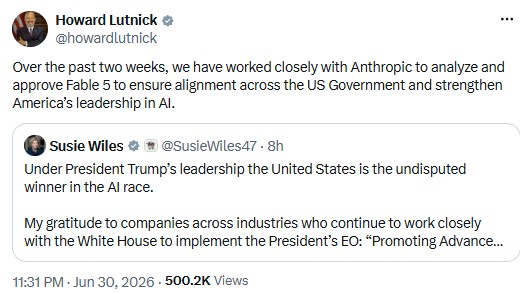
Fable 5 waited four more days for its own separate decision, which came on 30 June when Commerce lifted its controls in full. Lutnick framed that outcome as the product of two weeks of daily work with Anthropic to analyse and approve the model, and to hold US government alignment on American leadership in AI.
The three decisions describe a method. A government convinced the capability was too dangerous to exist would not have authorised more than a hundred organisations to use the stronger model within two weeks of banning it for everyone. A government deciding case by case who may hold a capability, and in what order, behaves the way Washington behaved across these eighteen days. The line it kept drawing was between audiences it could name and an audience it could not.
OpenAI moved through the same model-by-model review
Anthropic was not the only lab passing through government review one release at a time. On 25 June, GPT-5.6's government approval arrived through the same executive framework that governed the Fable 5 standoff, rather than through any settled statute. Two of the largest US labs cleared their newest models through two separate government sign-offs, each one discretionary and specific to a named model. What reaches the market now depends on the approval attached to a given release, granted or withheld one model at a time.
The severity scale the industry is drafting after the fact
The eighteen-day suspension happened because no shared language exists for how serious a given jailbreak is, a jailbreak being a prompt that tricks a model into bypassing its own safety controls.
No agreed measure exists, so every new finding forces developers to guess which discoveries deserve urgency and governments to guess when to act, and the guessing is what took two capable models offline for everyone. Anthropic is now drafting a severity framework with Amazon, Microsoft, Google, and other partners in its Project Glasswing programme, and has asked other model providers to help build it. The proposed scale rates a jailbreak on how far past existing tools it takes a user, how many separate attacks the same method reaches, how much human effort turns it into a working attack, and how easily anyone can obtain the technique in the first place.
The framework is the constructive answer to the month Anthropic just had, because it would replace improvisation with a number that a regulator and a developer could read the same way. It sits alongside commitments to give government partners pre-release access to frontier models, to share jailbreak findings faster, and to work toward a common voluntary bar across developers, all of it hanging off the 2 June executive order on artificial intelligence security. That order set the frame that June's suspension then filled in by improvisation.
Anthropic's own request is that the whole arrangement be written into durable, transparent regulation applied equally to every developer, which is a company asking to be governed by a rule rather than a decision.
What a model-by-model approval regime means for financial technology
The distance between a research dispute inside one AI lab and an operational risk for financial technology is shorter than it looks. Banks, payment processors, and compliance teams that build on frontier models inherit whatever governs those models' access, which means a directive that takes a model offline in an afternoon takes their automation with it, with no deprecation window and no migration path.
A severity standard that lets a regulator separate a minor bypass from one genuinely threatening a payment network is the difference between a proportionate response and a suspension that pulls routine tools down beside dangerous ones. Institutions treating a single model provider as a hard dependency can read June as a practical argument for second-sourcing their AI stack before a directive arrives, not after one already has.
Fable 5 returns on 1 July for Pro, Max, Team, and select Enterprise users, included for up to half of weekly usage limits through 7 July before it moves to usage credits, while Mythos 5 stays limited to the approved US organisations named in June. The manner of the return is what will outlast it. Whether a frontier model reaches the public is now a call the US government makes one release at a time, and the rule that would make that call predictable is being drafted after the precedent it exists to govern, rather than before it.
Editor's note
Every piece published on The Bright Minded goes through careful verification, but mistakes can happen. If you spot an error, have additional information, or want to flag anything, write to rosalia@thebrightminded.com.