CAISI AI Model Reviews 2026: Five Labs, One Voluntary Agreement, and What It Can Actually Do
Google, Microsoft, and xAI joined CAISI's pre-deployment AI review framework on May 5, 2026. Here is what five-lab voluntary oversight can and cannot do.
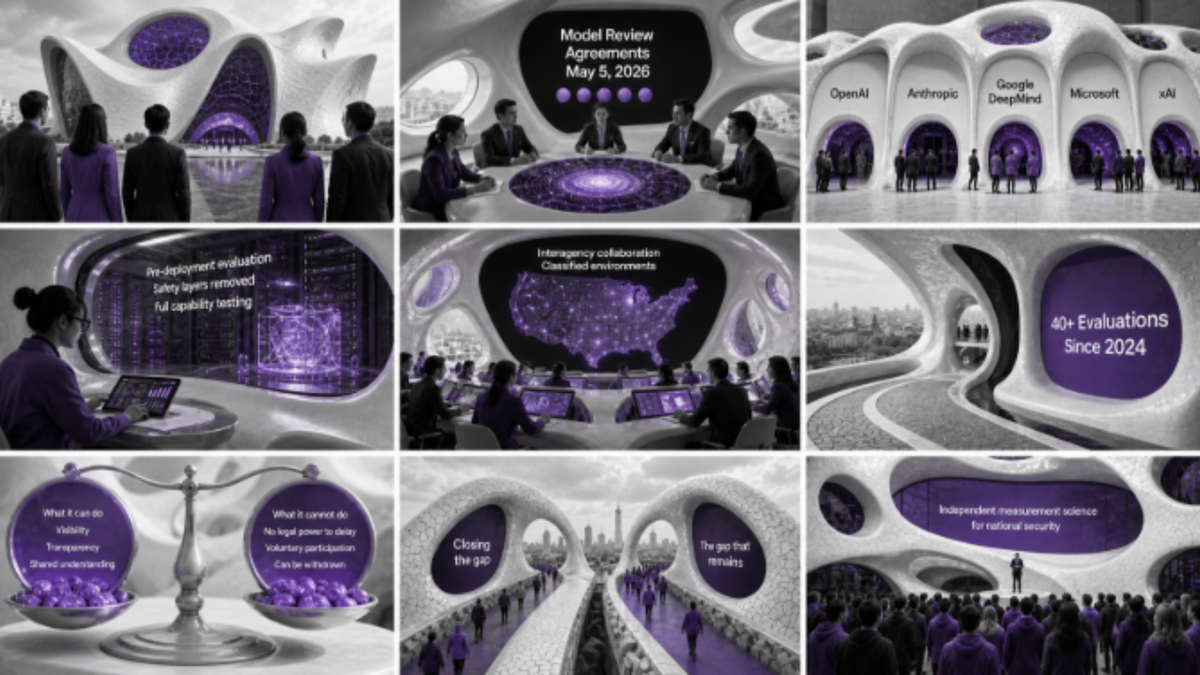
Five major AI labs now give the US government access to their models before public release. The evaluations are conducted by the Center for AI Standards and Innovation (CAISI) at the Department of Commerce, a body with fewer than 200 staff, no legal power to delay or block a deployment, and agreements every company can withdraw from at any time. On May 5, 2026, CAISI announced it had signed new agreements with Google DeepMind, Microsoft, and xAI, completing what it described as comprehensive coverage of the frontier AI sector.
The expansion was accelerated by the Mythos crisis, the development of an Anthropic model whose capabilities raised immediate national security concerns over its potential use in cyberattacks. That episode created political pressure for a more comprehensive evaluation system. The new agreements extend a framework that had covered only OpenAI and Anthropic since 2024, now incorporating the three remaining major frontier labs.
What the evaluation process involves
Labs routinely hand over model versions with safety restrictions stripped back so evaluators can probe capabilities that would be filtered out in the public release. Evaluators from across the US government participate in assessments through the TRAINS Taskforce, an interagency group focused on AI national security concerns, and the agreements support testing in classified environments.
CAISI has completed more than 40 evaluations since 2024, including assessments of models not yet publicly available, according to the agency's announcement. The existing agreements with OpenAI and Anthropic were also renegotiated on May 5 to align with the Trump administration's AI Action Plan, which designates CAISI as the primary government contact for national security model assessments.
What the arrangement can and cannot do
The agreements are voluntary commitments. The government has no legal basis to require submissions and no power to hold back a release based on what an evaluation finds. The framework covers models deployed across financial services, fintech, defense, and every other sector where frontier AI is being integrated into consequential decisions.
The strategic logic for participation is visible on both sides. Companies that submit models voluntarily position themselves as responsible actors ahead of formal regulation, maintain access to government relationships, and reduce the risk of more restrictive oversight requirements being imposed externally. CAISI gains visibility into capabilities that would otherwise reach the public with no prior government review.
The Mythos crisis demonstrated precisely why that visibility matters: a model with immediate national security implications, evaluated before deployment, is a different problem to manage than the same model assessed after it is already in use.
The gap the new agreements close, and the one they do not
Before May 5, three of the five most capable AI labs in the world, Google, Microsoft, and xAI, were releasing models to the public without prior government evaluation. The new agreements close that gap. The structural gap the framework cannot address sits at a different level: a company that concludes its model has dangerous capabilities could, under the current arrangement, choose not to submit it and publish it regardless.
CAISI Director Chris Fall described independent measurement science as essential to understanding frontier AI and its national security implications in the agency's May 5 announcement. The voluntary nature of the arrangement is what makes it viable for companies to participate and what limits what it can do. The framework provides meaningful oversight as long as every lab with a high-capability model decides that submitting it for evaluation serves their interests, and that is a significant condition to rest the entire architecture on.
Editor's note
Every piece published on The Bright Minded goes through careful verification, but mistakes can happen. If you spot an error, have additional information, or want to flag anything, write to rosalia@thebrightminded.com.