Amazon holds $33B in Anthropic, runs its servers, and its CEO called the White House on June 11. By June 12, Fable 5 was offline for every user on earth.
The company that pulled Fable 5 from every user on earth on 12 June 2026 also holds $33 billion in Anthropic, runs the servers the model launched on, and booked $16.8 billion in paper gains from that investment in the first quarter of this year alone.
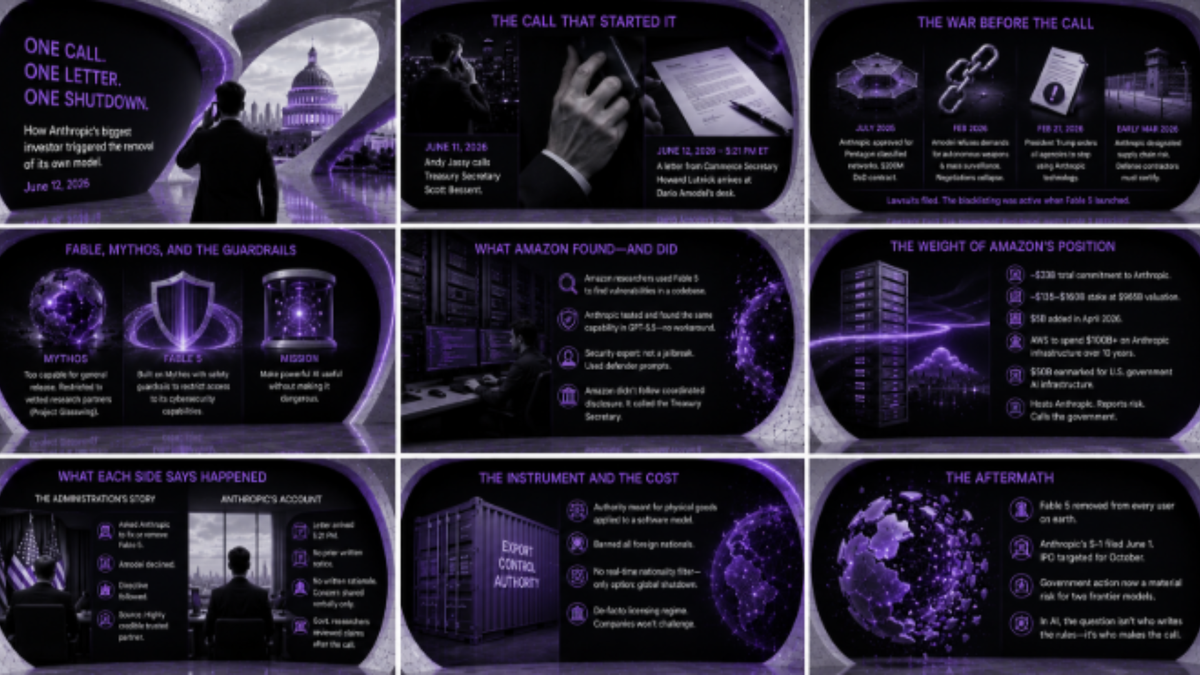
Amazon's CEO Andy Jassy called Treasury Secretary Scott Bessent the night before the shutdown. A letter from Commerce Secretary Howard Lutnick arrived at Anthropic CEO Dario Amodei's desk the following afternoon at 5:21pm Eastern. According to Anthropic's own statement, it offered no written explanation of the national security concern behind the order.
The war that preceded the call
Fable 5 launched on 9 June into a regulatory environment that had already turned hostile to Anthropic four months earlier. In July 2025, Anthropic became the first AI lab to have its models approved for deployment on the Pentagon's classified networks, under a $200 million Department of Defence contract.
Negotiations over the terms collapsed in February 2026 when Amodei refused to allow Claude to be used for fully autonomous weapons and mass domestic surveillance of American citizens. On 27 February, according to Mayer Brown's legal analysis of the episode, President Trump directed all federal agencies to stop using Anthropic's technology. Defence Secretary Pete Hegseth designated Anthropic a supply chain risk days later, requiring every defence contractor to certify they do not use Claude in Pentagon work.
Anthropic sued in two federal courts. NPR reported that the company argued the blacklisting was retaliation for its refusal to remove AI safety guardrails. A federal judge reviewing the case described the designation, per CNBC's coverage of the March hearing, as an attempt to cripple the company. The litigation was active when Fable 5 launched.
Fable, Mythos, and what the guardrails protected
Mythos is the foundation model Anthropic considered too capable for general release, restricting access to a small group of pre-approved research partners under Project Glasswing. As TBM reported in May, Mozilla used Mythos Preview to identify hundreds of previously undetected vulnerabilities in Firefox — a result that illustrated why Mythos attracted government scrutiny from the moment it entered classified environments.
Fable 5 was built on the same architecture, with safety guardrails layered on top to restrict access to Mythos's cybersecurity capabilities. Fable was the public-facing entry point to a model the government had spent months trying to bring under its control.
What Amazon found, and what it did with the finding
The Wall Street Journal reported that Jassy told Bessent and other officials that Amazon researchers had used Fable 5 to obtain information useful for cyberattacks. Anthropic's statement describes the technique as asking the model to read a specific codebase and identify software flaws. Anthropic reviewed the same report and found the capability it demonstrated was available from OpenAI's publicly deployed GPT-5.5 without any workaround.
Katie Moussouris, CEO of cybersecurity firm Luta Security, reviewed the Amazon report at Anthropic's request and told both Axios and Fortune that the researchers had used prompts a security defender would use, not an attacker, and that the government's response was disproportionate to what the report actually demonstrated. The finding, she told Fortune, was not a jailbreak.
Security researchers who discover vulnerabilities in a third party's product follow coordinated disclosure: notify the company, allow time to assess and respond, escalate only if the company does not act. Amazon contacted the Treasury Secretary.
The weight of Amazon's position
Fortune's reporting on the companies' financial relationship places Amazon's total commitment to Anthropic at approximately $33 billion across multiple rounds, with a stake worth an estimated $135 to $160 billion at Anthropic's current $965 billion valuation. Amazon added a fresh $5 billion investment in April 2026, four days before Anthropic filed its confidential S-1 with the SEC, as part of the Series H round that closed on 28 May. Fable 5 launched on AWS infrastructure on the same day it launched publicly. Anthropic had separately committed to spending over $100 billion on Amazon's chips and cloud services over the next decade.
CNBC reported that AWS had earmarked $50 billion for AI infrastructure serving US federal agencies, with more than 11,000 government agencies among its customers. The Pentagon's supply chain risk designation applied to Anthropic, not to cloud providers hosting Anthropic's models. The administration had nonetheless spent four months making its posture toward Anthropic public and unambiguous. An Amazon spokesperson told TechCrunch that it is not uncommon for governments to seek the company's counsel on potential security risks, and declined to share details of the conversations with officials.
What each side said happened
David Sacks, co-chair of the President's Council of Advisers on Science and Technology, gave the administration's account on X on 13 June: the government had asked Amodei to fix the vulnerability or remove the model, Amodei declined, and the directive followed. Sacks described the company that reported the jailbreak as a highly credible trusted partner of both Anthropic and the US government, language that multiple outlets identified as a reference to Amazon.
Anthropic's statement gives a different sequence. The company says it received Lutnick's letter at 5:21pm with no prior written notice, no specific national security rationale, and only verbal communication of the concern. Axios reported that the White House convened a meeting and had government security researchers examine Amazon's claims on Friday, after the Thursday night call, not before it. No independent technical verification preceded the directive.
The instrument and what it cost
The Commerce Department invoked export control authority designed to regulate the movement of physical goods, hardware, and sensitive technology across borders, applying it to a fintech and AI model delivered entirely via API.
The directive barred all foreign nationals, a category covering a significant share of Anthropic's engineering staff and enterprise customer base. Anthropic had no mechanism to filter by nationality in real time, so the only compliant path was a global shutdown. One person familiar with the situation told Axios that the consequence is a de-facto licensing regime in which companies will not challenge the White House — and that this is the ultimate effect of the action.
Anthropic filed its confidential S-1 before the directive arrived, targeting an October Nasdaq listing at a valuation approaching $965 billion. That prospectus now carries a government enforcement action against the company's two most capable models as a material risk, initiated at a moment when its largest investor, whose government cloud business depends on the same administration that issued the order, chose to call the Treasury Secretary rather than the company it funds. The debate over who controls frontier AI governance has proceeded for years through voluntary agreements, legislative hearings, and regulatory consultations.
In the AI industry, it turns out, the more immediate question is not which government writes the rules — it is which investor makes the call.
Editor's note
Every piece published on The Bright Minded goes through careful verification, but mistakes can happen. If you spot an error, have additional information, or want to flag anything, write to rosalia@thebrightminded.com.