Anthropic Gets Permission to Bring Mythos 5 Back, Just Not for Everyone
Anthropic confirmed the US government will let Mythos 5 return to critical infrastructure organizations. Fable 5 stays off, and the split says everything.

The Bright Recap
Anthropic said on 27 June 2026 that the US government had notified the company Mythos 5, its strongest cybersecurity model, can be redeployed to a set of US organizations that operate and defend critical infrastructure. Anthropic said it is moving to restore that access quickly. Fable 5, the company's public-facing model, was not part of the notification and stays offline.
Both models had been suspended since 12 June. Anthropic said it continues working with the government both to widen Mythos 5 access further and to bring Fable 5 back for general use. The company gave no date for either step.
To know more about this topic, read our related articles:
- Anthropic's Biggest Investor Called the White House
- Amazon's AI Strategy and That Call to the White House
- Five labs, one voluntary agreement
- What Mythos could not exploit
- Why Beijing left with nothing signed
- Financial technology explained
Bright Answers
Has Mythos 5 access actually been restored yet?
Anthropic said on 27 June 2026 that it is restoring access for the approved organizations quickly, language that describes an action underway rather than one already finished, and the company has not confirmed a completion date.
Why does Fable 5 remain offline while Mythos 5 does not?
Anthropic's own statement does not explain the distinction. It says only that the government's notification covered Mythos 5 and that talks continue toward making Fable 5 available again for general use.
Anthropic said on 27 June 2026 that the US government had notified the company Mythos 5, described by Anthropic as its strongest cybersecurity model, can be redeployed to a set of US organizations that operate and defend critical infrastructure.
The company said it is restoring access for those organizations quickly. Fable 5, the public-facing model built on the same underlying system, was not part of that notification, and Anthropic's statement leaves it offline with no date attached.
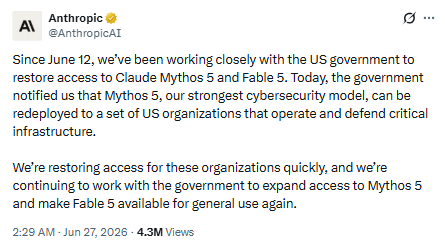
Both models had been suspended since 12 June, a fact the company restated itself in the same post, framing the new development as the result of two weeks spent working closely with the government to undo that suspension. What Anthropic actually confirmed is narrower than a full reversal: one model gets a path back, to a defined audience, while the other stays exactly where it was.
What Anthropic said, and what it carefully did not say
The wording is worth sitting with, because Anthropic chose it carefully. The company did not say Mythos 5 access has been restored. It said the government notified it that Mythos 5 can be redeployed, and that it is restoring access quickly. That is a statement about permission granted and action beginning, not a statement that every named organisation already has the model back in hand. The distinction matters for anyone trying to read this as a finished event rather than a step in one still underway.
The same caution applies to scope. Anthropic did not name the organisations, did not say how many there are, and did not describe what changed in its own systems to satisfy the government between 12 and 27 June. It said only that the redeployment covers organizations that operate and defend critical infrastructure, a category defined by function rather than by name, and that conversations with the government continue on two fronts: widening Mythos 5's reach further, and making Fable 5 generally available again.
Why a model can be unbanned for some and not others
The plainest reading of Anthropic's own words is that this was never a single on-or-off switch. The government drew a line between two audiences for the same underlying capability, and only one side of that line moved. Critical infrastructure operators, by the nature of what they do, are a bounded, identifiable group. The general public Fable 5 was built to serve is not. Anthropic's statement does not explain why the government chose to move on one and not the other, but the shape of the decision itself, narrow and functional rather than total, tells its own story.
A government that genuinely believed Mythos-class capability was too dangerous for anyone outside a research lab would not authorise a redeployment to over a hundred organisations within two weeks of banning it for everyone. A government managing exactly who holds a capability, rather than whether it should exist at all, behaves exactly like this.
This is the same dynamic this site traced when the CAISI evaluation framework shifted from public comparison to classified review: the question that actually moves policy is not how capable a model is in the abstract, but who can see it, who holds it, and who else might. Mythos 5's partial return answers that question for one audience. Fable 5's continued suspension leaves it open for everyone else.
What stays exactly as uncertain as it was on 12 June
Anthropic's statement is notable for what it does not resolve. It gives no account of the underlying jailbreak concern that triggered the original suspension, the same concern this site covered when examining what Mythos could not exploit in earlier testing. It gives no restoration date for Fable 5. And it gives no indication of how the list of approved organisations might grow, beyond saying that conversation is ongoing.
What it does confirm is the trajectory this entire month has followed. Washington has shown a consistent preference for narrow, named, controllable access over broad public release, whether the question is which evaluations get published, which customers get a new model first, or which organisations get a suspended one back. That preference, visible again in Anthropic's own choice of words, sits closer to a contest over who holds the lead than to a settled judgment about what is safe for the public to use.
Anthropic chose to frame this as progress, and on its own terms it is: a model that was fully dark for two weeks now has a path back to some of its users. But the company's own language, restoring rather than restored, a set of organizations rather than everyone, leaves the larger question exactly where it found it. Mythos 5 is coming back for the people the government already knows by name. Fable 5 is still waiting for an answer to the harder question of what happens when nobody can be named at all.
Editor's note
Every piece published on The Bright Minded goes through careful verification, but mistakes can happen. If you spot an error, have additional information, or want to flag anything, write to rosalia@thebrightminded.com.