
Anthropic's $65 Billion Round: What the Money Is, Where It Goes, and Who Pays If It Doesn't Come Back
Anthropic raised $65 billion at a $965 billion valuation. What that money actually is, what it costs to run an AI company, and who absorbs the gap when the math gets hard.
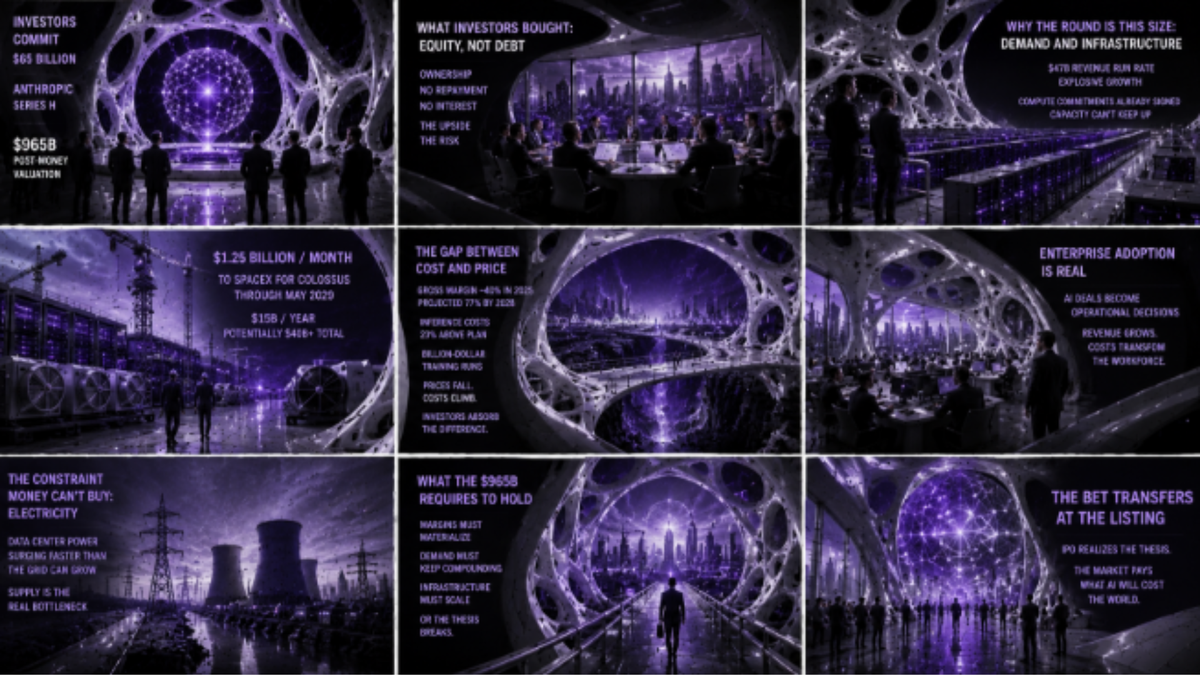
Investors handed Anthropic $65 billion on May 28, 2026, and received equity in return — a percentage of the company, no repayment date, no guaranteed return. The round, confirmed in Anthropic's Series H announcement, values the company at $965 billion post-money. What that valuation measures, what Anthropic does with the cash, and what the structure requires to hold together are three questions worth answering separately.
What investors actually bought
Equity funding and debt sit at opposite ends of the capital structure. The investors in this round — Altimeter Capital, Dragoneer, Greenoaks, Sequoia Capital, and a list of institutional names including Blackstone, Fidelity, Singapore's GIC, and General Catalyst — bought ownership stakes. There is no interest rate, no repayment schedule, no creditor relationship. The money belongs to Anthropic. What investors hold is a share whose value rises or falls with the company's fortunes.
Their exit, when it comes, will most likely be an IPO. Early investors sell their shares to public market buyers, recover their capital, and realize a gain proportional to how much the valuation has grown. Anthropic has already engaged law firm Wilson Sonsini to advise on that process. The risk transfers to public market buyers at the moment of listing — which is precisely why the valuation at IPO matters so much to everyone in the current round.
Why the round is this size
Anthropic's revenue run rate crossed $47 billion this month, per its own Series H announcement. At the February 2026 Series G close, that figure was $19 billion. In March 2025, it was $1 billion. Investors are competing for a position in a company scaling faster than almost any software business on record, before it lists publicly and the cost of entry increases.
The other driver is infrastructure. Serving existing demand has already outrun Anthropic's capacity. As detailed in the SpaceX S-1 filing coverage published here, Anthropic agreed to pay SpaceX $1.25 billion per month for access to the Colossus 1 and Colossus 2 data centers in Memphis through May 2029 — $15 billion a year, to a single compute supplier, for a contract that could deliver over $40 billion to SpaceX across its full term, as disclosed in the S-1 SpaceX filed with the SEC on May 20. Anthropic also committed, per its Series H announcement, to agreements with Amazon for up to five gigawatts of new capacity and with Google and Broadcom for five gigawatts of next-generation chips coming online in 2027. A significant portion of the $65 billion is pre-allocated to bills already signed.
The gap between cost and price
Running frontier AI models costs more than what the market will currently pay for them. Anthropic's gross margins were approximately 40% in 2025 — already 10 percentage points below its own internal projections — driven by the cost of running inference on Google and Amazon cloud infrastructure, as reported by The Information. The company projects margins reaching 77% by 2028, per TechCrunch's reporting on its internal financials, and positive cash flow by 2027. The 2025 shortfall was caused specifically by inference costs running 23% above internal estimates, again per The Information.
Training costs compound the picture. Anthropic's CEO Dario Amodei said in mid-2024 that billion-dollar training runs were already happening and that $10 billion runs were likely within a few years. Epoch AI's data, as reported in April 2026, shows training costs growing at roughly 2.4 times per year since 2016. Simultaneously, the price users pay per query has fallen sharply — GPT-4 launched at $30 per million input tokens, and today's mid-tier rates are a fraction of that. The cost of production climbs. The price the market accepts drops. Investors absorb the difference until the unit economics close, or until they stop.
The enterprise adoption driving Anthropic's revenue is real and accelerating. The Intuit layoffs in May — 3,000 jobs cut three months after the company signed AI deals with Anthropic and OpenAI — confirm that corporate spend on AI infrastructure is converting into operational decisions at scale. They also confirm that the consequences of that spend run well beyond the revenue line Anthropic reports.
The constraint money cannot buy
Compute requires electricity, and electricity supply is not keeping pace with demand. The International Energy Agency reported in April 2026 that data center electricity consumption surged 17% in 2025, against global electricity demand growth of 3%. The IEA projects data center consumption crossing 1,000 TWh by the end of 2026 — equivalent to Japan's entire annual electricity usage — with power consumption from AI-focused facilities set to triple by 2030. In Virginia, the largest concentration of US data center capacity, one in every five kilowatt-hours produced by the state's largest utility already goes to data centers, per the same IEA report.
Anthropic's compute agreements secure access to chips. They do not resolve the energy supply behind them. The Colossus facilities Anthropic is paying $1.25 billion per month to access were powered during construction by dozens of natural gas turbines that xAI installed without federal permits, claiming temporary use, as reported by CNBC. More capital secures more processors. The electricity to run them at scale is a separate problem, one that neither the Series H valuation nor the SpaceX contract addresses.
What the $965 billion requires to hold
The valuation is a statement of investor belief about Anthropic's future revenue, margins, and market position. For that belief to pay out, Anthropic needs to reach an IPO at a valuation close to $965 billion — which requires the margin projections to land, the infrastructure costs to stabilize, and enterprise demand to keep compounding.
The gap between what it costs to run these systems and what users and businesses currently pay is real, documented, and being absorbed by investors betting on that IPO. When the listing happens, the subsidy ends. At that point, either the unit economics close through efficiency gains, or the price of AI goes up, or both. The companies signing AI deals today — the ones cutting jobs to fund them, the ones building AI into their core operations — are the same ones that will face that repricing. The $965 billion is not an abstract number. It is the upstream event that will eventually determine what AI costs everyone downstream.
Editor's note
Every piece published on The Bright Minded goes through careful verification, but mistakes can happen. If you spot an error, have additional information, or want to flag anything, write to rosalia@thebrightminded.com.