
Agentic AI as a Catalyst for Intelligence and Resilience in Fintech Ecosystem
Agentic AI shifts fintech from passive analytics to autonomous, adaptive intelligence, enabling agents to reason, collaborate, and drive resilience across trading, and compliance.

In today’s digital economy, it is widely acknowledged that we are living in a data-driven age, where vast volumes of structured and unstructured information flow continuously across institutional, transactional, and behavioural ecosystems. The significance of data is no longer confined to descriptive analytics; rather, it is increasingly shaping how markets interpret signals, anticipate risks, and respond to uncertainty. However, the next frontier is not merely data-driven analytics. It is the emergence of agentic AI systems capable of autonomously reasoning, adapting, and coordinating decisions across Fintech-enabled infrastructure.
Agentic AI represents a shift from passive analytics toward goal-oriented intelligent action systems, where distributed AI agents collaborate across trading, risk management, compliance, and settlement environments to improve both market intelligence and systemic resilience.
Meet Cantica, the Fin-Tech intelligence system.
From Data Abundance to Autonomous Financial Technology Intelligence
Traditionally, data-driven systems have played a critical role in improving transactional transparency and operational efficiency within fintech world. Most analytical approaches relied heavily on descriptive statistical techniques rooted in classical methodologies, where insights were extracted retrospectively from historical observations. These approaches helped institutions distinguish between knowledge, which is a repository of observed scenarios and certainty, a probabilistic measure of confidence associated with expected outcomes.
However, knowledge in fintech ecosystems has always been inherently incomplete. Markets evolve dynamically, influenced by behavioural signals, geopolitical shocks, liquidity regimes, and technological disruptions. Agentic AI systems address this limitation by moving beyond static knowledge repositories and enabling continuous inference generation through adaptive interaction with market environments.
Instead of extrapolating observed values alone, AI agents actively construct contextual intelligence by integrating:
- Macroeconomic Indicators
- Behavioural Sentiment Signals
- Execution-layer Dynamics
- Regulatory Developments
- Cross-asset Correlations
This transforms analytics from retrospective interpretation into forward-looking decision orchestration.
Rethinking Certainty Beyond Classical Risk Measures
In traditional financial modelling frameworks, certainty has often been operationalized through measures such as Value at Risk (VaR). While VaR remains an important benchmark for estimating downside exposure, it is typically derived from assumptions regarding return distributions and variance structures that may not fully capture nonlinear market behaviour.
Agentic AI introduces a new paradigm in which certainty becomes dynamic and adaptive rather than static and distribution bound. Autonomous agents continuously revise probability estimates using streaming data inputs and scenario simulations, thereby strengthening predictive robustness during volatile market regimes.
In this sense, certainty evolves from a statistical abstraction into an interactive confidence architecture supported by real-time intelligence loops.
From Cognitive Computing to Agentic Collaboration
Earlier advances in cognitive computing attempted to replicate human reasoning through machine-based inference mechanisms. While these systems significantly enhanced analytical scalability, they often remained constrained by their dependence on predefined learning structures. Markets, however, are not static computational environments; they are adaptive socio-technical systems shaped by both rational expectations and behavioural heuristics.
Agentic AI resolves this limitation by introducing collaborative intelligence ecosystems, where autonomous agents interact with both humans and institutional infrastructures. Rather than replacing human cognition, agentic architectures augment decision-making through:
- Continuous Monitoring of Market Microstructure Signals
- Adaptive Pricing Intelligence
- Anomaly Detection in Trading Behaviour
- Predictive Liquidity Mapping
- Autonomous Compliance Escalation Mechanisms
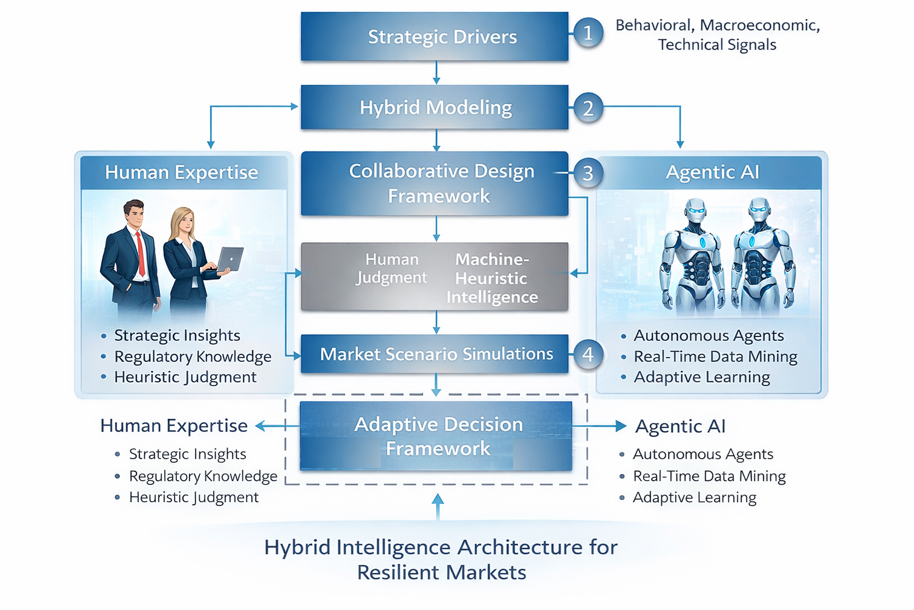
This creates a hybrid intelligence layer that strengthens both responsiveness and interpretability within fintech paradigms.
Human–Agent Interaction as a Driver of Market Resilience
While machines possess unparalleled memory and computational power necessary for accurate securities pricing and large-scale simulations such as Monte Carlo modelling, human expertise remains essential for heuristic reasoning, contextual judgment, and model governance. Agentic AI therefore enables a human-in-the-loop decision architecture, where traders, analysts, and risk managers collaborate with intelligent agents rather than supervising static automation pipelines.
Such interaction improves:
- Convergence Speed in Price Discovery
- Robustness of Predictive Asset-pricing Frameworks
- Adaptability During Regime Shifts
- Interpretability of Algorithmic Decisions
Importantly, agentic systems can dynamically recommend model selection strategies. For example, identifying when beta regression frameworks or scenario-driven simulations are better suited for specific market conditions.
This collaborative architecture enhances both market intelligence and institutional resilience, particularly during periods of volatility and liquidity stress.
Toward Resilient and Self-Adaptive Fintech Ecosystems
One of the most promising contributions of agentic AI lies in its ability to transform markets into self-adaptive intelligence networks. Instead of relying solely on centralized analytics pipelines, distributed agents coordinate across execution, surveillance, settlement, and portfolio optimization layers to maintain operational continuity and systemic stability.
Such systems enable:
- Autonomous Liquidity Discovery Across Fragmented Venues
- Proactive Settlement-risk Prediction
- Adaptive Portfolio Rebalancing based on Behavioural Signals
- Real-time Compliance Monitoring
- Scenario-driven Stress-testing Orchestration
Collectively, these capabilities enhance the resilience of fintech enabled infrastructures against uncertainty shocks and informational asymmetries.
Conclusion: From Data-Driven Markets to Agent-Orchestrated Markets
The evolution from classical analytics to agentic intelligence marks a structural transition in how markets generate knowledge and interpret certainty. Rather than relying exclusively on retrospective statistical inference or purely cognitive automation models, the future of market intelligence lies in interactive ecosystems where human expertise and autonomous AI agents co-create adaptive decision frameworks.
Such hybrid architectures not only accelerate price discovery and risk interpretation but also strengthen institutional confidence in algorithmic decision environments. As research continues to explore the measurable benefits of agentic collaboration, it is increasingly evident that the next generation of fintech orchestration will be defined not merely by data availability but by the intelligence, autonomy, and resilience of the agents that interpret it.