Anthropic IPO Prices at $83 With a Valuation Well Below $2 Trillion
Anthropic IPO priced at $83 a share before its Nasdaq debut as ANT. Why the valuation fell short of $2 trillion and what Amodei said about the compute bill.
The Bright Recap
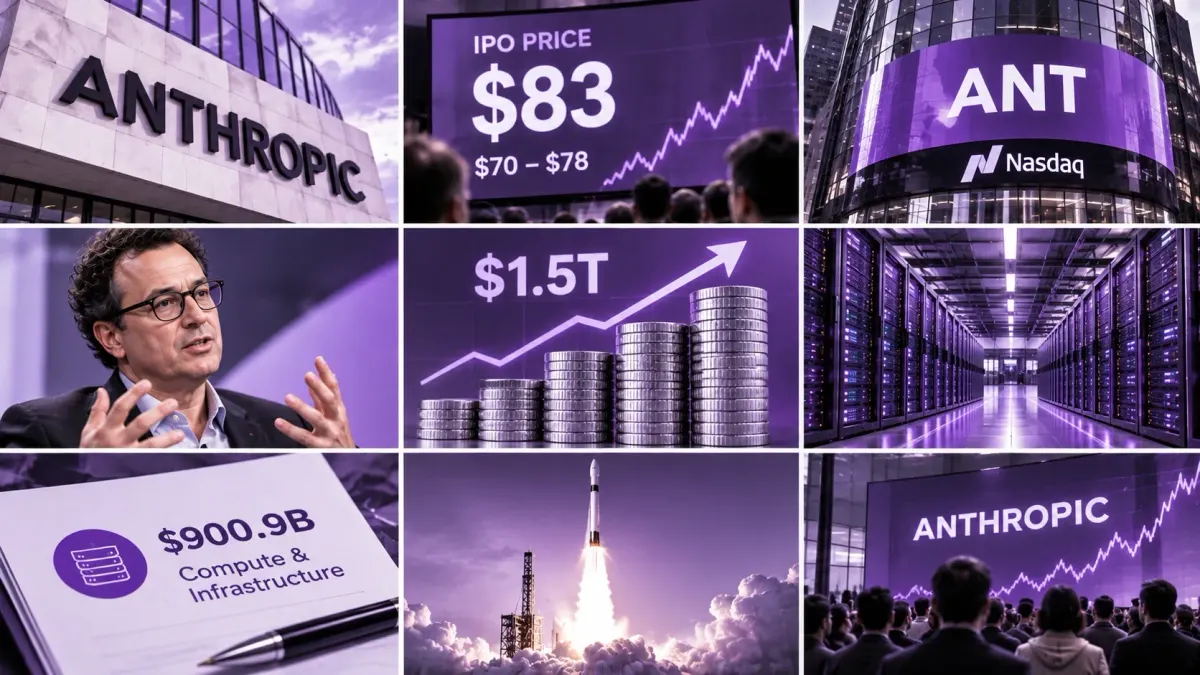
The Claude developer set its final offering price at $83 per Class A share, above its $70 to $78 range, for an estimated fully diluted value of about $1.5 trillion. Trading on Nasdaq under ANT begins on 19 November.
The valuation sits below the roughly $2 trillion discussed in September. Dario Amodei said the company would rather deliver more than it promised, while its amended filing puts committed spending at about $900.9 billion, substantially all of it for compute and infrastructure.
To know more about this topic, read our related articles:
- Why aftermarket buyers may lack Section 11 claims
- Kraken's ANTx requests and the S-1
- What the S-1 proves about the compute bill
- Nvidia's first board chair
- Nvidia earnings as Huang offers to return
- Anthropic's $65 billion round
- AI safety as a marketing bet
- SpaceX's $75 billion IPO
- SpaceX's first day on Nasdaq
- Financial technology explained
- Cantica business reports
Bright Answers
When does Anthropic stock start trading?
Anthropic's Class A shares begin trading on the Nasdaq Global Select Market under the ticker ANT on 19 November 2026, the day after the offering was priced at $83.
Why is Anthropic's IPO valuation below $2 trillion?
Investors pressed for a lower figure during the AI stock sell-off, with Yahoo Finance pointing to the higher cost of debt, political opposition to new US data centres and the upheaval at Nvidia, so Anthropic set a $70 to $78 range worth about $1.4 trillion at the top, and the $83 price lifted that to about $1.5 trillion.
Anthropic priced its initial public offering (IPO) at $83 per Class A share on 18 November, above the top of the $70 to $78 range it set a week earlier, according to Bloomberg, Reuters and CNBC, each citing a person familiar with the matter. Its shares start trading on Nasdaq under the ticker ANT on 19 November, and the price puts the company’s estimated fully diluted value at about $1.5 trillion. Investors had been discussing a valuation as high as $2 trillion only weeks before the roadshow began. Anthropic chose to ask for less and let the order book decide how much of that difference to win back, and the order book won back part of it.
Demand was strong enough to do so. Orders reached nearly seven times the shares on offer, according to Bloomberg figures reported in our piece on aftermarket buyers, with up to 20% of the deal aimed at individual investors. Those buyers will compete for a limited number of shares.
Meet Cantica, the Fin-Tech intelligence system for custom reports to strategise your next business move.
What Anthropic sold at $83
The deal was launched with 825 million Class A shares. Anthropic itself was to sell 801,351,354 of them, and existing stockholders the remaining 23,648,646, a portion from which the company receives nothing, according to its roadshow announcement. Underwriters also hold a 30-day option to buy up to 123,750,000 more shares, and reports say the offering was enlarged at pricing, although the final share count has not yet been published.
The original 825 million shares alone raise about $68.5 billion at $83, our own calculation based on the share count multiplied by the offering price, so the enlarged deal raises more. A separate $26 billion private placement of non-voting Class N stock closes alongside the offering at the same price. Google and Nvidia each take about $10 billion of it, while AMD, Broadcom, Micron, Microsoft and TSMC buy smaller stakes, as set out in the amended registration statement.
Why the $2 trillion talk became $1.4 trillion
September’s talk of a valuation near $2 trillion did not survive the AI stock sell-off. Investors pressed for less, and the $70 to $78 range values the company at about $1.4 trillion fully diluted at the top, roughly $600 billion lower by our own calculation, as we noted in our Kraken ANTx report. Yahoo Finance attributed the cut to the higher cost of debt, a political reaction against new data centres in the US and the upheaval at Nvidia, which both sells chips to Anthropic and holds a stake in it.
The Nvidia part of that explanation has a clear timeline. Jensen Huang stepped down as chief executive and director on 12 November, and Harvey C. Jones became the company’s first board chair in 33 years. Five days later Nvidia reported quarterly revenue above its own forecast, set up a board committee on national security and export controls, and received Huang’s offer to return, which Reuters reported the board is not considering, as covered in our Nvidia earnings piece. The business held up while its leadership did not, and Nvidia is both a chip supplier to Anthropic and one of the two largest buyers in its private placement.
Even the reduced range remains well above the $965 billion post-money valuation of the May funding round. Private investors who paid that price six months ago remain ahead on paper, while the public market has refused to pay the figure that circulated in September.
Amodei’s case for asking less
Dario Amodei addressed the valuation on 13 November, in a livestreamed conversation with JPMorgan Chase chief executive Jamie Dimon at the bank’s Manhattan headquarters, as reported by Yahoo Finance. He told Dimon that the company was not aiming for the biggest number it could get and would rather deliver more than it promised. He also argued that rising AI capability keeps opening markets that do not exist yet.
Compute, in his telling, is the hardest commercial problem Anthropic faces. Data centre capacity must be booked years before anyone knows how much customers will use, so the company reserves less than its forecasts would allow and buys extra later if usage outruns them. More cash from the listing gives it a wider cushion between buying too much and buying too little.
That buffer has a size. The amended registration statement puts Anthropic’s committed spending at about $900.9 billion, substantially all of it for compute and infrastructure, with about $70.7 billion due in the twelve months after 30 September. The top-up also has a cost, since the company went from a $974 million operating profit in the second quarter, the first in the series we covered in our analysis of the S-1, to a $567 million operating loss in the third. The amended filing attributes the loss mainly to $5 billion of short-term compute, which is far more expensive than capacity bought under multi-year contracts, and to a $2 billion non-cash charge linked to its donation matching programme.
What our earlier coverage said, and what the price does not change
The pricing settles the headline number, while the structure we described before it stays the same. Up to 316 million early-release shares can trade from the first day next to the offering, and buyers who purchase on the open market may find it hard to bring claims under Section 11 of the Securities Act of 1933, as we explained when we examined the tracing problem in the amended filing. Most retail buyers will likely land in that open-market group, given how small allocations are expected to be.
Control also remains where the filing placed it. A single Class F share held by seven co-founders carries 50.1% of the voting power, and a Long-Term Benefit Trust elects a majority of the board, so a public Class A share carries one vote with little practical route to changing either. We have also questioned whether the company’s safety messaging works partly as a commercial asset, in our piece on safety as marketing, and the prospectus now gives those safety statements legal consequences.
The SpaceX benchmark for 19 November
The closest comparison is the listing that opened this cycle. SpaceX priced at $135, raised $75 billion and was valued at $1.77 trillion, as we reported at its June pricing. Its shares then opened at $150, about 11% above the offering price, with the first trade coming shortly before midday New York time. Anthropic’s $68.5 billion on the original share count falls short of that figure, while the enlarged offering and the $26 billion private placement together take its total fundraising above $94 billion, according to TipRanks.
The route into the deal is also different from past mega listings. Eligible Kraken customers outside the US, the UK, Canada and Australia can request tokens tracking the shares, and brokers in several countries are taking orders, which turns access to a Nasdaq IPO into a fintech distribution question as much as a banking one. The SpaceX precedent showed what that access can deliver in practice, with Kraken subscribers receiving about 4.3 shares each.
The discount as a measure of the compute bill
Investors removed roughly $600 billion from the valuation discussed in September before the order book opened, and demand handed back about $100 billion of it at $83, by our calculation. Amodei says Anthropic reserves less compute than it could and tops it up later, and the third quarter showed that the top-up is where the money goes. The roughly $500 billion still missing between $2 trillion and $1.5 trillion is the discount public investors apply to a company that has committed about $900 billion to compute and still pays a premium for the capacity it did not reserve.
Editor’s note
Every piece goes through careful verification, but mistakes can happen. Readers who spot an error or have additional information can write to rosalia@thebrightminded.com.