
Nvidia Earnings Arrive With an Export Control Committee as Huang Offers to Return
Nvidia earnings top the company’s own forecast at $115.8 billion as the board adds an export control committee and faces calls for Jensen Huang’s return.
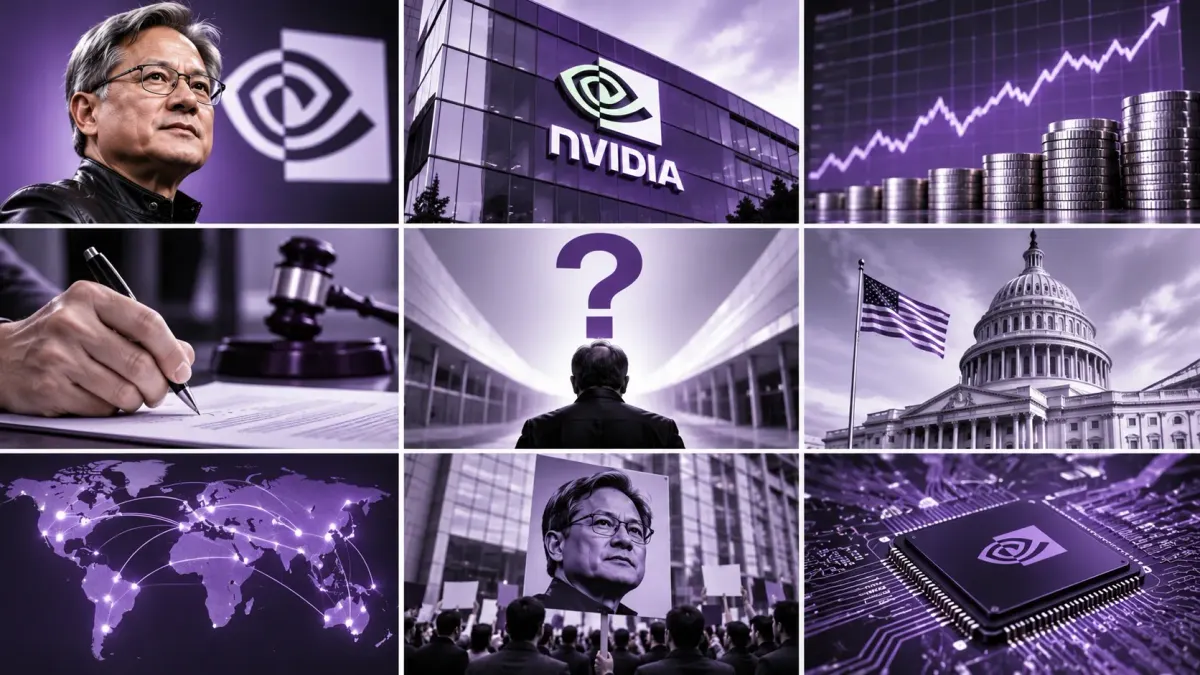
The Bright Recap
Nvidia reported third-quarter fiscal 2027 revenue of $115.8 billion, above the top of its own $108.0 billion forecast range, in its first results since Jensen Huang resigned. Interim chief executive Colette Kress guided fourth-quarter revenue to $130.0 billion, plus or minus 3%, with gross margin falling to between 71.0% and 72.0%.
The release also lists a new National Security and Export Control Oversight Committee of the board. Huang said on the same day that he would return if asked, while Reuters reported that the board is not weighing his return.
To know more about this topic, read our related articles:
- Nvidia's first board chair
- Nvidia as a financial counterparty
- Nvidia's bid for workplace AI
- Financial technology explained
- Cantica business reports
Bright Answers
Did Nvidia beat its own forecast in its first results without Jensen Huang?
Yes. Nvidia reported $115.8 billion in third-quarter revenue against guidance of $108.0 billion, plus or minus 2%, clearing the top of that range by $5.64 billion.
Is Jensen Huang returning as Nvidia's chief executive?
Not at present. Huang said on 17 November that he would return if the board asked him to, but three people familiar with the matter told Reuters the board is not considering it.
A founder’s worth to a company is usually argued in petitions and open letters, and Nvidia earnings on 17 November gave that argument its first set of numbers since Jensen Huang left. The chipmaker reported $115.8 billion in revenue for the quarter to 25 October, its first results since Huang resigned as chief executive, and on the same day its board created a committee to oversee national security and export controls. Huang also said that day that he would return if the board asked him to. The three facts, taken together, tell investors which question the board believes it has to answer first.
Meet Cantica, the Fin-Tech intelligence system for custom reports to strategise your next business move.
A quarter earned under Huang and reported by Kress
The quarter closed 17 days before Nvidia’s board accepted Huang’s resignation on 11 November, a decision The Bright Minded covered when the company named its first board chair. Huang led the company for the whole period, while the person presenting the results was Colette Kress, chief financial officer since 2013, who became interim chief executive and kept the finance role, according to the company’s announcement filed with the Securities and Exchange Commission (SEC). The board has said it will look at candidates from inside and outside Nvidia for the permanent job.
Revenue grew 103% year on year and 20% on the second quarter, with the Data Center business bringing in $107.6 billion, according to Nvidia’s third-quarter results. Net income under generally accepted accounting principles (GAAP) came to $65.3 billion, or $2.70 per diluted share. Nvidia had guided to $108.0 billion, plus or minus 2%, in its August outlook, so the result cleared the top of its own range by $5.64 billion, a Bright Minded calculation based on the two releases.
Kress called the start of Vera Rubin, Nvidia’s latest computing platform, explosive and said the product roadmap is on track. Vera Rubin NVL72 systems are already in operation at CoreWeave, Google Cloud, Microsoft Azure, Oracle Cloud Infrastructure and Nebius, according to the release. Huang’s name does not appear anywhere in it.
Kress’s first guidance carries a lower margin and an extra week
Nvidia expects fourth-quarter revenue of $130.0 billion, plus or minus 3%, while assuming no Data Center compute sales to China, and a GAAP gross margin between 71.0% and 72.0%, down from 74.8% in the third quarter. The release notes that the coming quarter includes one additional week. The midpoint implies 12.3% growth on the third quarter, a Bright Minded calculation, and the longer quarter accounts for part of that increase.
This guidance is the first forward-looking figure Nvidia has issued without Huang as chief executive, which makes it the first number the new leadership can be measured against. Nvidia’s reach extends past chipmaking, since it has become a financial counterparty in its own right, as The Bright Minded showed in its analysis of the guarantee behind an AI compute site in Ohio. Banks and fintech companies that build artificial intelligence (AI) products on Nvidia hardware rely on the same roadmap, including the desktop systems behind the company’s push for workplace AI.
The board answered with an export control committee
The results release names a new board body, the National Security and Export Control Oversight Committee, established on 17 November, without describing its members or mandate. The same document refers to the hunt for a permanent chief executive and to the investigation still being run by an independent committee of the board. The board opened that investigation on 8 November, after reports that foreign intelligence had targeted Huang, and said in a board statement at the time that it saw no reason to believe national security or company secrets had been compromised.
Treasury Secretary Scott Bessent framed the crisis in the same terms on 15 November, telling Fox News’ Sunday Morning Futures that Nvidia should look outside the company for its next chief executive. He gave the board and its outside counsel 10 days to provide answers. He also asked whether Nvidia had overlooked warning signs about shell companies in Singapore, citing press reports on where chips sold there ended up, and no finding on those claims has been published.
Congress has set its own timetable. Three House committee chairs requested a transcribed interview with Huang behind closed doors on 1 December, and Senate Banking Committee chair Tim Scott invited him to testify in public on 3 December, on a voluntary basis, Decrypt reported, citing the letters.
The case for bringing Huang back
Huang said in a statement posted on X on 17 November that he would be honoured to return if the board decided it served shareholders, employees, the company and the United States. He wrote that he had made serious mistakes in his personal life, that he took full ownership of them, and that he would cooperate with the board’s investigation.
Brad Gerstner of Altimeter Capital and Gavin Baker of Atreides Management, two major Nvidia investors, wrote to the board on 13 November asking it to leave Huang’s return among the options, without calling for his immediate reinstatement. A public petition backing him has gathered more than 180,200 signatures, Reuters reported, with Elon Musk, Replit’s Amjad Masad and Epic Games’ Tim Sweeney among the signatories. Over 8,800 of them say they currently work at Nvidia and over 94,000 say they own its shares, and the campaign’s site states that nobody has independently checked those claims.
Independent technology researcher Richard Windsor thinks shareholders would be better off with Huang back in the end because of his ties to customers and suppliers, according to Reuters. President Donald Trump has said he would have no objection to Huang’s reinstatement, according to Newsweek.
The case against it
Nvidia’s board is not considering Huang’s return, three people familiar with the matter told Reuters. Windsor, the same researcher who favours a return, expects large institutional investors to resist it until the investigations are resolved, given the legal risk involved. One unnamed institutional investor told Reuters it would be wary, pointing to Apple and Microsoft, which both did well after their visionary chief executives left.
Charles Elson, former director of the University of Delaware’s Weinberg Center for Corporate Governance, argued that reinstating Huang would fix none of the company’s problems, according to Newsweek. His reasons include the national security allegations, the prospect of shareholder lawsuits, the question of whether the board was properly informed and the risk of Nvidia relying too heavily on one executive. Dan Ives of Yorkville Ives & Co., a prominent Nvidia bull, told the same outlet that the damage to Huang’s reputation rules out a comeback and that an outside candidate would be his preference.
The two camps rarely argue about the same thing. Supporters point to vision, relationships and the scale of what Huang built, while opponents point to export compliance, legal exposure and oversight, and none of the opponents cited here gives the company’s performance as a reason.
A record quarter shows that Nvidia can sell chips without Huang in the room, and the committee the board created on the same day shows that his future depends on a separate question, whether anyone at the top was watching where those chips went.
Editor’s note
Every piece goes through careful verification, but mistakes can happen. Readers who spot an error or have additional information can write to rosalia@thebrightminded.com.