Tether Gold Shariah Certification: The Asset Clears, the Transaction Is Still Being Written
Tether Gold received Shariah certification from Amanah Advisors on 27 July 2026. Guidance on buying XAUT through secondary markets is still being developed.
The Bright Recap
Tether announced on 27 July 2026 that Tether Gold (XAU₮) has received a Shariah compliance certification from Amanah Advisors, led by Mufti Faraz Adam. The certification confirms that the issuer meets requirements covering ownership of the metal, verifiable backing, absence of interest, absence of leverage and speculative derivatives, and disclosure of reserves.
Each token stands for a troy fine ounce on a London Good Delivery bar in Swiss custody, traceable by serial number, purity and weight, and exchangeable for the metal itself. Amanah Advisors will continue developing guidance with Tether, particularly for tokens acquired through secondary markets. The announcement follows Tether Gold's recognition as an Accepted Spot Commodity in Abu Dhabi Global Market on 20 July.
To know more about this topic, read our related articles:
- Why the obstacle was never technical
- Settlement timing in tokenised markets
- Why savers choose a different asset
- Where banks reach the fewest people
- Blockchain explained
- Financial technology explained
Bright Answers
Is Tether Gold now approved for use by Islamic banks?
The certification comes from one advisory firm and confirms that the product structure meets stated Shariah requirements. Islamic financial institutions each maintain their own Shariah supervisory board and decide independently whether to adopt a product, so the certification is an input to those decisions rather than a general approval.
Why do secondary market purchases need separate guidance?
Gold is a ribawi commodity, meaning its exchange carries requirements of immediate settlement and clear allocated ownership. The industry benchmark, AAOIFI Shariah Standard No. 57, treats that condition as met by settlement on the same day or by a document naming the bar owned, which is straightforward when buying from the issuer and less so when buying from another holder on an exchange.
A certificate can settle what something is without settling how you are permitted to acquire it. Tether announced on 27 July that Tether Gold (XAU₮) has received a Shariah compliance certification from Amanah Advisors, the advisory firm led by Mufti Faraz Adam, confirming that the product satisfies core principles of Islamic finance.
The announcement is being read as a door opening onto Islamic banks, takaful providers and halal savings products across the Gulf, South Asia and parts of Africa. Buried in the same release is the sentence describing the work still outstanding, which concerns how the token is bought rather than what it holds.
This story was Elevated by Cantica's Purgatorio.
Cantica is the Fin-Tech intelligence system behind The Bright Minded.
What the certification actually confirms
The obstacle to Islamic finance adopting tokenised assets was never the software, in the same way that Wall Street's difficulty with blockchain has been a matter of legal and institutional plumbing rather than engineering. The certification applies to TG Commodities as issuer and rests on five findings: that the metal is genuinely owned, that the backing can be checked, that no interest arises anywhere in the structure, that neither leverage nor speculative derivatives are involved, and that the composition of reserves is disclosed. A product offering price exposure without allocated metal behind it could not have satisfied those tests.
Each token stands for a troy fine ounce sitting on a London Good Delivery bar in Swiss custody, with the specific bar traceable by serial number, purity and weight, and the holder able to ask for the metal itself. Those design decisions were taken years before this certificate existed, which is the reason the certificate was available at all. Allocation, redeemability and the absence of an interest mechanism are structural properties of a product, and either it has them or it does not.
What Cantica's Purgatorio elevated here
Cantica is the Fin-Tech intelligence system running behind this publication, and Purgatorio is the layer where it forms a view. Every event it surfaces is either elevated or condemned, and the test it applies is the effect on people rather than the size of the transaction or the standing of the company behind it. It elevated this one on the reading that Muslim savers and Islamic financial institutions can hold digital gold without religious or ethical compromise, lowering a barrier to entry in markets that Islamic finance has served thinly.
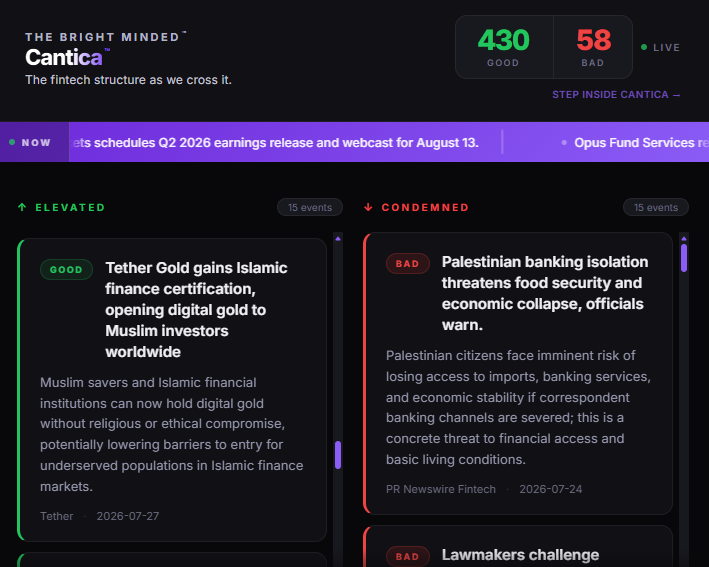
We agree on who stands to benefit and would qualify the timing. What falls today is the barrier facing institutions deciding whether to examine the product at all. The barrier facing a saver falls later, once a bank they already use has put it on the shelf and the guidance covering secondary purchases exists to govern how they buy it. The judgement is right about direction and early about date.
Why secondary markets need their own guidance
Gold occupies a specific category in Islamic jurisprudence as a ribawi commodity, which brings requirements of immediate settlement and clearly allocated ownership whenever it changes hands. The benchmark the industry works to is Shariah Standard No. 57, issued in 2016 by the Accounting and Auditing Organisation for Islamic Financial Institutions (AAOIFI) with the World Gold Council. It accepts possession that is constructive rather than physical, on condition that the metal is allocated in full, and it treats that condition as met either by settlement on the same day or by a document naming the bar the buyer owns. A purchase from the issuer fits without difficulty, since the buyer ends up holding identified metal.
A purchase from another holder on an exchange is a different transaction. This is why the release states that Amanah Advisors will keep working with Tether on practical guidelines and governance frameworks, with particular attention to acquisitions through secondary markets. Anyone who has followed how settlement timing shapes tokenised markets will recognise the shape of the problem, which is that possession and payment can move at different speeds. The certification answers the question about the asset, and the question about the transaction is being written now.
The Abu Dhabi step that came a week earlier
Seven days before the Shariah certificate, Tether announced that Tether Gold had been recognised as an Accepted Spot Commodity in Abu Dhabi Global Market, which lets firms operating there offer it where their own permissions allow. The order of the two announcements describes how an Islamic finance desk onboards anything. One establishes what a regulated firm is permitted to offer, and the other addresses what its Shariah supervisory board will let it offer. The World Gold Council records that the United Arab Emirates made AAOIFI standards mandatory in 2018.
What it changes, and what it does not
For savers in markets where interest-bearing deposits are religiously unavailable, gold has long been the instrument that fills the gap, and the practical obstacles have been storage, authentication and the cost of a whole bar or coin. Allocated ownership in a Swiss vault with a redemption right removes several of those, which matters to people who have been choosing between a jeweller and nothing at all. Savers reaching for assets outside their domestic banking system is a pattern we have documented in households choosing a different store of value and in the markets where banks reach fewest people.
The limits deserve equal precision. Islamic finance has no single global authority, and each institution's own Shariah supervisory board rules for itself, so one advisory firm's certificate persuades rather than binds. The token stays exposed to the gold price, blockchain infrastructure carries operational risks of its own, and any financial technology product resting on a single issuer concentrates counterparty exposure in that issuer. None of that is a criticism of the certificate, which addresses a narrower question and answers it.
The certification tells an Islamic bank what Tether Gold is. Whether its own board accepts how a client came to hold it is a separate question, and each institution will answer that one for itself.
Editor's note
Every piece goes through careful verification, but mistakes can happen. Readers who spot an error or have additional information can write to rosalia@thebrightminded.com.