
Digital Dollarization: Why Millions Are Choosing Stablecoins Over Their Own Currency
In Brazil, 90% of crypto activity flows through stablecoins. Here is why millions across emerging markets are choosing digital dollars over their own currency.
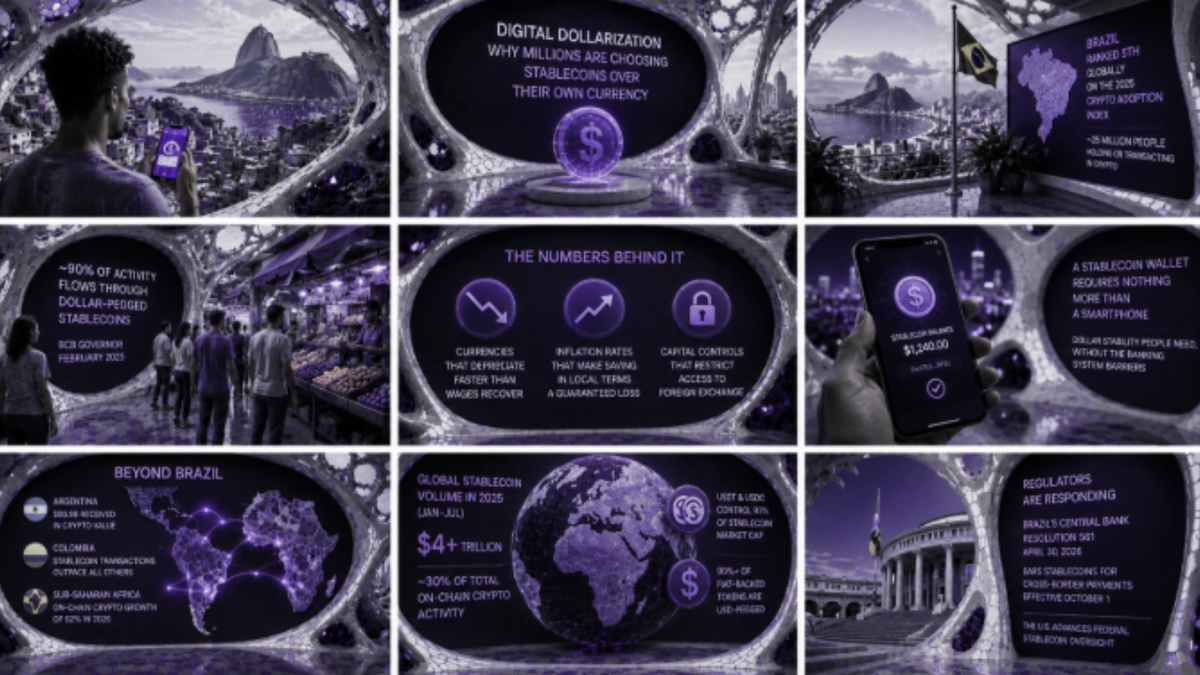
A currency earns trust by holding its value. When it fails that, people find something that will. Brazil ranked fifth globally on the 2025 Chainalysis Global Crypto Adoption Index, with roughly 25 million people holding or transacting in cryptocurrency. The country's central bank governor stated in February 2025 that approximately 90% of that activity flows through dollar-pegged stablecoins.
This is digital dollarization. The term describes what happens when a population substitutes a foreign currency for its own because their national currency fails them as a store of value. Stablecoins have given millions of people access to that substitution through blockchain payment rails that require nothing more than a smartphone. Brazil is the clearest proof: it received $318.8 billion in crypto value between July 2024 and June 2025, nearly a third of all Latin American crypto activity, and the fintech market that generated it runs almost entirely on stablecoins.
The numbers behind it
Chainalysis identifies three structural pressures driving the trend across Latin America: currencies that depreciate faster than wages recover, inflation rates that make saving in local terms a mathematical loss, and capital controls that restrict access to foreign exchange. The BCB governor noted at a Bank for International Settlements event in February 2025 that most of those flows are used to purchase goods and services from abroad.
Dollar savings accounts typically require documentation, minimum balances, and banking relationships that a large share of the population does not hold, while a stablecoin wallet requires nothing more than a smartphone. The gap between the dollar stability people need and the dollar stability their banking system provides is where stablecoins built their largest audience.
Beyond Brazil
The pattern repeats across the region. Argentina received $93.9 billion in crypto value in the same 12-month window, ranking second in Latin America, with stablecoin demand driven by inflation that exceeded 100% annually for two consecutive years per Argentina's national statistics institute, INDEC.
In exchange order books across the same period, stablecoin transactions outpaced all other crypto categories combined for Argentine pesos, Colombian pesos, and Brazilian reais, per Chainalysis order book data. Sub-Saharan Africa recorded on-chain crypto growth of 52% in 2025, with stablecoins increasingly central to cross-border remittances in markets where dollar accounts remain structurally inaccessible.
TRM Labs data for 2025 puts global stablecoin volume at over $4 trillion in the first seven months of the year, representing roughly 30% of total on-chain crypto activity worldwide. USDT and USDC together control 93% of total stablecoin market capitalisation, and more than nine in ten fiat-backed tokens carry a US dollar peg. The dollar is winning an adoption contest it did not officially enter.
What regulators are responding to
The volume is now large enough to register as a monetary policy concern. BCB Governor Galipolo flagged stablecoin opacity as a taxation and anti-money laundering challenge at a BIS event in February 2025, noting that the pattern creates an opaque channel for cross-border value transfer.
On April 30, 2026, Brazil's central bank published Resolution 561, barring electronic foreign exchange providers from using stablecoins to settle cross-border payments effective October 1, while leaving crypto trading and ownership untouched. The United States is advancing federal stablecoin oversight through legislation that will determine how dollar-pegged tokens are issued and supervised globally.
Brazil's central bank began treating stablecoin flows as a foreign exchange policy problem in 2026. That response confirmed something users had understood far longer: the dollar is the currency millions of people actually want, and the blockchain got there before the banking system did.
Editor's note
Every piece published on The Bright Minded goes through careful verification, but mistakes can happen. If you spot an error, have additional information, or want to flag anything, write to rosalia@thebrightminded.com.