DTCC Tokenization Service 2026: The $114 Trillion Settlement Machine Is Moving to Blockchain
DTCC announced its tokenization service launches in October 2026. Here is what the $114 trillion settlement machine changes, and why it matters.
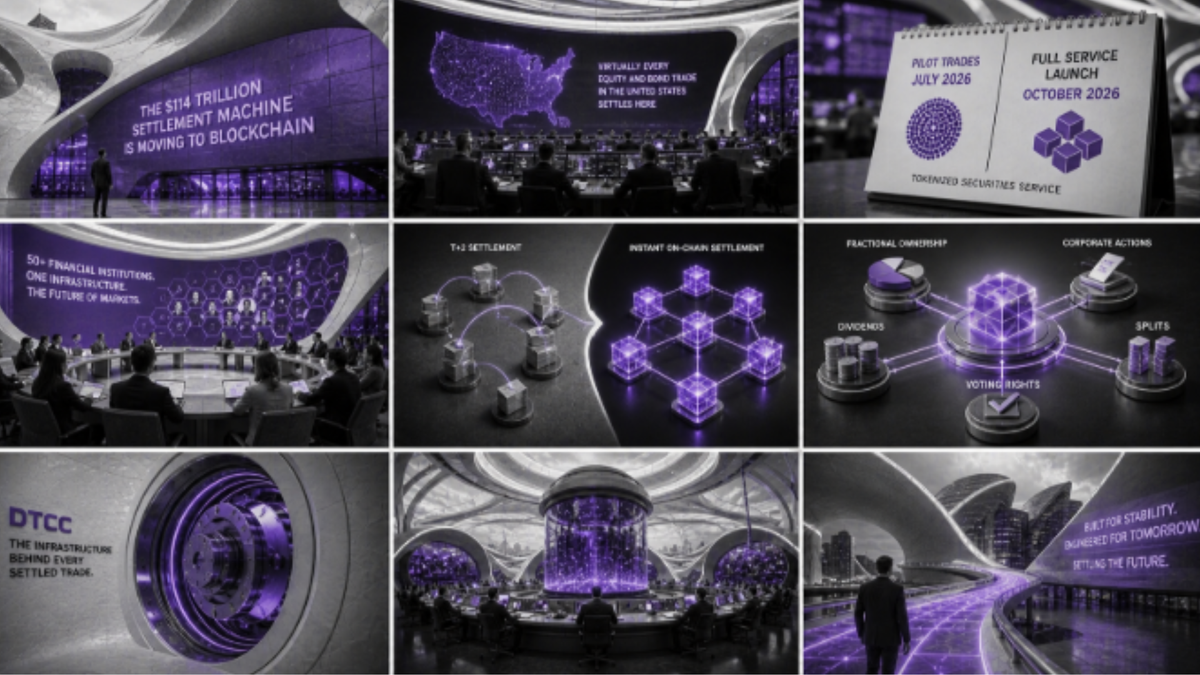
The two-day gap between buying a stock and actually owning it has a name: T+2 settlement. Behind it sits an institution most investors have never heard of, the Depository Trust & Clearing Corporation (DTCC), which processes the settlement of virtually every equity and bond trade in the United States and holds $114 trillion in custodied assets. On May 4, 2026, DTCC announced it is rebuilding that infrastructure on blockchain.
Limited production trades of tokenized securities will begin in July 2026 under DTCC's Depository Trust Company (DTC) division, with a full service launch following in October. The scope covers Russell 1000 constituents, major exchange-traded funds, and U.S. Treasury bills, bonds, and notes, the most liquid instruments in the American financial system.
The 50 firms that shaped the service
More than 50 financial institutions contributed to the industry working group that designed the service, spanning the full width of the sector from traditional banks to fintech and crypto-native platforms. BlackRock, Goldman Sachs, Bank of America, and Citadel Securities participated alongside Circle, Coinbase, and Kraken.
The regulatory foundation was established in December 2025, when the Securities and Exchange Commission (SEC) issued a No-Action Letter authorizing DTC to offer tokenization services for a defined set of assets under a three-year framework. That approval is what makes the July pilot legally possible.
What changes when settlement happens instantly
T+2 settlement exists because moving ownership requires updating records across multiple custodians, exchanging cash and assets through intermediaries, and reconciling positions that no single party controls. Blockchain-based settlement can compress this significantly, because ownership transfer can be written directly into the token rather than confirmed through a chain of intermediaries. Whether DTCC's service delivers that compression from launch, or in stages, has not been specified.
The practical consequences extend further than speed. Fractional ownership becomes structurally simpler when assets are represented as tokens, and corporate actions, including dividends, voting rights, and stock splits, can attach directly to the token rather than flowing through a layer of intermediaries. DTCC confirmed that tokenized assets will preserve the custody rights and investor protections that currently apply to the same securities held in conventional form.
The infrastructure nobody sees
DTCC operates at the exact point where financial ownership becomes real. Retail brokerages process trades; DTCC is the institution confirming that each one settled. Its invisibility is intentional. Infrastructure is noticed only when it breaks, and DTCC's has not broken in a way that forced change.
Editor's note
Every piece published on The Bright Minded goes through careful verification, but mistakes can happen. If you spot an error, have additional information, or want to flag anything, write to rosalia@thebrightminded.com.