
Jensen Huang Reinstated as Nvidia CEO Under an Independent Chair
Jensen Huang reinstated as Nvidia CEO after the board ruled out his return, with Harvey Jones kept as chair and a security committee of independent directors.
The Bright Recap
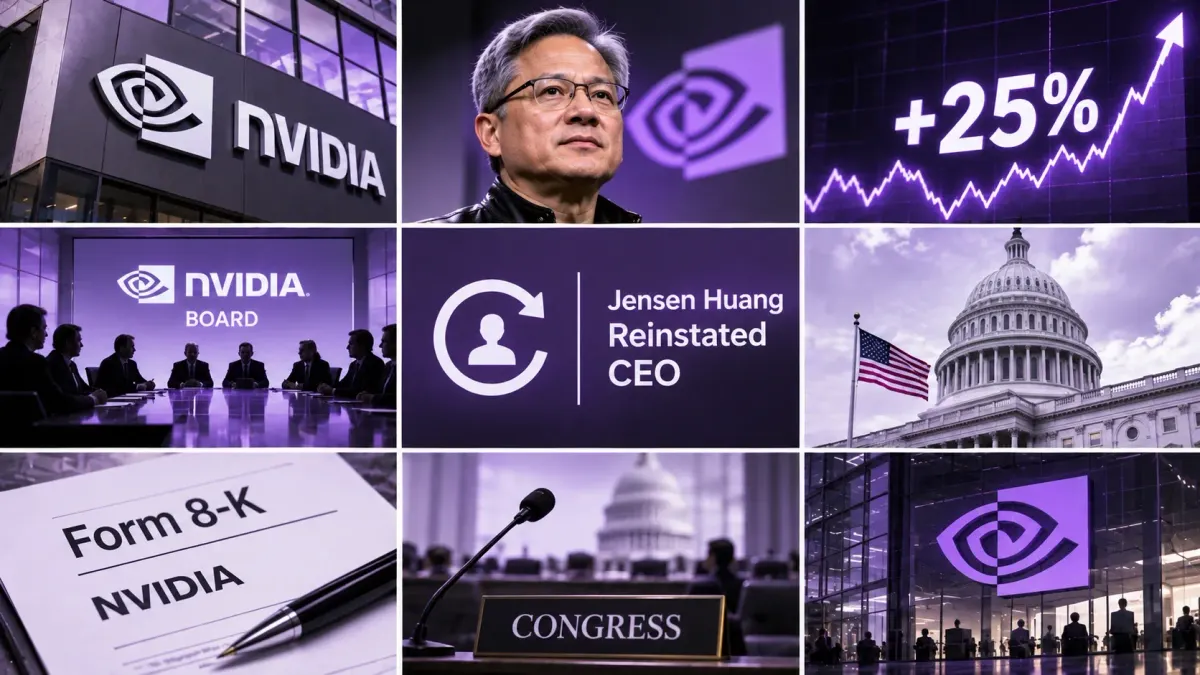
Jensen Huang is again Nvidia's president, chief executive and director, after a unanimous board vote announced on 23 November 2026. Harvey C. Jones remains board chair, and Colette Kress continues as chief financial officer after serving as interim chief executive.
The board cited input from senior US government officials that his return poses no national security risk, while its own independent investigation is still open. A National Security and Export Control Committee of independent directors stays in place, and Nvidia is hiring a chief compliance officer who will report to a board committee.
To know more about this topic, read our related articles:
- Nvidia's first board chair
- Nvidia's results without Huang
- The call that pulled Fable 5
- Tokenised Nvidia shares on Binance
- Nvidia as a financial counterparty
- Financial technology explained
- Cantica business reports
Bright Answers
Why did Nvidia reinstate Jensen Huang as CEO?
The board said discussions and meetings with Huang left it satisfied with his candour and ability to lead, and that input from senior US government officials gave it confidence his return poses no national security risk.
Is the investigation into Jensen Huang over?
No. A committee of independent directors, advised by independent counsel, is still investigating reports that Huang was targeted by a foreign intelligence effort, and the board says it will proceed to its conclusion.
Nvidia has reinstated Jensen Huang as chief executive, reversing the position its board chair gave investors on 17 November, when he said the directors did not intend to bring him back. The board voted unanimously to return Huang to his roles as president, chief executive and director with immediate effect, and announced the decision on 23 November.
Its stated reasons are a series of discussions and meetings with Huang that left it satisfied with his candour and his ability to lead, and input from senior levels of the US government that gives it confidence his return poses no national security risk. Harvey C. Jones stays on as chair, which means the founder comes back to a board he no longer leads.
Meet Cantica, the Fin-Tech intelligence system for custom reports to strategise your next business move.
What the board decided on 23 November
Nvidia announced Huang's resignation on 12 November, and on the same day named chief financial officer Colette Kress interim chief executive and Jones its first board chair. The resignation came during a board investigation, opened on 8 November, into reports that Huang had been the target of a foreign intelligence effort.
The vote to reverse that outcome was unanimous, according to the company's announcement. Jones said the board considers Huang the right person to lead the company and thanked Kress for her service as interim chief executive, a role she held alongside her continuing job as chief financial officer. Huang said he takes the job back with humility and a renewed commitment, and that he fully supports the investigation and will cooperate with it.
Nvidia also reported the decision to the Securities and Exchange Commission (SEC) in a Form 8-K, the filing listed companies use to disclose major events. The filing gives 22 November as the date of the event and states that Kress continues as executive vice president and chief financial officer. It does not set out any compensation terms or new agreements for Huang.
From a firm no on the earnings call to a unanimous yes
The board's position was explicit last week. On 17 November Huang wrote on X that he would return if the board asked him to, and later that day Jones opened the third-quarter earnings call by saying the directors had unanimously accepted the resignation and did not intend to reinstate him. Our earnings day coverage reported the same position, citing three people familiar with the matter who told Reuters a return was not under consideration.
Pressure from Washington ran in two directions throughout this period. President Donald Trump said on 16 November that he would not mind seeing Huang reinstated, and on 20 November he said he wanted Huang to make a big apology and be given a second chance, adding that he had discussed the case with Chinese President Xi Jinping. Treasury Secretary Scott Bessent had taken the opposite line on 15 November, saying the board should look outside the company for a new chief executive and that Nvidia needed a dramatic shake-up.
The reinstatement matches what Trump asked for and goes against the outside appointment Bessent argued for. Nvidia's release does not name the government officials who gave input, and it does not say what information they reviewed before the board concluded that Huang's return carries no national security risk.
The board's investigation has not reported yet
The inquiry led by independent directors continues, and the release says it will proceed to its conclusion. On 10 November those directors said they had retained independent counsel, naming Joon H. Kim, a former acting US Attorney for the Southern District of New York, and his firm Wachtell, Lipton, Rosen & Katz. The board's 8 November statement had said it had no reason to believe national security or Nvidia's trade secrets had been compromised, while adding that the inquiry would review all relevant information.
The board has reappointed Huang before its own counsel has published any findings, and it rests the national security question on the government's input rather than on its investigation. Adverse findings would leave the directors judging a chief executive they have just reappointed unanimously, while a clean report would confirm their vote.
Congress is also still asking questions. Huang had been scheduled, ahead of the reinstatement, to sit for a closed-door transcribed interview on 1 December with the House Foreign Affairs Committee, the House Select Committee on the Chinese Communist Party and the House Intelligence Committee, while the Senate Banking Committee had invited him to testify publicly on 3 December. The release does not mention either date.
What stays from the period without him
The structures the board built in Huang's absence stay. The Bright Minded wrote on 12 November, when Nvidia appointed a chair in place of its independent lead director, that the leadership Huang had concentrated was now split. The reinstatement keeps that split, since Huang returns as chief executive and director while Jones keeps the chair.
The national security committee announced on 17 November now has a defined role. Our earnings piece noted that the company had published its creation without describing its members or mandate. The new release says the National Security and Export Control Committee is made up solely of independent directors, oversees trade compliance and national security risks, and is engaging national security counsel.
Nvidia is also searching for a chief compliance officer, who will report to the board's Nominating and Corporate Governance Committee. Our 17 November piece reported the committee's creation alongside Bessent's claims about shell companies in Singapore, on which no findings had been published. The company has now said which parts of the board will oversee trade compliance, and the compliance role it is filling will answer to a board committee.
A decision taken on a government signal
The Bright Minded has covered a government signal deciding a company's fate before. In June, our reporting traced how a call from Amazon's chief executive to the Treasury Secretary preceded a Commerce Department letter, a government order that led Anthropic to take its Fable 5 model offline for all users before any independent review of the claim behind it. Nvidia's case runs in the opposite direction, because here the government input helped a company restore its leader.
The common element is that the assessment itself stays private. In both cases the people affected, from customers to shareholders, learned the outcome without seeing the evidence the government relied on.
Who felt the share price move
Nvidia shares jumped more than 25% in premarket trading after the announcement, according to Reuters. The audience for that move reaches beyond institutional funds, since our coverage of Binance's tokenised stocks showed that 320 million registered users outside the US can buy fractional Nvidia shares from $5. That kind of fintech access means a decision taken by Nvidia's board also reaches retail investors who hold tokenised Nvidia in a crypto wallet.
The decision matters to Nvidia's financial partners as well. The company acts as a financial counterparty in deals such as its OpenAI backstop for SB Energy's AI campus in Pike County, Ohio, where it guarantees part of the lease and power payments if OpenAI, the tenant, defaults. The parties on the other side of those guarantees have a direct interest in who runs the guarantor.
Huang is back in the job he first took when he co-founded Nvidia in 1993, and the board he answers to now has an independent chair, a national security committee with its own counsel and a chief compliance officer who will report to a board committee. Nvidia's board brought back its founder and kept every check it created while he was away, so the company's next real test is how those checks handle the investigation's findings.
Editor’s note
Every piece goes through careful verification, but mistakes can happen. Readers who spot an error or have additional information can write to rosalia@thebrightminded.com.