
NVIDIA's OpenAI Backstop in Ohio: How a Chipmaker Turns AI Compute Into an Asset Class
NVIDIA is guaranteeing OpenAI's lease at the PORTS-Pike AI campus in Ohio. The residual-value backstop is how a chipmaker turns compute into an asset class.
The Bright Recap
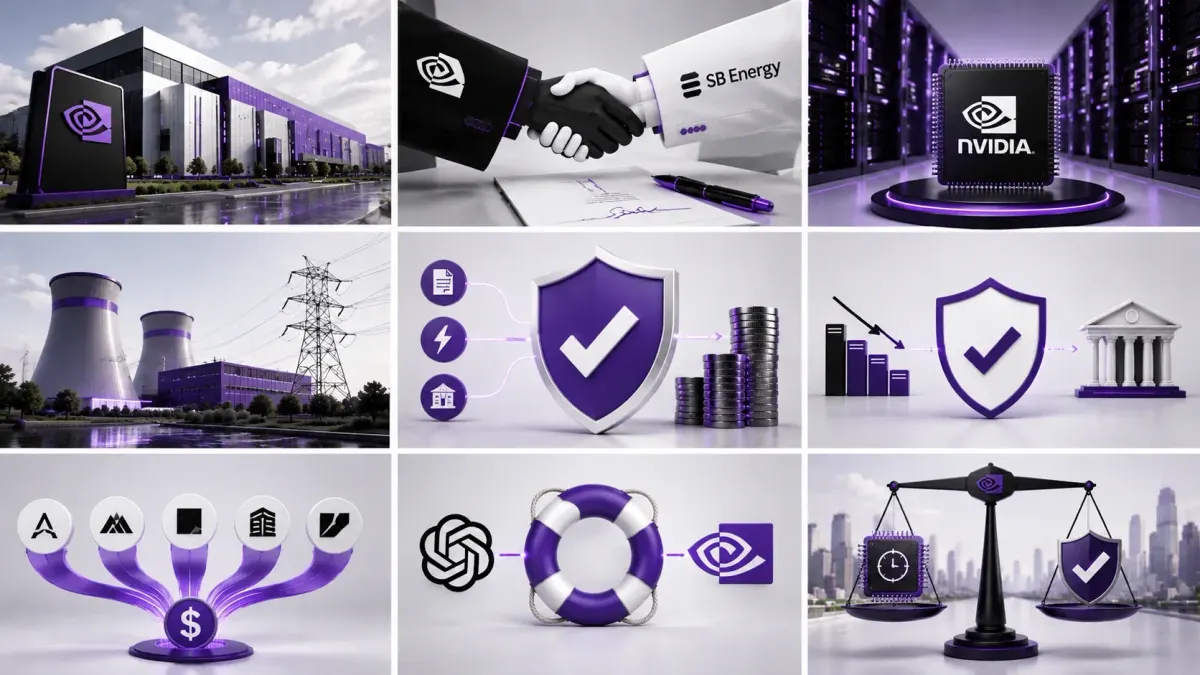
NVIDIA agreed on 17 August 2026 to provide credit support for SB Energy's PORTS-Pike AI campus in Ohio, guaranteeing lease and power payments and part of the finished site's value if OpenAI defaults, and taking a $1.5 billion stake in the developer.
The backstop is a residual-value guarantee, the instrument that makes a fast-depreciating asset fundable by outside investors. Paired with NVIDIA's separate $500 billion financing platforms, it turns the AI buildout into an infrastructure asset class, resting on one company's read of its own obsolescence.
To know more about this topic, read our related articles:
- Inside a 2-gigawatt AI campus with its own power plant
- Cantica, the Fin-Tech intelligence system for custom business reports to strategise your next move
- OpenAI's confidential S-1 filing
- Financial technology explained
Bright Answers
What did NVIDIA agree to at the PORTS-Pike campus in Ohio?
NVIDIA agreed to be the exclusive compute provider at SB Energy's PORTS-Pike campus and to provide credit support for the buildout, backstopping lease and power payments and guaranteeing part of the finished site's value if OpenAI, the 20-year tenant, defaults. It is also investing $1.5 billion in SB Energy.
What is a residual-value guarantee in the NVIDIA OpenAI deal?
It is a promise that a depreciating asset will be worth a set amount later, the same instrument used in car and aircraft leasing. By guaranteeing the resale value of the compute, NVIDIA makes the campus fundable by outside investors who could not otherwise hold a speculative technology bet.
The most valuable company in the world just committed to a data centre in Ohio, and the decisive commitment is a financial one. NVIDIA agreed on 17 August 2026 to stand behind the money for SB Energy's PORTS-Pike campus in Pike County, guaranteeing lease and power payments and part of the finished building's value if the tenant walks away. The tenant is OpenAI, on a 20-year lease, and NVIDIA will also be the only compute running inside.
Underneath the gigawatts and the job numbers, a single instrument is doing the heavy lifting. NVIDIA is underwriting the resale value of its own product so that other people will pay to build with it.
The scarce input is no longer the chip
The AI story has been a hunt for graphics chips, and this deal is about everything around them. Land, power and the shell of a building, the trio the industry now shortens to LPS, are the scarce inputs at PORTS-Pike. SB Energy, the developer, calls itself power-first and treats electricity as the real bottleneck, which is why the campus pairs at least 10 gigawatts of new power generation with the AI capacity it feeds. We saw the same logic when a two-gigawatt campus arrived with its own power plant attached.
NVIDIA's real product in Ohio is a guarantee
NVIDIA's commitment here is financial before it is technical. It will provide credit support on the buildout to secure an initial 4.25 gigawatts of computing capacity, with an option on the rest, and it is taking a $1.5 billion stake in the developer, SB Energy. Fortune reports that the arrangement covers some of the lease and power bills and promises to make good on part of the finished campus's value if OpenAI defaults, a design that keeps NVIDIA's own exposure contained. The company is promising, in effect, that if the tenant fails the building and its machines will still be worth something.
A guarantee is how a depreciating asset becomes bankable
This instrument is old, even if the setting is new. It is a common practice among manufacturers to promise buyers a floor on resale value, because a lender will fund an asset it can price at the end of the loan. A stack of graphics chips loses value quickly and would frighten a bank on its own, and financial technology has a standard fix, which is to wrap a hard asset in a guarantee that makes it lendable. NVIDIA is doing that for compute, turning a fast-depreciating campus into something a cautious investor can hold.
The guarantee exists to bring in outside money
The reason to build this machinery is visible in a second NVIDIA move from the same month. On 10 August the company set up financing platforms with Apollo, BlackRock, Blackstone, Brookfield, Goldman Sachs and KKR to pull in more than $500 billion of third-party capital for AI infrastructure. Guarantees are what let pension funds and insurers, which cannot touch speculative technology bets, treat compute as conventional infrastructure debt. The PORTS-Pike backstop and the financing platforms are two halves of one project, which is to convert the AI buildout into an asset class the wider market will fund.
Why the tenant needs a backstop at all
The guarantee only makes sense because of who is signing the lease. OpenAI is the customer for all 8 gigawatts of capacity, and it remains a heavily lossmaking company that has filed confidentially for a listing while saying a float can wait. A 20-year commitment from a firm at that stage is not something a lender treats as safe, and the tenant's weakness is exactly what the guarantee is built to cover. NVIDIA, the supplier with the clearest view of future demand, is vouching for the customer so the customer can keep buying.
What actually holds this up
None of this is reckless on its face, and the fear that the chips would be stranded is weak, because a trained cluster has buyers well beyond OpenAI. The real load-bearing assumption sits with the guarantor. NVIDIA is underwriting the future value of hardware whose value it alone controls, since it decides when the next generation ships and makes the last one worth less.
NVIDIA has made itself the bank, the insurer and the supplier of the AI buildout inside a single campus, and the arrangement is rational and carefully structured. It rests on one company's willingness to be honest about when it will make its own products obsolete. That is a great deal of trust to place in a single balance sheet, and it is worth understanding before it is worth judging.
Editor's note
Every piece goes through careful verification, but mistakes can happen. Readers who spot an error or have additional information can write to rosalia@thebrightminded.com.