Claude Fable 5.1 and Mythos 5.1: Anthropic Cut the One AI Cost Finance Actually Pays
Anthropic released Claude Fable 5.1 and Mythos 5.1 on 1 September 2026, cutting cache reads by 75% to $0.25 per million tokens while token pricing held.
The Bright Recap
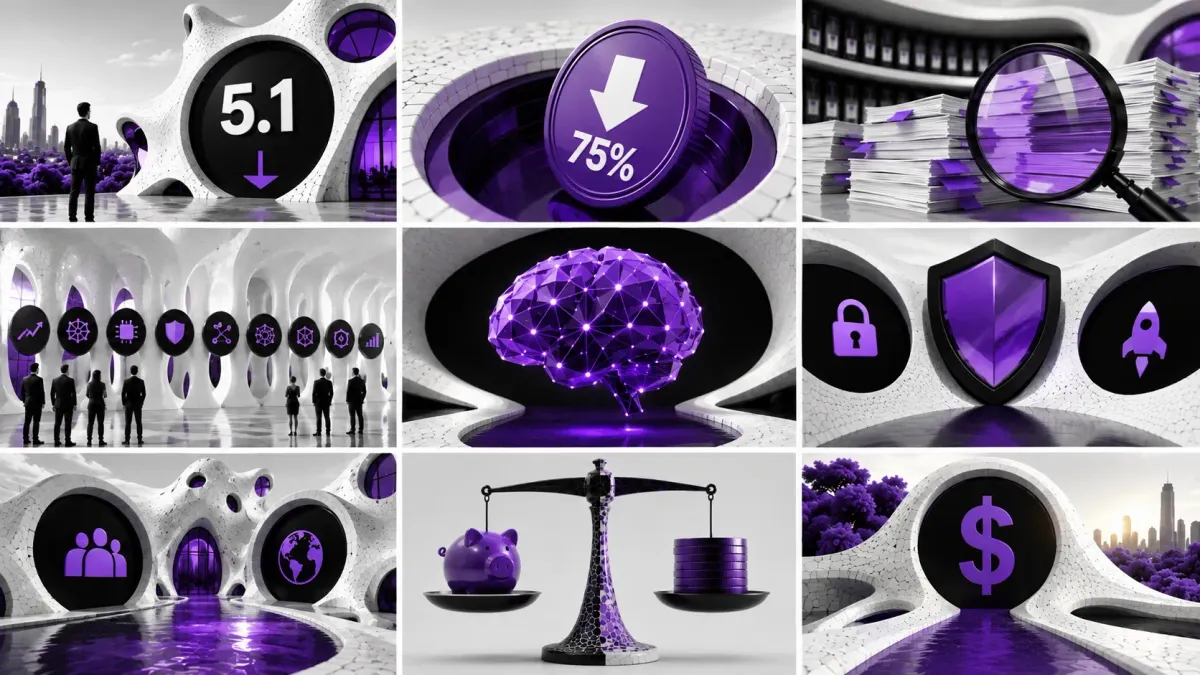
Anthropic released Claude Fable 5.1 and Claude Mythos 5.1 on 1 September 2026. Token prices stayed at $10 per million in and $50 per million out. One charge moved: cache reads, billed when the model reads context it has already processed, now cost $0.25 per million tokens, a drop of 75%.
Anthropic estimates the change saves around 25% on a typical workload and up to 45% on heavily agentic work. By our count, nine of the twenty-two early-access partners it published are trading firms, financial platforms or fintech infrastructure, among them Jane Street Capital, Millennium, Block, Ramp, Plaid and Samaya.
To know more about this topic, read our related articles:
- AI's hidden cost problem
- The Fin-Tech intelligence system behind this publication
- Why flagged requests fall back to Opus
- How Mythos came back restricted
- Financial technology explained
Bright Answers
How much cheaper is Claude Fable 5.1 than Fable 5?
Anthropic estimates around 25% cheaper for a typical workload and up to 45% for heavily agentic work. Headline pricing is unchanged, and the entire saving comes from cache reads falling 75% to $0.25 per million tokens.
Can anyone use Claude Mythos 5.1?
No. Mythos 5.1 is the same underlying model as Fable 5.1 with more permissive safeguards, and it is reachable only through the Cyber Verification Program and the Life Sciences Verification Program, currently open to US-based organisations.
Claude Fable 5.1 pricing changed in exactly one line, and that line is where financial firms spend most of their money. Anthropic released Fable 5.1 and Claude Mythos 5.1 on 1 September 2026 and left the input and output token prices untouched. The charge for cache reads, meaning context the model has already processed and reads again, fell by 75% to $0.25 per million tokens. Financial document work is almost entirely re-reading.
The only price that moved
Headline pricing holds at $10 per million input tokens and $50 per million output tokens. Anthropic estimates the total saving at around 25% for a typical workload and as much as 45% for heavily agentic work, using default effort settings over a four-week sample of August 2026 usage. The saving concentrates there because repeated reads dominate the bill on tasks that hold long context and call many tools. A team asking a hundred unrelated questions will barely feel it, and a team running an agent across the same credit agreement all afternoon will feel close to half, the sort of asymmetry that makes AI's hidden cost problem legible on an invoice.
Who Anthropic asked to prove it
Anthropic published assessments from twenty-two early-access partners. Nine of them are trading firms, financial platforms, or the financial technology plumbing beneath them: Jane Street Capital, Millennium, IMC, Block, Ramp, Plaid, Rogo, Samaya and Hebbia. That tally is our own count from the companies named on the page.
A crash appearing roughly once in a million runs had gone unexplained at Millennium for four to five years. The launch announcement reports that Fable 5.1 located the fault inside a third-party library, which it took apart and compared against the crash dump. Samaya put the model at 55.9% on its FrontierFinance rubric against 49.2% for Fable 5, attributing the difference to Fable 5.1 pulling numbers from the original earnings call rather than from articles written about it. Rogo measured identical accuracy to Fable 5 on its own finance test set at a 20% lower token count.
What the safeguards still refuse
Fable 5.1 and Mythos 5.1 are the same underlying model separated by safeguard settings. Claude Code users should see roughly 60% fewer safeguard interruptions in an average session than under the settings Fable 5 shipped with, and Fable 5.1 is now permitted to find software vulnerabilities without building working attacks against them. Three categories still route to Opus: penetration testing, exploit generation and binary-based vulnerability scanning.
Who gets Mythos 5.1
Mythos 5.1 reaches vetted cyberdefenders and life scientists through the Cyber Verification Program (CVP) and the Life Sciences Verification Program (LSVP), the second of which Anthropic built with the US government. Only US-based organisations can enrol at present, which extends the restricted return that applied to Mythos 5, and Anthropic says it is working to widen eligibility.
Anthropic ran its cyber evaluations with the safeguards switched off and records in the system card the strongest cyber capability of any model it has released, still inside the lower risk band of its Frontier Compliance Framework. Mythos 5.1 scored 60.9% on Terminal-Bench 4.0 against 55.8% for Fable 5.1, a gap Anthropic attributes to its older cyber safeguards and expects to shrink.
Anthropic's own figures put Fable 5.1 at 52.6% on Terminal-Bench-Science 0.1, against 24.7% for Fable 5 and 29.0% for Opus 5, with a standard error the company gives as 3.5 to 4.5 points and no independent score yet published for the new model. The price that fell is the one finance actually pays, the cost of reading the same document again rather than the cost of asking something new.
Editor's note
Every piece published on The Bright Minded goes through careful verification, but mistakes can happen. If you spot an error, have additional information, or want to flag anything, write to rosalia@thebrightminded.com.