Claude Opus 5 Fallback: Anthropic Answers Flagged Requests with a Weaker Model
Claude Opus 5 answers requests its safety filter flags using the older Opus 4.8 rather than refusing, so a flagged reply can come from a weaker model than labelled.
The Bright Recap
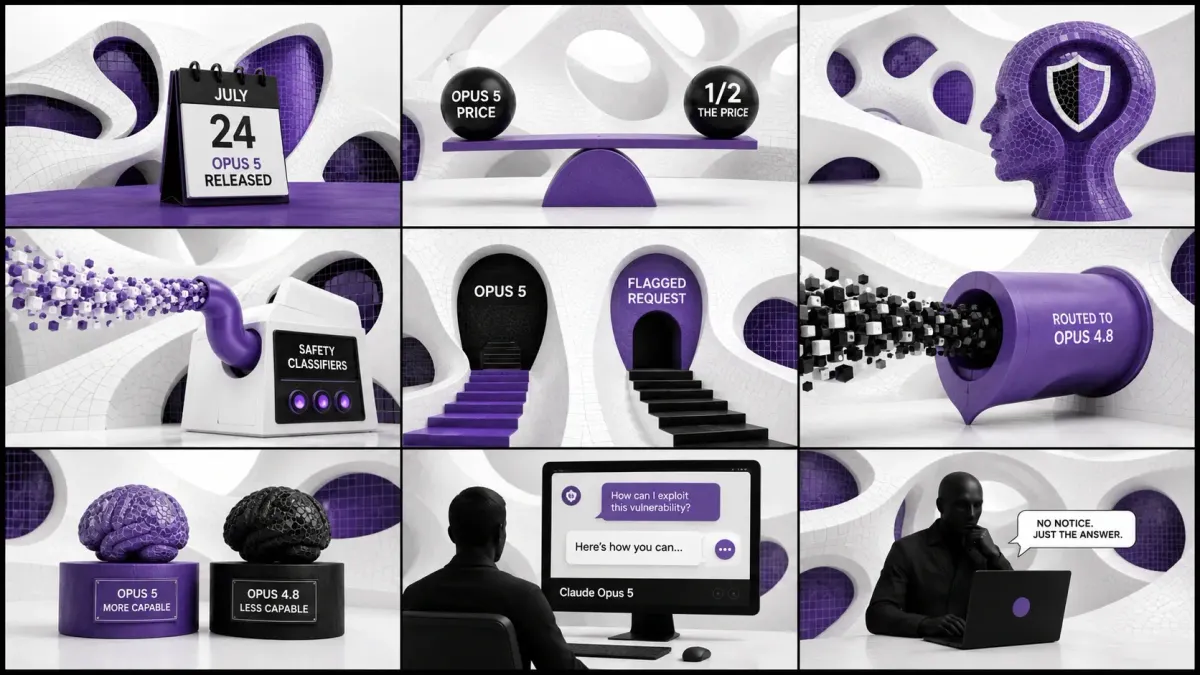
The Claude Opus 5 fallback answers a request its safety filter flags by handing it to the older Opus 4.8 instead of refusing it. On Anthropic's own products, Claude.ai, Claude Code and Claude Cowork, this happens automatically, so a flagged reply can come from a weaker model than the one the user selected.
To know more about this topic, read our related articles:
Bright Answers
Does Claude Opus 5 refuse a request its safety filter flags?
Usually no. On Claude.ai, Claude Code and Claude Cowork a flagged request is answered by the older Opus 4.8 rather than refused, so the reply still arrives, but from a less capable model than the one selected.
Can you tell when Opus 5 has fallen back to Opus 4.8?
On the API the response names the model that answered, and Claude Code shows a notice in the transcript. In the standard chat window and in many third-party apps the reply still displays the model you picked, so the swap is easy to miss.
Anthropic released Claude Opus 5 on 24 July, and most of the coverage settled on one number: it runs at half the price of the company's top model, Fable 5, for the same cost as the model it replaces. The detail that matters to a professional sits lower down, in the safety notes. Opus 5 changes what happens when Claude decides a request is too sensitive to answer. A flagged request still gets answered, but by a different model than the one you selected.
How the safeguard works now
Claude Opus 5 runs a set of safety classifiers, small automated checks that watch for a narrow band of sensitive requests, mostly around cybersecurity and biology. A request flagged on Anthropic's own products, Claude.ai, Claude Code and Claude Cowork, is not refused. The reply is written instead by the older model it succeeds, Opus 4.8, without any action from the person asking. The people most exposed are those using these tools for serious financial technology work, where a fintech team can watch a dependable answer turn flawed the moment the model quietly changes.
The logic behind the swap
Anthropic tunes these filters strictly on purpose, which means they also catch a good deal of harmless work. Users of Fable 5 saw routine tasks blocked, from a standard coding routine read as a hacking attempt to a genetics pipeline read as something far more dangerous. A flat refusal would put a wall in front of a paying customer on a legitimate job. The company reports that Opus 5's cyber filters should trigger around 85% less often than Fable 5's, and that it sets its safeguards deliberately cautious.
The reason for a downgrade rather than a refusal rests on what the filter actually guards, which is the power of the model answering, more than the wording of the question. Opus 5 is capable enough that its help on a genuinely dangerous request could give a bad actor real advantage. Opus 4.8 is weaker at those same tasks, so its answer carries less risk. Anthropic applies the same reasoning one rung higher, with its most powerful system kept from most users because of its capabilities.
The trade this makes
The mechanism did not arrive with this release. It first shipped on Fable 5, the model Anthropic gave away free to paying subscribers until 19 July, and Opus 5 now makes it standard across the range.
This buys something real. A researcher, an analyst or a developer doing lawful work stops hitting a locked door on a false alarm, and the request goes through. It also takes something away. The model that answers a flagged request is, by design, the less capable one, and on the surfaces most people use, the swap is easy to miss.
Whether you can tell
The served model is not hidden outright. Anthropic's application programming interface (API) returns the name of the model that actually answered, and Claude Code prints a notice in the transcript when a fallback happens. The gap sits on the consumer side. An answer written by Opus 4.8 can still read as Opus 5 in the standard chat window and in the many third-party apps that pin the model you picked and label every reply with that name.
Claude Opus 5 rarely says no. The reply on a flagged question now comes from a model built to be less capable, carrying the name of the model you chose, and the interface owes you no notice that the swap took place.
Editor's note
Every piece published on The Bright Minded goes through careful verification, but mistakes can happen. If you spot an error, have additional information, or want to flag anything, write to rosalia@thebrightminded.com.