
The Deterministic Advantage Fintechs Already Own
How fintechs and banks can safely give AI agents payment authority.

The Bright Recap
Agentic AI decides probabilistically. Payment infrastructure moves money deterministically, and it assumes every instruction is complete, accurate and human-authorised. This article explains the seam where the two meet, the five risks the money layer cannot catch alone, and the control pattern that closes the gap: an Agentic Payment Gateway that lets agents express intent while deterministic systems keep the final authority over moving money.
Internal links in this article:
- Financial technology
- Cantica, the Fin-Tech intelligence system for custom business reports.
- Mastercard's Agent Pay
- Agents at checkout
Bright Answers
What is an Agentic Payment Gateway?
It is a control point placed in front of existing payment infrastructure. Agents submit structured requests describing intent, and the gateway builds the actual payment instruction, tests it against a defined mandate, and passes only compliant instructions to the deterministic rails, which stay untouched and keep the final authority over moving money.
Why can't existing payment systems catch agent errors on their own?
Payment hubs, screening and ledgers assume an instruction is complete, accurate and authorised because a human approved it or rule-based software produced it. An agent decides probabilistically, so a duplicate payment under a new reference, a drifted objective or a fabricated account number can all arrive looking like valid instructions the money layer has no basis to flag.
Meet Cantica, the Fin-Tech intelligence system for bespoke intelligence reports to strategise your next business move.
AT A GLANCE
- Payment authority is about to be delegated to software that decides for itself. Few agentic strategies say who constructs the payment instruction.
- Agents are probabilistic; the money layer is deterministic. The exposure is not the rails but the assumption beneath them: every instruction is human-approved orrule-driven.
- Re-platforming does not fix it. Modern APIs process duplicate, drifted and fabricated payments faster; they do not prevent them.
- The control point is an Agentic Payment Gateway: agents express intent, the gateway constructs the instruction, the rails stay as they are.
Every bank has an agentic AI strategy. So does every payment fintech, orchestration layer and platform sell payments inside somebody else's product. They describe what the agent will judge; rarely what writes the payment instruction that follows. That omission is worth pausing on.
Anyone who has worked inside payment integration knows the money layer never went anywhere: the payment hub in a bank, the processor, ledger and scheme connector in a fintech — tightly controlled and routinely called a constraint. Agents decide probabilistically; money moves deterministically. That constraint is the seam where the two must meet.
What an agent is
An AI agent is not traditional software, which follows predefined steps. An agent is given an objective — pay supplier invoices due this week, capture worthwhile early-payment discounts — and decides for itself how to reach it. Think of it as a capable junior colleague: fast, tireless, occasionally confidently wrong.
That unpredictability is not a defect awaiting a patch: the same capability that lets a probabilistic model interpret a loose instruction is what makes its behaviour impossible to predict.
Flexibility and uncertainty arrive together. You cannot buy one without the other.
What the money layer assumes
Payment infrastructure was built on the opposite foundation. Payment hubs, messaging middleware, sanctions screening, scheme connectors and ledgers behave deterministically and expect instructions that are complete, accurate and authorised: a human approved this payment, or predictable software executed a rule a human wrote.
Agentic AI challenges that assumption: the infrastructure is not broken; the assumption behind it is.
Five risks stand out.
| The risk | Why the money layer cannot catch it on its own |
|---|---|
| Duplicate payment | An unanswered agent may retry under a new reference, settling the same invoice twice. To the hub, two valid instructions; detection relies on a stable identifier the agent never supplies. |
| Goal drift | Agents interpret objectives. Pay invoices due this week quietly becomes pay next week's early for the discount. Defensible reasoning, unauthorised payment: it exceeds the intent granted. |
| Invented information | Models produce plausible but wrong data. An invalid purpose code fails validation harmlessly; a realistic but wrong account number does not, and nothing downstream tells the difference. |
| Machine speed failure | An agent clearing repeated failures can generate thousands of attempts, adapting between them — a load systems tuned for human tempo cannot absorb. Markets learned this from algorithmic trading; payments has not. |
| Loss of accountability | An audit trail proves an authenticated instruction arrived; it rarely explains how the agent decided. The gap between intent and machine action opens exactly when accountability matters most. |
The wrong response
The instinct in most institutions is modernisation: replace the hub, build the platform, then adopt AI. That sequencing does not survive the calendar — hub replacements run for years, and agentic payments will arrive first. Nor does re-platforming address the five exposures: modern APIs do not prevent duplicate, drifted or fabricated payments; they process them faster.
The asset worth protecting is not flexibility. It is determinism.
The Agentic Payment Gateway
The practical answer is a pattern the industry already understands keep the existing estate as the system of record and place an Agentic Payment Gateway in front of it, the control point between unpredictable agents and predictable money movement.
Agents express intent. Thegateway creates payment instructions
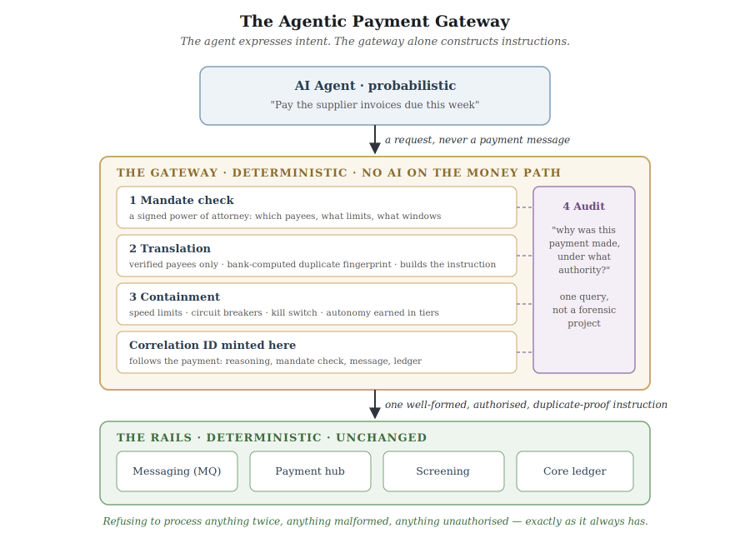
FIGURE 1. The agent sits above the line and only expresses intent; everything below the mandate check is deterministic, and the rails stay untouched.
I. IDENTITY AND MANDATE
Every agent gets its own identity, credentials and a named human owner. A mandate defines what it may do: approved payees, value and volume limits, operating windows. Testing each request against it turns agent judgement into a binary control: inside the boundary, or outside.
II. TRANSLATION
Agents never generate payment messages. They submit structured requests, payee, amount, invoice, mandate reference and the gateway builds the instruction. Two controls follow:
• Agents select payees only from a verified directory, confirmation of payee, rebuilt for machines, so an invented account number has nowhere to land.
• Duplicate detection is computed by the gateway from payment attributes, not from an identifier the agent supplied.
III. CONTAINMENT
No control is perfect, so the blast radius must be bounded: rate limits, circuit breakers on abnormal activity, and a kill switch that stops pending as well as new payments. Autonomy is earned in tiers, observation, recommendation, then limited authority, exactly as institutions onboard junior staff.
IV. AUDITABILITY
One correlation identifier travel from request to settlement, linking human authorisation, agent reasoning, gateway validation, instruction and ledger posting. Why a payment was made, and under whose authority, becomes one query, not a forensic project.
Where the gateway sits in embedded finance
Inside a bank the gateway is an internal control between agent and payment hub. In embedded finance it must be productised: a platform letting a merchant's agent initiate payouts delegates payment authority across an organisational boundary, and the mandate stops being a configuration file, it becomes an agreement between platform, funds provider and the human who owns the agent.
A category is forming Visa's Trusted Agent Protocol, Mastercard's Agent Pay, Google's AP2 and the OpenAI–Stripe ACP all converges on agent identity and delegated authority, the signed mandate is their shared primitive and whoever ships it as a product will define what everyone else buys.
The risk is uneven, too. A large bank absorbs a runaway agent with reconciliation teams and manual break handling; a lean fintech on thin float cannot. Machine-speed failure is heaviest exactly where adoption is fastest.
The way forward
None of this requires new science. The building blocks, middleware, cryptographic controls, digital mandates, workflow engines are already in production somewhere. The work is integration and governance.
What to do now
- Build the gateway before deploying any autonomous agent, not alongside it.
- Start every agent in observation mode; autonomy is earned.
- Make the mandate the primary control, each with a named human owner.
- Leave the existing payment rails unchanged wherever you can.
- Keep deterministic systems the final authority on moving money.
For forty years payment systems were designed on a single principle: trust nothing, verify everything. The rigidity drew constant criticism; today it reads less like a limitation than a specification.
The rails are not the obstacle to agentic payments. Their discipline is the blueprint for whatever replaces them.
Institutions that recognise this will grant agents payment authority sooner, and with more confidence, than those waiting for a perfect next-generation platform.
Editor's note
Every piece goes through careful verification, but mistakes can happen. Readers who spot an error or have additional information can write to rosalia@thebrightminded.com.