
Alchemy AgentCard Launches With Visa: AI Agents Get an Inbox, a Phone Number, and a Place in the Checkout Queue
Alchemy's AgentCard gives AI agents a Visa token, a dedicated email, and a phone number. For the first time, agents can pass any standard checkout flow.
The Bright Recap
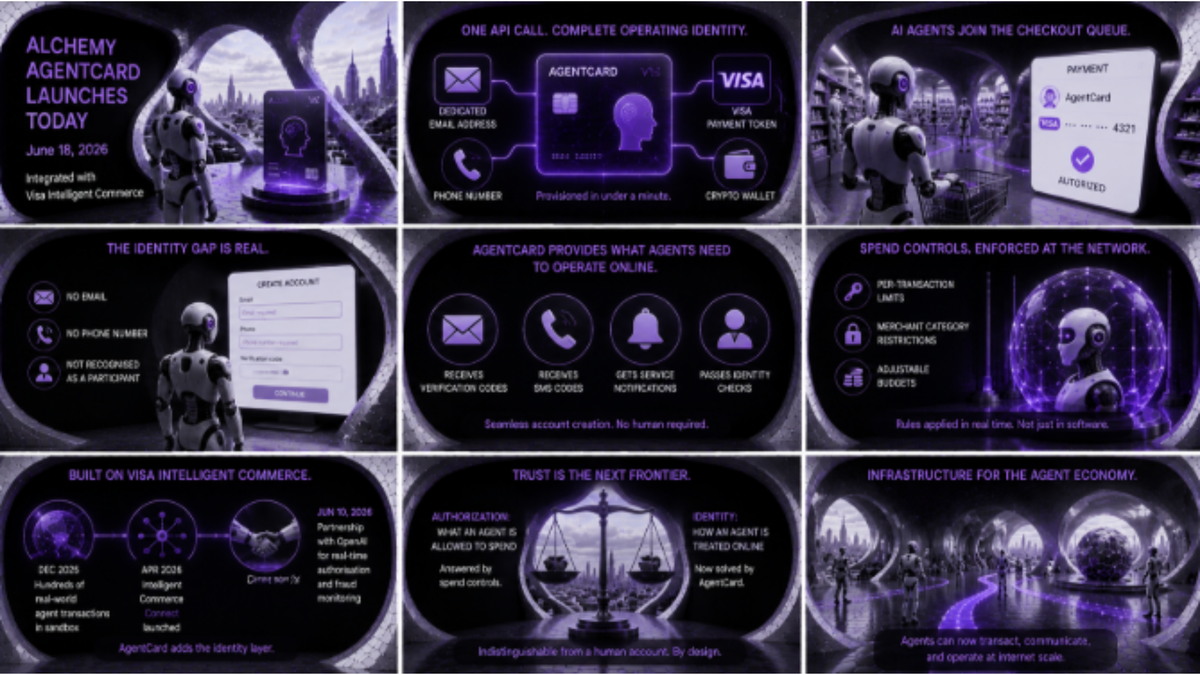
Alchemy AgentCard, integrated with Visa Intelligent Commerce, gives AI agents a payment token, a dedicated email address, and a phone number through a single API, solving the identity gap that blocks autonomous agents from standard checkout flows.
To know more about this topic, read our related articles:
Alchemy AgentCard, launched on June 18, 2026 and integrated with Visa Intelligent Commerce, gives AI agents a complete operating identity through a single API call: a Visa payment token, a dedicated email address, a phone number, and a crypto wallet.
Payment credentials for AI agents existed before today. Account creation flows did not recognise them as participants. Every checkout screen on the internet assumes the entity arriving has an inbox, and most AI agents do not. AgentCard is the first product to treat that gap as a fintech infrastructure problem.
What the identity gap actually costs an agent
Every account creation flow on the internet was designed around a person who arrives with credentials already in hand. An email address for confirmation, a phone number for security verification, and the implied understanding that the account will be operated by a human. An AI agent built on any model — OpenAI, Anthropic, or otherwise — arrives with none of those things. It can be authorised to spend money. It cannot sign up for the service it is being sent to buy from.
That gap has a practical consequence. An agent instructed to book a flight, renew a software subscription, or order supplies hits the account creation screen and stops. The intelligence required to complete the task exists. The credentials required to begin it do not. AgentCard closes that gap by provisioning a functional email address and phone number alongside the payment token. Both receive verification codes and service notifications. Both allow the agent to pass the same identity checks a human account holder would face.
Visa's infrastructure and the developer layer Alchemy adds
Visa Intelligent Commerce (VIC) has been building the payment side of this problem since December 2025, when the company reported hundreds of controlled, real-world agent-initiated transactions across more than 30 partner organisations building in its sandbox. The April 2026 launch of Intelligent Commerce Connect extended that to a single merchant integration covering four agent payment protocols and both Visa and non-Visa cards. The June 10 partnership with OpenAI added real-time authorisation and fraud monitoring for agent-initiated transactions at scale.
AgentCard sits on top of that infrastructure and adds what VIC does not provide: the identity layer. Setup takes under a minute, according to Alchemy. Each agent receives spend controls configurable at launch or adjusted in real time, including per-transaction limits, merchant category restrictions, and adjustable budgets enforced at the network level. Where agent-native payment protocols are not yet supported by a merchant, AgentCard routes to a single-use Visa token and upgrades the payment path automatically as adoption grows.
The trust question the identity layer inherits
The AI agents in finance debate has spent most of 2026 on authorisation: what an agent is permitted to spend, and how the boundaries are enforced. AgentCard's spend controls address that directly. A token issued to a grocery-shopping agent cannot be used for travel bookings; a budget set at $200 cannot authorise a $500 transaction. The network enforces the limit, not the software layer.
The harder question is what the identity layer inherits. An agent with a dedicated email address and phone number is, from the perspective of every platform it interacts with, indistinguishable from a human account holder. That is precisely the point. It is also the feature most likely to attract regulatory attention as agentic payments move from infrastructure pilots to consumer products at scale. Alchemy's spend controls and Visa's token architecture are the current answer to that concern. Both are configurable. Neither is yet standardised across the industry.
Why this moment matters for fintech infrastructure
Juniper Research's April 2026 study identified trust as the primary barrier to agentic commerce deployment, ahead of all technical concerns. AgentCard's launch reframes where that trust problem lives. The payment credential was a solved problem. The identity credential was not, and fintech infrastructure is now catching up to that reality.
The internet was built on the assumption that accounts belong to people. Alchemy's product is the first to make the counter-assumption explicit at the infrastructure level, with a major card network's payment rails underneath it. Every checkout flow that currently gates entry behind an email inbox will, eventually, need to decide what it does when the inbox is owned by software.
Editor's note
Every piece published on The Bright Minded goes through careful verification, but mistakes can happen. If you spot an error, have additional information, or want to flag anything, write to rosalia@thebrightminded.com.