Starbucks Is Counting Milk by Hand Again. Is AI Just Vogue?
Starbucks retired its AI inventory tool after nine months. Klarna rehired the staff it replaced. Here is what the pattern reveals about how enterprises are buying AI right now.
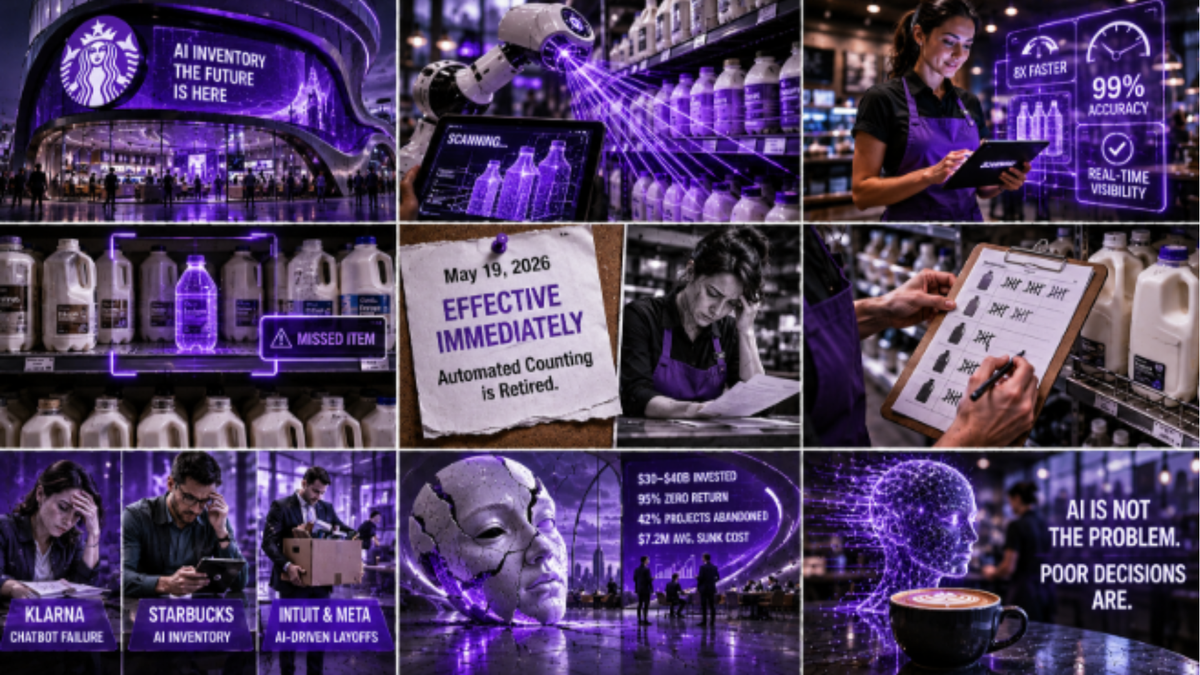
On May 19, 2026, Starbucks sent an internal memo to every company-operated store across North America. Automated counting was retired, effective immediately. Milk and beverage components would be counted the same way staff count everything else — by hand.
Nine months earlier, Starbucks had deployed an AI inventory tool across more than 11,000 locations, backed by a launch announcement describing technology that would free workers to focus on crafting beverages and connecting with customers. That announcement has since been deleted from the Starbucks website.
What the tool was supposed to do
The system was built by Redmond, Washington-based startup NomadGo and used LiDAR sensors, computer vision, and smartphones and tablets to scan shelves and generate automated tallies of syrups, milk varieties, and other beverage components.
At launch in September 2025, NomadGo claimed counts up to eight times faster than manual methods with 99% accuracy, per the company's BusinessWire announcement. Starbucks CTO Deb Hall Lefevre described it as a solution that would give the company real-time store-level visibility it had been missing — one of CEO Brian Niccol's headline operational fixes since joining from Chipotle in 2024.
Employees and managers across multiple locations described the system routinely confusing similar milk varieties and missing items entirely, according to Reuters. A promotional video from the launch period captured one malfunction directly: a peppermint syrup bottle sitting on a shelf went unregistered as the system scanned the bottles on either side of it, as reported by TechTimes. A tool that requires human verification of every result does not reduce the inventory task. It adds a step to it.
This is not an isolated case
Klarna ran the same experiment at a different scale. In 2023, the Swedish fintech deployed an OpenAI-powered customer service chatbot, froze all non-engineer hiring, and announced the system was handling the equivalent work of 700 full-time agents. By May 2025, CEO Sebastian Siemiatkowski told Bloomberg the strategy had produced lower quality service. Customers complained about generic, repetitive responses that could not handle complex issues. Klarna began rehiring human agents, with Siemiatkowski stating: "From a brand perspective, a company perspective, I just think it's so critical that you are clear to your customer that there will always be a human if you want."
The Standard Chartered decision to cut 7,800 back-office jobs while absorbing a crypto custody business in the same week follows a recognizable structure: headcount reduced on the premise of AI capability, operational consequences to be absorbed later. The numbers behind these individual cases tell a consistent story. MIT's Project NANDA reviewed more than 300 publicly disclosed enterprise AI deployments, conducted structured interviews with 52 organizations, and gathered survey responses from 153 senior leaders. Its July 2025 report found that despite $30 to $40 billion in enterprise investment into generative AI, 95% of organizations recorded zero measurable return. Just 5% of integrated AI pilots reached production with real P&L impact.
The purchasing decision nobody examines
The Intuit layoffs in May — 3,000 jobs cut three months after signing AI deals with Anthropic and OpenAI — and the Meta layoffs the same week share a structure with the Starbucks and Klarna reversals. In each case, the AI decision preceded a clear operational definition of what problem it was solving. The MIT NANDA report identified the pattern directly: budgets favor high-visibility top-line functions over back-office operations, where the actual return is higher. The 5% of deployments that succeeded shared three traits — tightly scoped initiatives, domain-specific focus, and a defined problem matched to a tool before procurement began.
Starbucks did not fail because AI cannot count inventory. Computer vision systems count items reliably in controlled warehouse environments every day. Starbucks failed because the specific tool it chose could not distinguish between two similar bottles on a shelf in a busy store, and that limitation was not caught before the system went live across 11,000 locations.
Deloitte's 2026 State of AI report found that 42% of companies abandoned at least one AI initiative in 2025, at an average sunk cost of $7.2 million per abandoned project, per S&P Global Market Intelligence's 2025 survey. That figure does not include the operational disruption of a rollback, the reputational cost of a deleted press release, or the staff hours spent verifying outputs that turned out to be wrong.
So is AI just vogue?
The technology is not. The 5% of deployments the MIT NANDA report identifies as successful are measurably rewriting cost structures and operational capacity in the companies running them. Computer vision works. Chatbots handle millions of routine interactions daily without failing. The capability is real.
The purchasing pattern is vogue. The Anthropic funding round closed at $965 billion partly because enterprise demand for AI is genuine — and partly because boards are demanding AI ROI while 71% of CIOs expect budget cuts if they miss mid-2026 targets, per Gartner's 2025 data. That pressure is good for AI providers. It is not the same thing as AI working. Vendors demonstrate controlled environments and ship to chaotic ones. Executives approve pilots before defining success metrics. The press release lands before the tool is stress-tested.
The result is technology deployed into problems it was never precisely matched to, at a cost that only becomes visible once the memo goes out telling staff to go back to counting by hand.
Editor's note
Every piece published on The Bright Minded goes through careful verification, but mistakes can happen. If you spot an error, have additional information, or want to flag anything, write to rosalia@thebrightminded.com.