SpaceX Bought Cursor for $60 Billion, and the Asset It Wanted Was Compute
SpaceX completed its $60 billion all-stock acquisition of Cursor on 14 August 2026, making the AI coding company a wholly owned subsidiary via SEC filing.

The Bright Recap
Cursor, the artificial intelligence (AI) coding company, became a wholly owned subsidiary of SpaceX on 14 August 2026, when a $60 billion all-stock acquisition closed through a filing with the United States Securities and Exchange Commission. Cursor's shareholders received rights to about 389 million SpaceX Class A shares in place of cash.
The deal folds Cursor into SpaceX's AI division alongside Grok and xAI. Its central logic is compute: Cursor gains access to SpaceX's large-scale infrastructure, while SpaceX adds a fast-growing enterprise revenue line to an AI unit competing with Anthropic and OpenAI.
To know more about this topic, read our related articles:
Bright Answers
How much did SpaceX pay for Cursor and how was it paid?
SpaceX paid $60 billion entirely in stock, issuing rights to about 389 million SpaceX Class A shares to Cursor's shareholders. The deal closed on 14 August 2026 and made Cursor a wholly owned subsidiary.
Why did SpaceX buy an AI coding company?
The purchase strengthens SpaceX's AI division, which competes with Anthropic and OpenAI, and gives Cursor access to large-scale computing infrastructure. Cursor's growth had been constrained by the compute needed to train larger models.
SpaceX completed its $60 billion acquisition of Cursor on 14 August 2026. A company built to launch rockets and run satellites now owns the software developers use to write code. The price was paid entirely in SpaceX stock, and the reason for the deal has little to do with code itself.
Cursor sold from a position of strength. It had crossed a billion dollars in annual revenue by late 2025 and ranked among the fastest-growing tools in software. The constraint it hit was physical: the computing power needed to keep training larger models at the pace its growth demanded. SpaceX offered the one input money alone could not buy at speed, and it offered it in exchange for the whole company.
Commission your Fin-Tech intelligence report and strategise your next business move.
The deal, and what changed hands
The transaction became effective on 14 August 2026 through a filing with the Securities and Exchange Commission (SEC), turning Cursor into a wholly owned subsidiary of SpaceX. Cursor's existing shareholders received rights to about 389 million SpaceX Class A shares in place of cash.
At the valuation SpaceX reached in its record public listing, the $60 billion price amounted to a dilution of roughly 3.4 per cent for existing shareholders. The all-stock structure is a manoeuvre watched closely in financial technology and capital markets, where a newly listed company can convert its own shares into acquisition currency almost overnight.
Why Cursor sold
The logic of the deal starts with compute. Training and running advanced models depends on vast banks of graphics processing units (GPUs), and access to them has become the hard limit on how fast an artificial intelligence (AI) company can grow.
Cursor began working with SpaceX in April 2026 precisely because computing capacity had turned into a brake on its expansion. The economics here mirror a wider problem the leading model builders have been forced to confront, the same rising cost of compute that now drives valuations across the sector.
What Cursor told its users
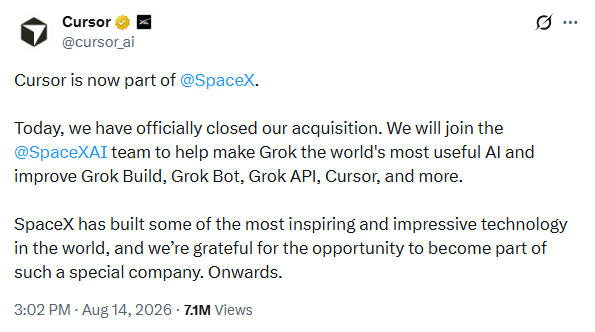
Cursor confirmed the closing in a post on X, telling users it had officially joined the SpaceX AI team. It framed the move around capacity, pointing to a far larger pool of computing power and the ability to train more capable models at a lower cost to run. The company said its work would now feed directly into Grok, the AI system developed by xAI, which SpaceX merged with earlier in 2026.
Reports indicate Cursor's data had already helped train a recent version of Grok, which makes the acquisition a formal step in a relationship that was producing results before any papers were signed.
SpaceX's vertical bet
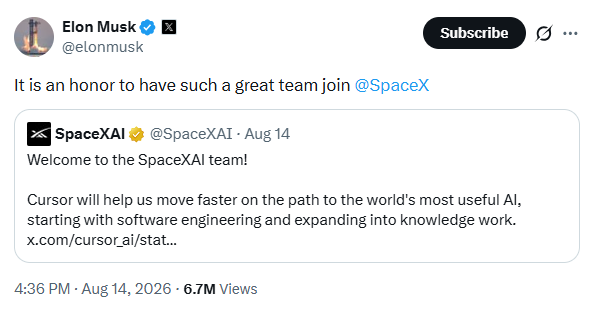
Elon Musk welcomed the Cursor team in his own reply, calling it an honour to have them join SpaceX. For SpaceX, the purchase strengthens an AI division that had been trailing Anthropic and OpenAI and working through a restructuring.
Cursor brings a large enterprise revenue line, a base of professional developers and a proven model team into a company whose public pitch rests on artificial intelligence as much as on rockets. Analysts at Morgan Stanley estimate Cursor could add around $2.5 billion to SpaceX revenue in 2026 and $13 billion in 2027.
The asset SpaceX cannot print
Money can be raised and stock can be issued, and SpaceX has just shown how quickly both can be turned into an acquisition. Compute cannot be conjured the same way, because it rests on hardware, data centres and a steady supply of electricity. This is the constraint now sitting underneath the whole sector, and it is why power and grid capacity has become inseparable from the race to build better models. SpaceX arrives at that problem already owning launch, satellites and the physical footprint to expand its own computing base.
Cursor had the users, the revenue and a strong model, and it still could not manufacture the one input it needed most: compute. SpaceX could supply it, because it already builds the launch capacity, the satellites, the data centres and the power to run them. The frontier of artificial intelligence has moved from who writes the best model to who owns the machines and the electricity that train it. That is what $60 billion in stock secured.
Editor's note
Every piece published on The Bright Minded goes through careful verification, but mistakes can happen. If you spot an error, have additional information, or want to flag anything, write to rosalia@thebrightminded.com.