SpaceX IPO: The Dinosaur Warning, Solar Energy From Space, and the Planet Left Behind
SpaceX filed its S-1 on May 20, 2026. The extinction argument, the $45 billion Anthropic deal, and what the filing reveals about AI's real energy problem.
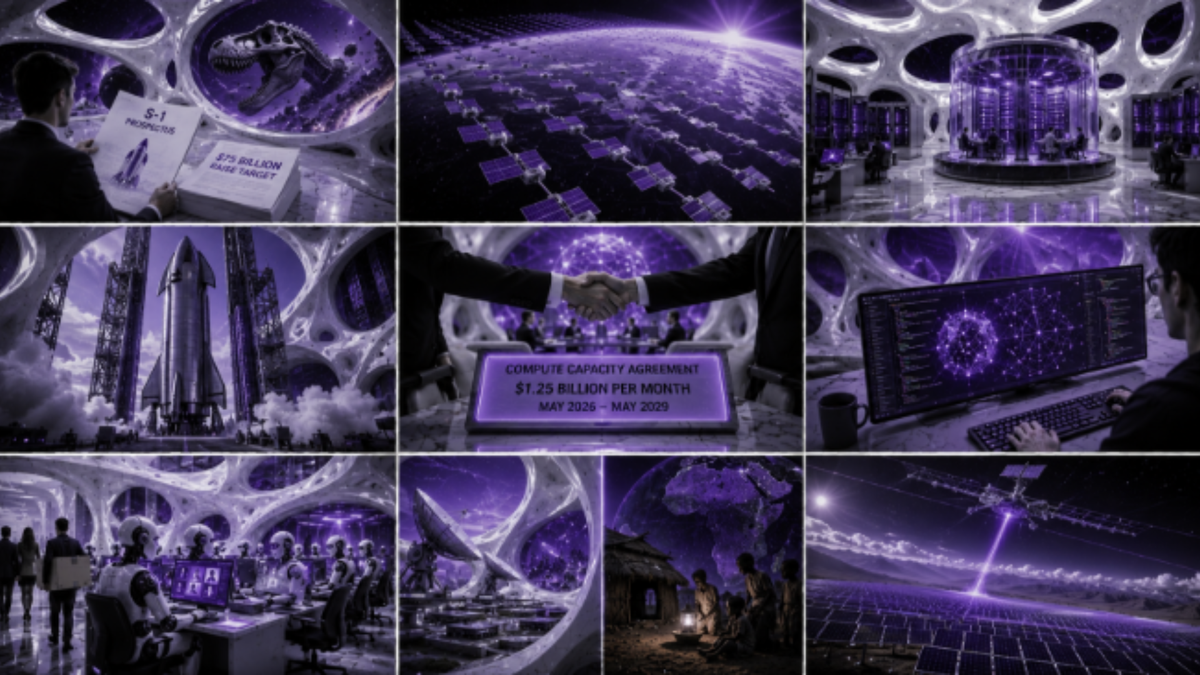
On page 3 of its IPO prospectus, filed with the SEC on May 20, 2026, SpaceX states that it does not want humans to have the same fate as the dinosaurs. The sentence opens the company's case for becoming multiplanetary, but it carries the weight of everything else in the 277-page document: the $75 billion raise target, the plan to launch one million solar-powered satellites, and the argument that AI's energy demand has already outgrown the infrastructure built to serve it. The solar energy SpaceX wants to harvest in orbit reaches Earth every day. The filing does not explain why it needs to be collected from above first.
The energy argument at the centre of the filing
SpaceX's case for moving AI compute into space begins with a grid constraint. The S-1 cites a January 2026 Introl report finding that the United States faces a 175-gigawatt shortfall between projected AI data centre demand and available grid capacity by 2030, and references the IEA's April 2025 special report on energy and AI as a supporting source.
SpaceX's answer is a constellation of compute satellites operating on near-constant solar power at altitudes between 500 and 2,000 kilometres, connected via optical laser links to the existing Starlink network. In its January 2026 FCC filing, SpaceX described the project as a first step toward a civilisation capable of harnessing the full energy of the Sun, with the first orbital AI compute satellites expected to deploy from 2028.
The spending behind that plan is already visible in the S-1. SpaceX's AI segment, acquired through its February 2026 merger with xAI, spent $12.7 billion in capital expenditure in 2025, more than the combined spending on Starlink satellite deployment and rocket launch operations that year.
In Q1 2026 alone, AI capital expenditure reached $7.7 billion, against $1.3 billion for connectivity and $1 billion for space. The company has accumulated more than $37 billion in losses since its founding in 2002, all of it spent building toward a future the S-1 now asks public investors to fund.
The Anthropic detail the filing reveals for the first time
The S-1's recent developments section contains a disclosure that had not appeared in any previous public document. In May 2026, SpaceX entered into Cloud Services Agreements with Anthropic, giving the AI company access to compute capacity across Colossus and Colossus II, SpaceX's data centre facilities in Memphis, Tennessee and Southaven, Mississippi.
Anthropic agreed to pay $1.25 billion per month through May 2029, with reduced fees during the May and June 2026 ramp-up period, and either party can exit with 90 days' notice. SpaceX describes the arrangement as a way to monetise unused compute capacity and states it expects to enter additional similar agreements. Over the full term, the deal represents approximately $45 billion in potential revenue.
Anthropic was founded in 2021 by seven researchers who left OpenAI. Musk co-founded OpenAI in 2015, left its board in 2018 after his bid to become CEO was rejected, and filed two lawsuits against the company and its CEO Sam Altman in 2024. The trial ran from April 27, 2026, and the deal was announced publicly on May 6, during its second week. The jury ruled against Musk on May 18, citing the statute of limitations, and the S-1 was filed two days later. The filing treats the Anthropic agreement as a straightforward commercial transaction, and on its financial terms alone, it qualifies as one.
What the arrangement reveals is something the orbital AI narrative tends to obscure: the most commercially significant application of SpaceX's compute capacity right now is a terrestrial lease to OpenAI's direct competitor, at $1.25 billion a month. That compute powers AI models serving financial services operators, legal firms, and enterprise clients, the same professional sectors driving current AI adoption across fintech and adjacent industries. Anthropic is also the company moving fastest to replace the professionals it sells to. The extinction argument opens the filing. The business model relies on Earth.
The move on Cursor
On April 22, 2026, SpaceX announced an agreement with Cursor, the AI coding startup developed by Anysphere. The deal gives SpaceX the option to acquire Cursor for $60 billion later in 2026, or pay $10 billion for the collaboration if it does not exercise that option. Cursor had been days away from closing a $2 billion funding round at a $50 billion valuation; the offer reached Cursor's founders before that round closed. Microsoft had considered buying Cursor and passed. The S-1 references the partnership within the AI segment as part of SpaceX's stated goal of producing the most capable coding and knowledge work AI available.
What the extinction argument leaves behind
SpaceX's extinction framing is coherent as a strategic position. If AI infrastructure is becoming as fundamental as electricity, and if the terrestrial grid cannot scale to meet demand at the required pace, then building the energy source above the grid follows a clear logic. The Kardashev framing takes that logic to its farthest point: the only energy supply that does not face terrestrial constraints is the Sun itself, accessed from orbit. The S-1 presents this as a commercial and engineering commitment, disclosed in audited financials.
What it leaves unaddressed is the proximate version of the same problem. The IEA's April 2025 report on energy and AI, cited in the S-1's own source list, frames the grid constraints driving SpaceX's orbital bet as an investment and infrastructure gap, not a physical ceiling. According to the IEA's October 2025 report on electricity access, 730 million people worldwide still lacked access to electricity in 2024, with progress stalling across sub-Saharan Africa, the region with the highest concentration of unconnected households and among the highest solar irradiance on Earth.
The solar technology SpaceX plans to deploy above the atmosphere is a more capable version of what is already deployable on the ground. The gap it is designed to solve is a financial and political one as much as an engineering one. The AI tools most needed in those regions, including basic financial guidance and access to services, run on the same infrastructure.
The infrastructure SpaceX is racing to build in order to leave Earth's energy limits behind is the same infrastructure that could remove them.
Editor's note
Every piece published on The Bright Minded goes through careful verification, but mistakes can happen. If you spot an error, have additional information, or want to flag anything, write to rosalia@thebrightminded.com.