
Italy's Internet Outage Today: The Risk of Building on Too Few, in Networks and in AI
Italy's internet went down on May 29, 2026. TIM's infrastructure failure took millions offline. Here is what it has in common with AI concentration.
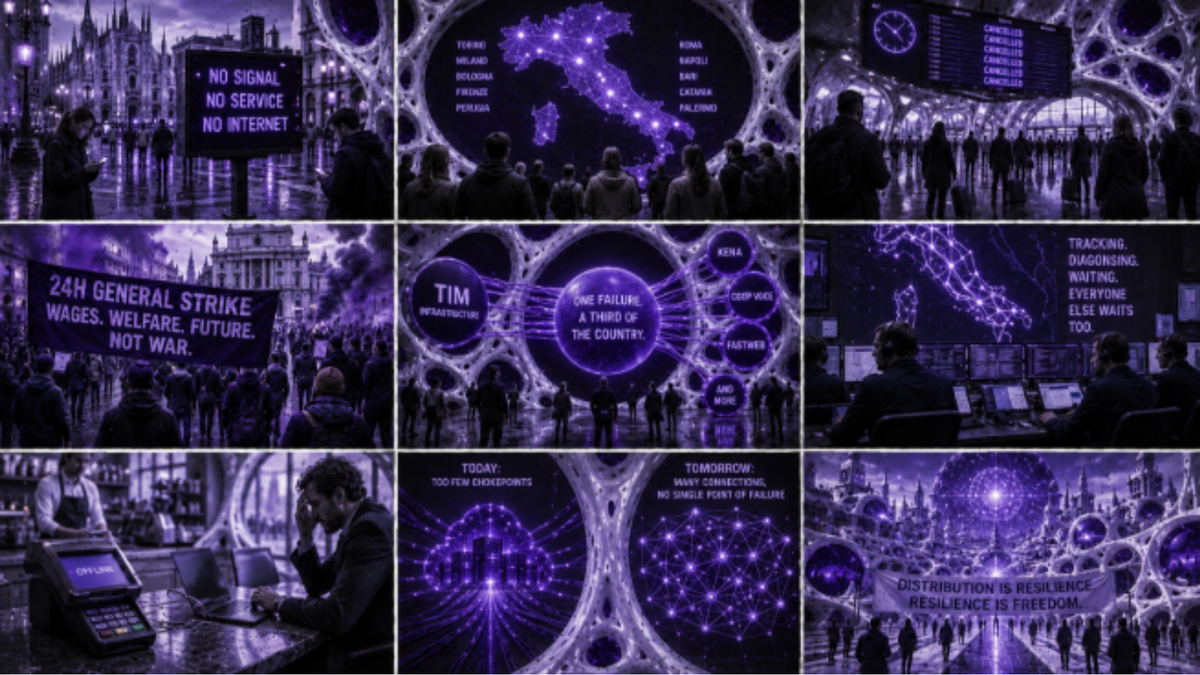
This morning, Italy went quiet. Not everywhere, not for everyone, but for enough people that the pattern was unmistakable: no signal, no calls, no messages, no way to work.
From the early hours of May 29, 2026, cities across the country began reporting a widespread network outage, with TIM users and the virtual operators running on its infrastructure, including Kena, Coop Voce and Fastweb, all affected. The disruption hit harder in the major urban centres: Torino, Milano, Bologna, Firenze, Perugia, Roma, Napoli, Bari, Catania, Palermo. By mid-morning, no official cause had been confirmed.
The timing made it worse. Italy was already navigating a 24-hour general strike on May 29, with transport, schools, healthcare and public administration all disrupted, called by a coalition of grassroots unions over declining wages, welfare cuts and military spending. Trains already disrupted, airports already uncertain, and then the internet goes down too. The day became a stress test for every system people assumed would hold.
One failure, a third of the country
The structure of Italy's network has always made this kind of cascade possible. Three of Italy's top eight largest networks by user base are managed by the Telecom Italia group, with Sparkle acting as the international transit provider that other operators depend on for connectivity.
TIM's landline network directly serves over 20% of the population and, because it functions as transit infrastructure, indirectly reaches an additional 8.5%, bringing the group's total reach to around 38% of Italy's population. When something goes wrong at that layer, the failure does not stay contained. It spreads to every operator that built on top of it.
Analysts who studied a previous TIM outage in 2023 noted that the issues could have been avoided by having greater redundancy and more interconnection, and that network operators should design their infrastructure so that no single point of failure can take the whole system down. The advice was sound. The architecture did not change.
The structure is the problem
This is not a story about a company having a bad day. It is a story about what happens when critical infrastructure collapses into too few hands. Italy's internet did not become vulnerable overnight. It became vulnerable through years of consolidation and underinvestment in redundancy, a model where millions of people's connectivity routes through a single set of pipes. One fault, one misconfiguration, one cable, and the thing stops working.
The Italian Network Operators Group was tracking the outage in real time, with network specialists trying to piece together what had happened while waiting for Sparkle representatives to provide updates on resolution. The rest of the country waited with them.
The fintech implications are direct. Payment terminals went offline. Remote work stalled. Businesses relying on cloud-based tools lost access mid-task. The economy does not pause while engineers diagnose routing failures. It bleeds quietly, one failed transaction at a time.
The same architecture, different industry
There is a parallel worth sitting with. The concentration problem that makes a single telecom outage capable of silencing a third of a country's internet is not unique to telecoms. The AI market is dominated by a small number of large firms that control not just models and applications but also the essential infrastructure underneath them: cloud computing, GPUs, proprietary datasets, creating a vertically integrated situation that complicates competition and raises the prospect of new forms of technological dependency.
What once looked like healthy competition between AI challengers and established platforms has become a carousel of Big Tech ownership, with OpenAI's biggest investors including Microsoft and Nvidia, and Anthropic's including Amazon and Google, each having also acquired or invested in countless AI startups. The language used to describe these arrangements is "partnerships." The structure they produce is the same one that left Italy offline this morning: a system where the thing everyone depends on runs through too few chokepoints, controlled by too few actors.
This is the question that does not get asked loudly enough. When the trust layer of onchain banking becomes the next dependency stack, and when the AI sitting underneath it lives on infrastructure owned by three or four companies whose outages nobody can prevent or route around, the democratisation argument starts to carry a hidden caveat. Access is only as reliable as the pipe it travels through.
Blockchain's original proposition was precisely this: distribute the ledger so that no one entity's bad day becomes everyone's problem. The idea has not disappeared. What has happened, in both AI and in traditional network infrastructure, is that the people building the systems have quietly opted for the opposite, because concentration is more efficient and efficiency is what gets funded.
Italy will come back online. It always does. But the vulnerability it exposed today is structural. And structure, unlike a router, does not reboot itself.
Editor's note
Every piece published on The Bright Minded goes through careful verification, but mistakes can happen. If you spot an error, have additional information, or want to flag anything, write to rosalia@thebrightminded.com.