
Russia Crypto Law 2026: The State Legalized What It Needed and Is Closing What Its Citizens Built
Russia's new crypto law permits cross-border sanctions evasion for companies. For citizens, it criminalizes the informal channels they already rely on.
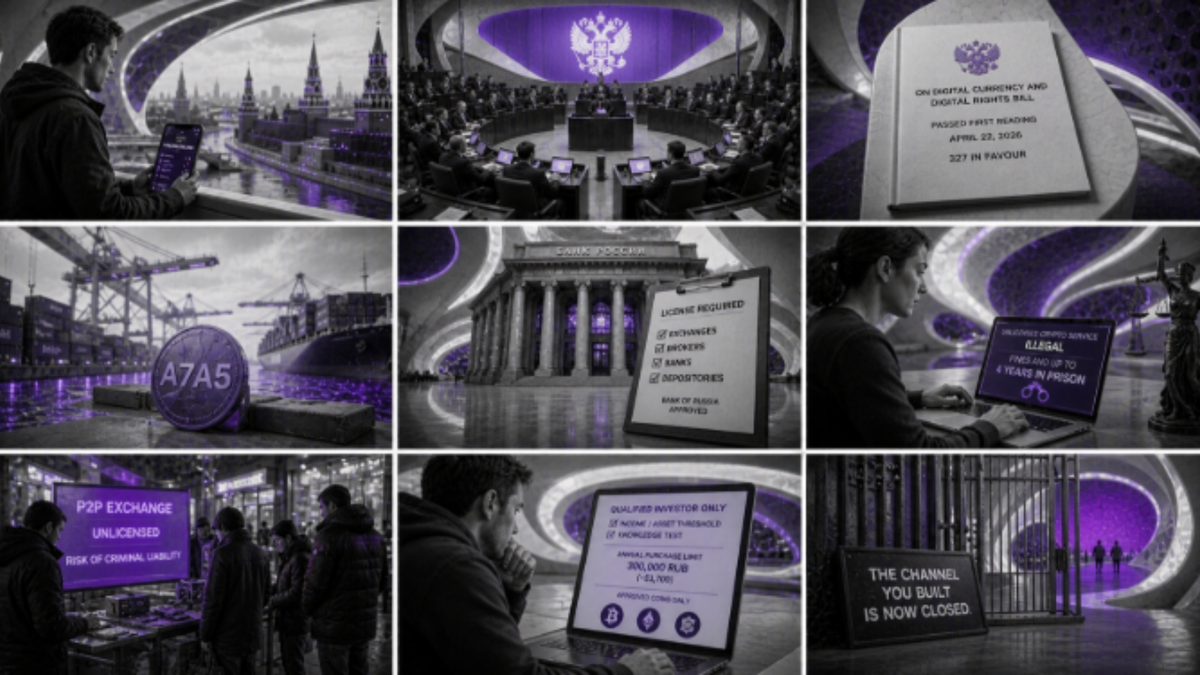
More than $40 billion in crypto is held by Russian residents, according to the Russian Association of Cryptoeconomics. Spending any of it inside Russia has been illegal since 2020. On May 1, 2026, Russia's government submitted a bill to its State Duma that would make running unlicensed crypto services a criminal offense, with fines and up to four years in prison.
Nine days earlier, the Duma had passed the first reading of a digital currency framework giving Russian companies legal cover to use that same crypto to settle foreign trade under Western sanctions. Both laws were drafted together, and both move in the same direction: the state acquires a controlled financial channel for sanctions evasion while the informal channels its citizens relied on become criminal.
Russia's On Digital Currency and Digital Rights bill passed its first reading on April 22, 2026, with 327 deputies in favour. The Bank of Russia will license all market participants, including exchanges, brokers, banks, and depositories.
Crypto is recognised as property, enforceable in court proceedings including bankruptcy and divorce. Companies can use it to pay foreign counterparties and receive export revenue. Kaplan Panesh, deputy chairman of the State Duma Committee on Budget and Taxes, stated in parliamentary records that the framework explicitly permits Russian companies to pay foreign counterparties in crypto as a mechanism for getting around sanctions restrictions. The legislation must be adopted by July 1, 2026.
For citizens, the framework is more restrictive. Investors who do not meet the income or asset thresholds to be classified as qualified, the broad category covering most of the public, face a mandatory knowledge test and an annual purchase cap of 300,000 rubles, roughly $3,700, per licensed intermediary. Only coins meeting strict market capitalisation and trading volume thresholds will be permitted, likely Bitcoin, Ethereum, and a small number of others. Privacy-focused cryptocurrencies that conceal transaction data are banned.
How the informal system grew before the law existed
Russia's crypto infrastructure grew from the sanctions environment, years before any formal framework existed. Western nations cut off Russian banks from SWIFT and froze dollar-denominated accounts following the 2022 invasion of Ukraine. Russian businesses responded by moving trade flows through digital assets. The ruble-pegged stablecoin A7A5 became the clearest evidence of how far the informal system had grown.
By January 2026, A7A5 transactions had topped $100 billion. The 2026 TRM Crypto Crime Report estimated that A7A5 and the wallet network connected to it processed roughly $70 billion in transactions tied to sanctions evasion during 2025.
For four years, the state monitored this expansion without dismantling it. The framework law and the criminalization bill together represent the moment it decided to absorb the system rather than compete with it, licensing the parts that serve state strategy and criminalizing the rest.
What the licensed framework offers the people who built it
The $40 billion already held by Russian residents accumulated because the ruble's purchasing power eroded sharply under sanctions-driven inflation and because access to foreign banking became increasingly restricted.
Informal crypto channels offered a way to hold dollar-equivalent value without a Western account. Those channels, meaning unregistered exchanges, peer-to-peer platforms, and unlicensed service providers, now carry criminal liability under the fintech legislation submitted on May 1.
Russia's Supreme Court flagged the criminalization bill as lacking adequate justification for criminal penalties and called it premature pending full enactment of the broader framework. The State Duma is expected to proceed regardless.
The licensed alternative that replaces the informal system is capped, tested, whitelisted, and Bank of Russia-approved. A $3,700 annual purchase limit per intermediary, combined with a mandatory knowledge test and a whitelisted coin list, is a framework calibrated to demonstrate regulatory control rather than enable meaningful participation. The people using informal crypto channels to protect savings were doing so precisely because formal alternatives had already failed them.
Russia's new crypto law legalizes exactly what the state needed from digital assets and criminalizes exactly what its citizens found there first.
Editor's note
Every piece published on The Bright Minded goes through careful verification, but mistakes can happen. If you spot an error, have additional information, or want to flag anything, write to rosalia@thebrightminded.com.