
Rakuten XRP Japan: How 44 Million Consumers Entered Crypto Without a Crypto Decision
Rakuten gave 44 million Japanese users access to XRP through loyalty points. Here is what that reveals about the psychology of crypto adoption.

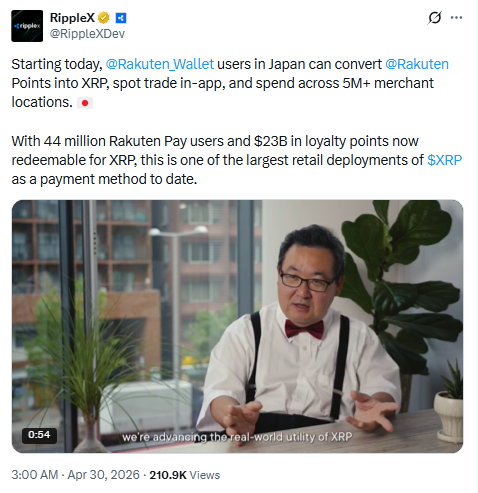
Forty-four million Japanese consumers now hold XRP in a wallet they use for everyday purchases, and the question of whether they want to use cryptocurrency was never put to them. On April 15, 2026, Rakuten Wallet launched XRP as a payment method, allowing users to convert Rakuten Points into the token and spend at more than five million merchant locations across Japan.
On April 30, RippleX confirmed the integration as one of the largest retail deployments of a cryptocurrency globally. It reached that scale without a single user having to decide to enter crypto.
A loyalty mechanic, not a crypto decision
Tatsuya Kohrogi, Ripple's senior ecosystem growth manager, announced the integration on April 13 and described Rakuten Pay as Japan's everyday commerce platform rather than a crypto-native application. Rakuten built the integration independently, without a formal partnership with Ripple.
Users convert Rakuten Points into XRP, hold the token in Rakuten Wallet, and load it as Rakuten Cash to spend at merchant locations, while every transaction settles in yen on the merchant side and no user manages a private key at any point. The cryptocurrency operates as invisible rail.
More than 3 trillion Rakuten Points were in circulation at launch, worth approximately 23 billion dollars and now convertible to XRP. Japan's government is also advancing proposals to reclassify major cryptocurrencies as financial instruments and introduce a flat 20 percent tax on gains from specified assets, down from a maximum of 55 percent, which would align crypto with the treatment of equities and investment trusts. The commercial and regulatory conditions for fintech-native crypto entry converged at the same moment.
The barriers that kept people out
Research in consumer psychology consistently identifies three overlapping obstacles to crypto payment adoption: the perception that existing infrastructure already works, technical complexity at the point of entry, and concern about volatility and loss.
A 2024 study published in Psychology & Marketing examined consumer resistance to crypto payment across multiple markets and found that usage barriers, including the sense that crypto is more inconvenient than established alternatives, ranked among the most persistent. A global survey of more than 19,600 respondents across 34 countries by TGM Research in 2024 found that 49 percent cited lack of understanding as the primary reason for not entering.
The US Federal Reserve reported in 2023 that only 2 percent of American adults had used cryptocurrency for any payment. Those numbers point to something more specific than low awareness, which is measurably high and growing across major economies. They describe the persistent gap between knowing about crypto and acting on that knowledge at the moment of a transaction. Every approach to narrowing that gap has assumed the decision must occur, and has focused on making it easier.
An entry point with no gate
Rakuten placed the first encounter with XRP inside a loyalty mechanic users already engage with routinely, bypassing the standard obstacles to crypto payment adoption without addressing any of them individually. The entry point is a loyalty point conversion inside a platform people already visit for groceries and restaurant payments. The entry point is a loyalty mechanic already embedded in a platform people use daily, with no new account, interface, or decision about crypto required.
A promotional window running through May 15, 2026, offers 500 yen in XRP for users who purchase 30,000 yen or more of the token, and 1,500 yen for purchases of 100,000 yen or more. The structure frames the mechanic as a reward within the existing Rakuten ecosystem, which means users engaging with it are extending a familiar behaviour rather than starting a new one. The contrast with how Meta began routing stablecoin payouts to creators in Colombia and the Philippines through platforms they already used for work is structural: both bypass the standard adoption decision, one through necessity, one through habit.
The real test is May 15
Social sentiment for XRP in Japan reached its second-highest level in two years following the integration, according to blockchain analytics platform Santiment.
The behaviour of users who remain engaged after the promotional window closes on May 15 will produce the first real data on a question the crypto industry has not yet had the conditions to study: whether adoption that begins without a conscious choice generates the same sustained engagement as adoption built on deliberate intent.
The Rakuten loyalty pool, worth approximately 23 billion dollars, is more than 20 times the total held across all US XRP exchange-traded funds combined, according to analysis by 247wallst.
The outcome carries implications for any market where the standard model of crypto adoption has assumed the decision to enter is the starting point, including the communities already using stablecoins in Venezuela and other economies where institutional trust has collapsed, where adoption without a formal decision has also been happening, though driven by urgency rather than habit.
Research on crypto adoption has mapped every friction point between awareness and use. Rakuten built a system that bypasses them entirely, and it went live for 44 million people.
Editor's note
Every piece published on The Bright Minded goes through careful verification, but mistakes can happen. If you spot an error, have additional information, or want to flag anything, write to rosalia@thebrightminded.com.