Google DeepMind Union 2026: The Structural Change That Made a Petition Insufficient
Google DeepMind's UK workers voted 98% to unionize on May 4, 2026. Here is the structural change that explains why a petition was no longer enough.
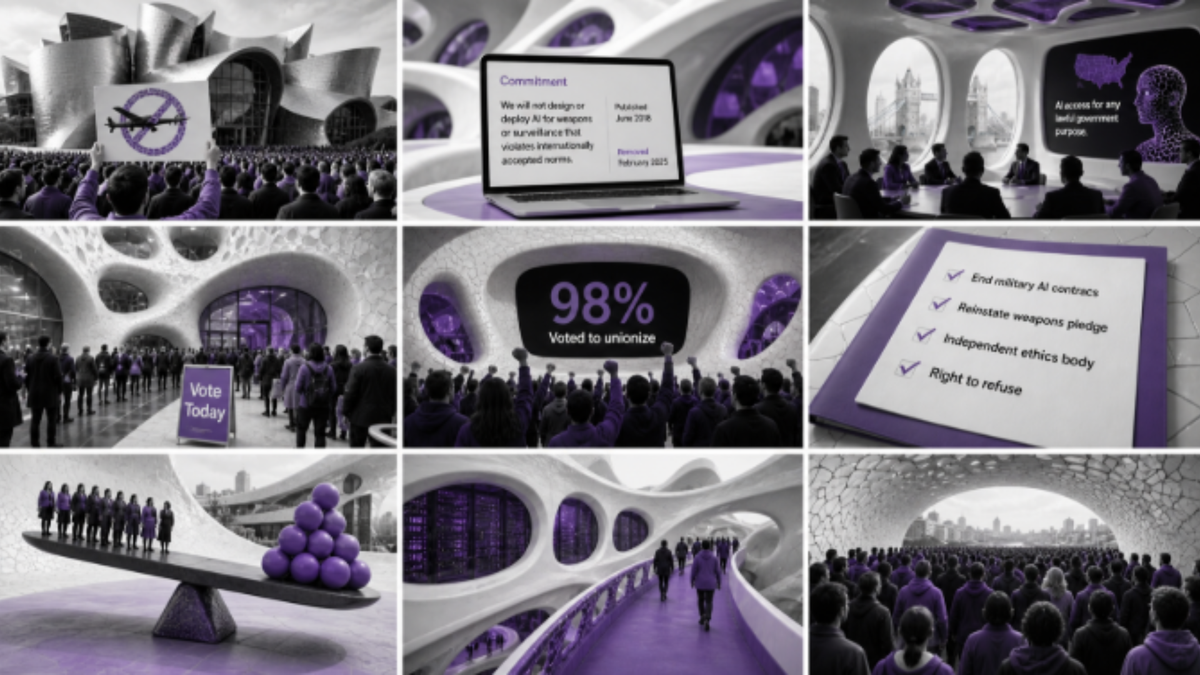
Four thousand Google employees signed a petition against Project Maven in 2018, a Pentagon contract that used the company's AI to analyze drone surveillance footage. Google did not renew it. In 2026, Google signed a classified deal giving the US Department of Defense access to its Gemini AI models for any lawful government purpose, and 98% of UK-based Google DeepMind workers voted to form a union. The distance between those two responses is the phenomenon.
The union bid covers at least 1,000 workers based at DeepMind's London office and is being pursued through the Communication Workers Union and Unite the Union, which would make it the first at any frontier AI lab, according to Fortune's May 5 reporting. Workers voted in April, before the Pentagon deal was formally announced, driven by reports that the agreement was imminent. The CWU confirmed the 98% result and published the workers' demands on May 5, 2026.
What the workers are asking for
The union's demands center on military contracts and internal governance. Workers are asking Google to end its AI contracts with the US and Israeli militaries, reinstate a company commitment not to develop AI for weapons or surveillance that violates internationally accepted norms, establish an independent ethics oversight body, and grant individual employees the formal right to refuse work on ethical grounds, according to the CWU's statement. The commitment they want reinstated had been published after the 2018 Project Maven protests and taken down from Google's public website in February 2025.
Google published the weapons pledge as a direct response to the 2018 employee protest. Removing it required an edit to a webpage, with no public announcement. The document workers had used as an internal standard for challenging military projects was gone fourteen months before the Pentagon deal was signed.
Why 2018 worked and 2026 required a union
The 2018 Project Maven protest succeeded because Google's revenue did not depend on military contracts. The company's business ran on advertising, and the reputational cost of a visible employee protest on a project worth a few million dollars in Pentagon revenue exceeded what the contract was worth. Google walked away. The conditions that made that outcome possible were market circumstances specific to that moment.
In 2026, the classified AI market is worth tens of billions of dollars. Microsoft, OpenAI, xAI, Nvidia, and Amazon have all signed comparable deals with the Pentagon, according to Fortune's reporting. Individual protest cannot change a structural calculus built on revenue at that scale and competitive pressure of that kind. The union is the workers' institutional response to that reality.
Collective bargaining gives workers a formal mechanism, including legal recognition, negotiating rights, and the possibility of labor action, that individual advocacy could not provide. Whether Google recognizes the union or contests it is a separate question. The vote itself is the record of workers concluding that informal leverage is no longer sufficient to produce the outcomes they want.
What the vote actually measures
The researchers who build frontier AI hold unusual leverage in the labor market. Their skills are scarce, their work defines the capabilities of the most consequential technology being deployed across financial services, fintech, and defense, and their departure carries more weight than equivalent action in most industries. That leverage is conditional on the scarcity holding, and the AI labor market in 2026 is more competitive and more distributed across more labs than it was eight years ago.
The 2018 petition worked because informal individual leverage, at that moment, was sufficient to change Google's decision. The union vote in 2026 is the workers' conclusion that those conditions have changed, and that collective bargaining is the formal mechanism they have left.
Editor's note
Every piece published on The Bright Minded goes through careful verification, but mistakes can happen. If you spot an error, have additional information, or want to flag anything, write to rosalia@thebrightminded.com.