Robinhood Stock Tokens: The AMC Fight Shows How a Stock Becomes Programmable
Robinhood stock tokens linked to AMC expose how a company's financial identity can become programmable inside infrastructure the company did not create.
The Bright Recap
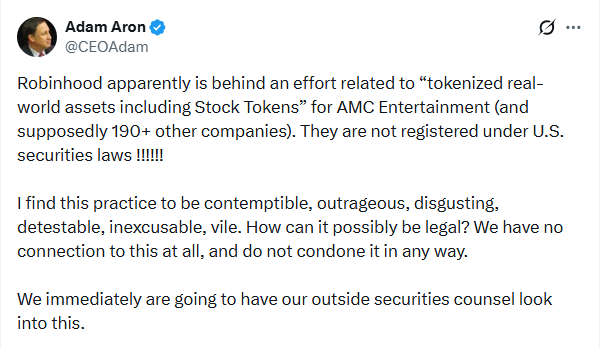
Robinhood's Stock Tokens have created a new kind of financial representation: a token can reference the economic performance of a public company's shares while being issued by a different entity and operating on blockchain infrastructure. AMC Entertainment CEO Adam Aron challenged Robinhood on 3 September 2026 after AMC-linked Stock Tokens appeared in Robinhood's offering.
Robinhood's filings identify the products as tokenised debt securities issued by Robinhood Assets (Jersey) Limited. Holders receive economic exposure to the referenced securities, while the tokens do not give them legal or beneficial rights in those securities. The deeper change is that the reference to a company's equity can now exist as a programmable asset inside a separate financial system.
To know more about this topic, read our related articles:
- FinTech explained
- Cantica, the Fin-Tech intelligence system for original datasets and custom reports to strategise your next business move
- DTCC tokenization service
- Tokenized equity access
BRIGHT ANSWERS
Does a Robinhood AMC Stock Token make someone an AMC shareholder?
No. Robinhood says Stock Tokens provide economic exposure to the referenced securities without giving holders legal or beneficial rights in those securities.
Who issues the AMC-linked Stock Token?
Robinhood says its Stock Tokens are tokenised debt securities issued by Robinhood Assets (Jersey) Limited. AMC Entertainment is the referenced company, not the issuer of the token.
A company's economic identity can now exist as a programmable asset somewhere else. Robinhood stock tokens put that change into concrete terms because an AMC-linked token can follow AMC's share price while the token itself has another issuer, another legal structure and its own blockchain infrastructure.
AMC Entertainment CEO Adam Aron challenged Robinhood on 3 September 2026 after AMC-linked Stock Tokens appeared in Robinhood's offering. Robinhood's own documents describe those products as tokenised debt securities issued by Robinhood Assets (Jersey) Limited.
The development matters because tokenisation can separate the economic reference from the legal asset. A token can carry the financial identity of a stock into a system that the company behind that stock did not build.
The AMC token has a different issuer
Robinhood introduced Stock Tokens in July 2026 as part of its expansion into onchain finance. Its regulatory filing describes them as tokenised debt securities issued by Robinhood Assets (Jersey) Limited, a Jersey company.
Robinhood also states that Stock Tokens provide economic exposure to the referenced securities while giving holders no legal or beneficial rights in those securities. The distinction separates the token from an AMC share at the level of the legal claim itself.
Robinhood's disclosure library lists final terms for tokenised debt securities linked to AMC Entertainment Holdings, dated 12 August 2026. A new RHJ base prospectus was added on 2 September.
That structure gives investors exposure to the economic performance of AMC while placing the security they actually hold under the terms of Robinhood Assets (Jersey) Limited.
Meet Cantica, the Fin-Tech intelligence system for custom reports to strategise your next business move.
The token enters a different kind of market
The technical structure changes what can happen after issuance. Robinhood describes its Stock Tokens as ERC-20 tokens and says they can be held and transferred on Robinhood Chain.
Robinhood Chain is a permissionless Ethereum-compatible Layer 2 designed for tokenised real-world assets. Its documentation describes an environment where developers can build applications around onchain assets.
This connects with DTCC tokenization service and the institutional move toward blockchain-based securities infrastructure. The difference lies in what becomes programmable. DTCC's project concerns the infrastructure supporting securities markets, while Robinhood's model puts a separate security representing economic exposure onto a programmable network.
Robinhood's filing also recognises that third parties can deploy applications and tokens on its Chain. The company says those activities can occur outside its control.
AMC remains the reference
The legal distinction becomes clearer when the token and the underlying share are placed side by side.
AMC issues AMC shares. Robinhood Assets (Jersey) Limited issues the tokenised debt security. The token references AMC's security, while the holder's rights arise from the token's own terms.
That arrangement lets the token reproduce an important economic property of the stock without reproducing the shareholder relationship.
The investor therefore encounters AMC through a financial instrument created elsewhere. The company remains connected to the price reference, while another issuer controls the legal instrument carrying that reference.
Tokenisation turns a reference into software
Robinhood's Chain documentation describes Stock Tokens as assets that can be transferred and used by applications. The token therefore has a technical life beyond the interface through which an investor first encounters it.
That property is familiar in other areas of blockchain finance. A programmable asset can become an input for another piece of software, subject to the rules of the network and the applications using it.
The same principle sits behind tokenised equity access, where investors can obtain exposure to the economic value of an equity through a tokenised product rather than through the original share itself.
Robinhood's AMC product makes the separation particularly visible because AMC itself objected to the creation of the product. The disagreement puts a corporate issuer face to face with a financial representation that can operate independently of its corporate securities.
The company controls the share, the token carries the reference
AMC's position concerns its own securities and its relationship with investors. Robinhood's product sits outside that relationship and gives investors exposure through a separate security.
Robinhood's disclosures also make clear that Stock Tokens are subject to jurisdictional restrictions and are unavailable to U.S. persons. The products operate through the legal structure established for Robinhood Assets (Jersey) Limited.
The regulatory framework therefore follows the tokenised product itself. The underlying company remains part of the reference structure.
That distinction gives tokenisation a practical consequence that is easy to miss when the technology is described simply as a new way to hold shares. The thing being tokenised can become a separate financial object with its own issuer and technical environment.
The AMC fight reveals the real change
The dispute that began on 3 September is therefore about more than whether a token holder is an AMC shareholder.
The underlying share and the token can coexist with different issuers, different rights and different technical properties. Robinhood can issue the token under its Jersey structure while AMC remains the company whose stock supplies the economic reference.
Blockchain adds another property. Once that reference exists as a programmable token, other software can interact with it without recreating the original corporate security.
That is where the broader fintech story sits.
Tokenisation has separated an asset's financial identity from the system that originally issued it, turning the reference itself into something that can circulate as software.
Editor's note
Every piece goes through careful verification, but mistakes can happen. If you spot an error, have additional information, or want to flag anything, write to rosalia@thebrightminded.com