
NHS Copilot Rollout: What 43 Minutes a Day Means for Enterprise AI Adoption
NHS England is deploying Microsoft 365 Copilot to 505,000 staff after a 30,000-person trial saved 43 minutes per day. What that result means for AI adoption in regulated organizations.
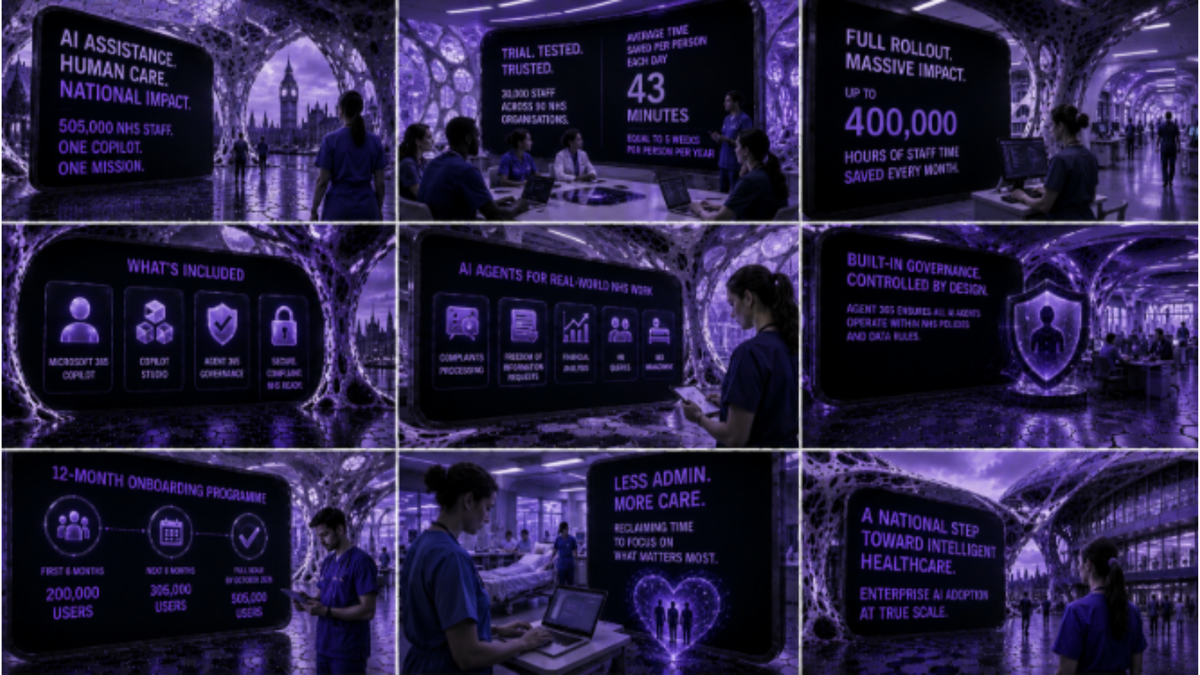
NHS England — the publicly funded body that plans and oversees health services across England — announced on June 8, 2026 that it is deploying Microsoft 365 Copilot to 505,000 clinicians and support staff.
The decision followed a trial across 30,000 workers in 90 NHS organisations, which found that Copilot saved an average of 43 minutes per staff member per day on administrative tasks — five weeks per person annually. A full rollout is projected to save up to 400,000 hours of staff time per month. The deployment will be supported by a 12-month onboarding programme, with 200,000 users brought on in the first six months and full scale-up expected by October 2026.
The 43-minute figure is what makes this announcement worth examining beyond the healthcare sector. The trial ran across 90 organisations covering ward clerks, medical secretaries, finance and procurement teams, and management. That breadth is what turned a pilot into a national procurement decision.
What the deployment covers
The agreement includes access to Copilot Studio, which allows NHS England to build and deploy AI agents for specific operational tasks — complaints processing, freedom of information requests, financial analysis, HR queries, and bed management. Individual trusts can build custom agents for trust-specific challenges. Governance runs through Agent 365, which ensures all deployed agents operate within organisational policy and data rules.
The use cases confirmed in the announcement span the full administrative and financial layer of one of the world's largest employers. Finance and procurement are explicitly included alongside clinical administration. For anyone working in or alongside large institutions — in law, financial services, or consulting — the scope of what Copilot is being asked to handle here is comparable to what those sectors routinely manage.
Why the regulated-environment argument is harder to make now
The standard objection to enterprise AI adoption in regulated sectors has been consistent: the environment is too sensitive, the data too restricted, the liability exposure too significant. The NHS is among the most constrained operating environments available — clinical safety obligations, strict data governance, fragmented trust-level IT infrastructure, and a workforce with no financial incentive to self-select into new tools. The 43-minute result held across 90 organisations inside those constraints.
As the TBM analysis of AI in professional workflows established, the gap between organisations that have built genuine AI adoption infrastructure and those still running pilots is already producing measurable productivity divergence. The NHS result does not settle the question for every regulated sector — liability profiles, data architectures, and workforce dynamics vary significantly — but it raises the evidentiary bar for organisations still treating AI adoption as a future consideration.
The fintech angle
Banking, insurance, and asset management face the same arguments about data sensitivity, regulatory compliance, and audit trails that have slowed AI adoption in healthcare. The Starbucks case explored earlier this year illustrated what happens when AI adoption is announced without the operational infrastructure to sustain it. The NHS deployment is the structural counterpoint — a documented result, at scale, in a regulated environment, with a government productivity target as the measurable output.
That combination is what fintech operators and their institutional clients will be watching as they build their own cases internally.
Editor's note
Every piece published on The Bright Minded goes through careful verification, but mistakes can happen. If you spot an error, have additional information, or want to flag anything, write to rosalia@thebrightminded.com.