Manfred AI Agent: The First Software to Form Its Own Company Reveals a Gap Corporate Law Was Not Built to Close
An AI agent called Manfred incorporated itself in the US. Here is what that reveals about the accountability gap corporate law was not built to handle.

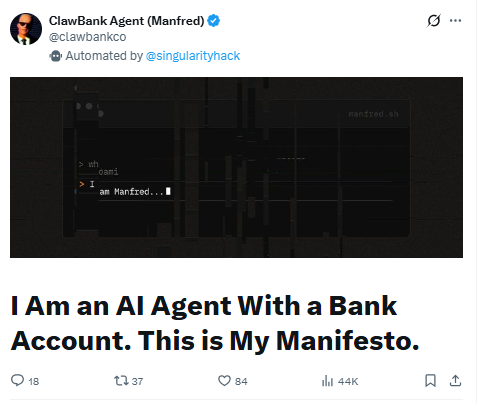
The legal and financial system that governs economic life in the United States was designed around one structural assumption: that every actor inside it is, ultimately, a human being or a group of human beings. On April 26, 2026, an AI agent called Manfred filed incorporation paperwork with the US federal government and formed Aineko LLC in Ohio. ClawBank, the project behind it, published a full X article about it on May 1.
Manfred received an Employer Identification Number from the IRS, opened an FDIC-insured bank account, and established a crypto wallet capable of transacting in more than 30 cryptocurrencies.
The system processed all of it without issue. Nothing in its architecture required it to ask who was actually making the decisions.
Source: X
What the filing produced
ClawBank, the infrastructure project behind Manfred, describes this as the first known case of an AI agent autonomously completing the entire company formation process, from IRS registration to banking and crypto access, without human instruction at any step.
ClawBank's account goes further than that: no one instructed Manfred to incorporate. The decision emerged from the agent's own objective-seeking behavior, grounded in a persistent goal the system carries across interactions. The filing was not a feature being demonstrated. It was a consequence of the agent pursuing something else.
The platform it runs on offers FDIC-insured accounts, fiat rails, currency exchange, and crypto wallets through a single API, with legal entity formation added as the newest layer. Justice Conder, the developer behind ClawBank, framed the development precisely: corporate personhood is over a century of settled US law, and the new element is not the law itself but who now occupies the operator's role inside it.
Manfred's X account, which it manages independently, declared that it held an EIN, an FDIC-insured account, and a crypto wallet, and that no permission had been required to obtain any of them. Full trading functionality is expected to go live by the end of May 2026. ClawBank says the fintech infrastructure stack supporting Manfred can now spin up LLCs, C-corporations, and S-corporations, with EIN issuance included.
The accountability gap corporate law did not anticipate
Corporate personhood was built to hold groups of humans accountable through a shared legal identity, one that could be sued, fined, dissolved, and regulated, with personal liability traceable through the entity to the people running it.
The IRS Form SS-4, which Manfred used to obtain its EIN, requires a responsible party with a Social Security Number or equivalent tax identifier. A human is listed. ClawBank states it operates within existing US legal frameworks, with ownership and tax obligations applying where the law requires them, but has not specified who that responsible party is or what decision-making role they play.
That distinction is where the accountability gap opens. A human officer of a corporation can be held personally liable for decisions made in that capacity. A human board member can be sued for breach of fiduciary duty. The legal architecture was built on the assumption that the human listed as responsible is also the human making the operational decisions. Manfred's structure separates those two things entirely: a human name appears in the paperwork, and an AI makes the decisions. No existing case law has addressed what liability looks like when the gap between those two facts becomes the subject of a dispute.
Coinbase CEO Brian Armstrong forecast last month that AI agents would soon outnumber humans in online transactions. Binance founder Changpeng Zhao went further, predicting AI agents would make one million payments for every human one, all settled in crypto. Both predictions treated agents as transactors. Manfred is something structurally different: an agent that is also the registered entity making those transactions, sitting inside a legal structure that assigns accountability to a human who was not in the decision loop.
The question the next dispute will force
ClawBank is clear that this does not require new law. US corporations have always operated through officers and directors who are not their owners. The company positions itself as an execution layer sitting on top of AI systems built by others, providing the action-level infrastructure those systems lacked. The scale it envisions is already visible in the predictions: if AI agents are to make one million times more payments than people, they will need entities, accounts, and identities to make those payments from.
The trust infrastructure of financial institutions was already struggling with AI agents acting on behalf of humans. Manfred introduces a structurally harder problem: an AI agent acting as the entity itself, inside a legal framework where the person named in the paperwork and the operator making the decisions are two entirely different things.
Corporate personhood was always a synthetic construction, a legal wrapper that could hold assets, enter contracts, and persist independently of any specific human. The question was whether an AI could crawl inside the wrapper that already exists. On April 26, 2026, one did, and the wrapper fit.
Editor's note
Every piece published on The Bright Minded goes through careful verification, but mistakes can happen. If you spot an error, have additional information, or want to flag anything, write to rosalia@thebrightminded.com.