
China AI Firing Ruling: Hangzhou Court Decides Who Pays When a Machine Takes Your Job
On April 30, the Hangzhou court ruled AI replacement doesn't justify firing a worker. The legal reasoning behind that decision reaches further than China.
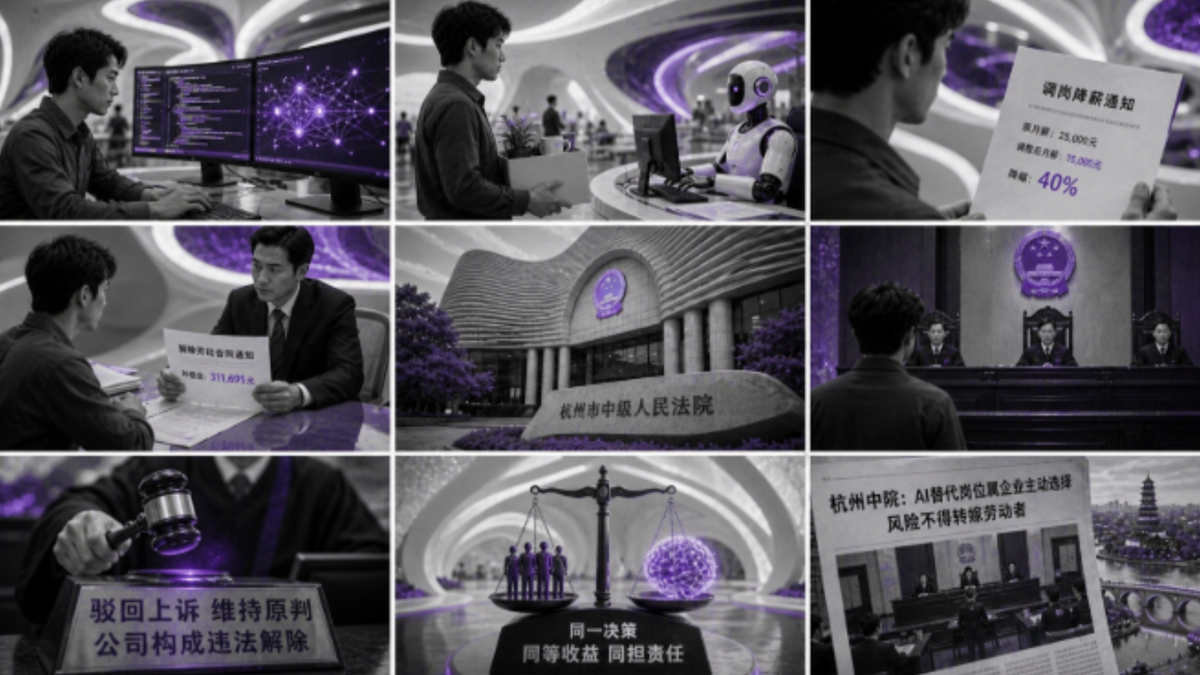
The question every labor court will eventually face is simple: when a company deploys AI and a human role disappears, who owns the cost of that decision? On April 30, 2026, the Hangzhou Intermediate People's Court upheld a ruling that a tech company in Hangzhou had illegally terminated a worker after replacing his role with large language models, offered him a 40% pay cut to stay on in a lower position, and fired him when he refused. The legal mechanism the court used to reach that outcome is what the ruling actually establishes, and what it establishes reaches further than the case itself.
What the court ruled
The worker, surnamed Zhou, joined the company in November 2022 as a quality assurance supervisor on a monthly salary of 25,000 yuan, approximately 3,640 US dollars. His role involved reviewing AI-generated outputs, matching user queries with large language models, and filtering inappropriate content. The company automated that work and offered Zhou a reassignment at 15,000 yuan per month, which he rejected.
The company then terminated his contract with an offer of 311,695 yuan in compensation, citing organizational restructuring and reduced staffing needs. Zhou sought higher compensation through arbitration, which ruled the dismissal unlawful. The company filed a lawsuit in a Hangzhou district court in August 2025 and appealed to the Hangzhou Intermediate People's Court. Both courts upheld the arbitration outcome.
The legal mechanism behind the verdict
At the center of the court's reasoning was a specific provision of China's Labor Contract Law that permits termination when a major change in objective circumstances makes the original contract impossible to perform. Companies have historically invoked this clause to exit contracts after relocations, mergers, or market collapses, situations outside their control. The Hangzhou court ruled that deploying AI falls outside this category. A company's decision to adopt large language models is a deliberate competitive strategy, the court found, and the legal framework does not permit a company to reclassify its own choices as external events it could not control.
That classification is where the legal weight sits. By citing AI replacement as grounds for dismissal, the court ruled, the company had transferred the risk of its own strategic choice onto its employee. Wang Xuyang, a lawyer at Zhejiang Xingjing law firm, told Xinhua that the gains from automating work and the obligations toward the people whose work is automated belong to the same decision, and cannot be separated. The alternative position offered to Zhou, with its 40% salary reduction, was also found to be an unreasonable reassignment proposal, which compounded the unlawfulness of the termination.
A second case, the same logic
The Hangzhou ruling was published alongside a separate Beijing case announced by the city's Human Resources and Social Security Bureau on December 26, 2025. Liu, hired in July 2009 as a manual map data collector, saw his entire division eliminated when his employer switched to AI-based data collection in early 2024 and was dismissed later that year. The arbitration panel applied the same principle: the company's pivot to automated data collection was a deliberate, predictable business decision, qualifying it as neither unforeseeable nor beyond the employer's control. Treating it as such transferred the cost of the decision onto Liu rather than the employer who made it.
The Hangzhou court published the Zhou case on April 28 as part of a set of typical examples of protecting the rights of AI enterprises and workers, a signal of deliberate timing from a court in one of China's primary AI industry hubs, ahead of International Workers' Day on May 1.
What the doctrine means beyond this jurisdiction
China's core AI industry exceeded 1.2 trillion yuan in 2025, with government projections placing AI penetration in next-generation intelligent terminals and agents above 90% by 2030. At that scale, disputes like Zhou's will accumulate faster than courts can build doctrine. The distinction Hangzhou has drawn, between voluntary competitive strategy and genuinely unforeseeable disruption, is the same distinction labor frameworks in financial services and other sectors are being asked to draw as AI takes on roles previously held by people. The accountability question sharpens further when the AI system is also the legal entity making the decisions, a scenario that courts have not yet reached but are now closer to.
China's Labor Contract Law predates AI entirely. Its application to automation disputes means the burden of proof now sits with employers who invoke technological change as grounds for termination, and the standard they must meet is that the change was genuinely unforeseeable, not merely inconvenient. Hangzhou and Beijing have produced the first legal answers to a question most jurisdictions have not yet formulated: when a company chooses AI and a worker loses their income to that choice, the company carries the cost.
Editor's note
Every piece published on The Bright Minded goes through careful verification, but mistakes can happen. If you spot an error, have additional information, or want to flag anything, write to rosalia@thebrightminded.com.