
Cavour Hyperscale Campus: The €4 Billion Trino Data Centre Overrides Local Planning
Italy's €4 billion Cavour Hyperscale Campus at Trino carries a single authorisation that acts as a planning variant and opens expropriation procedures.
The Bright Recap
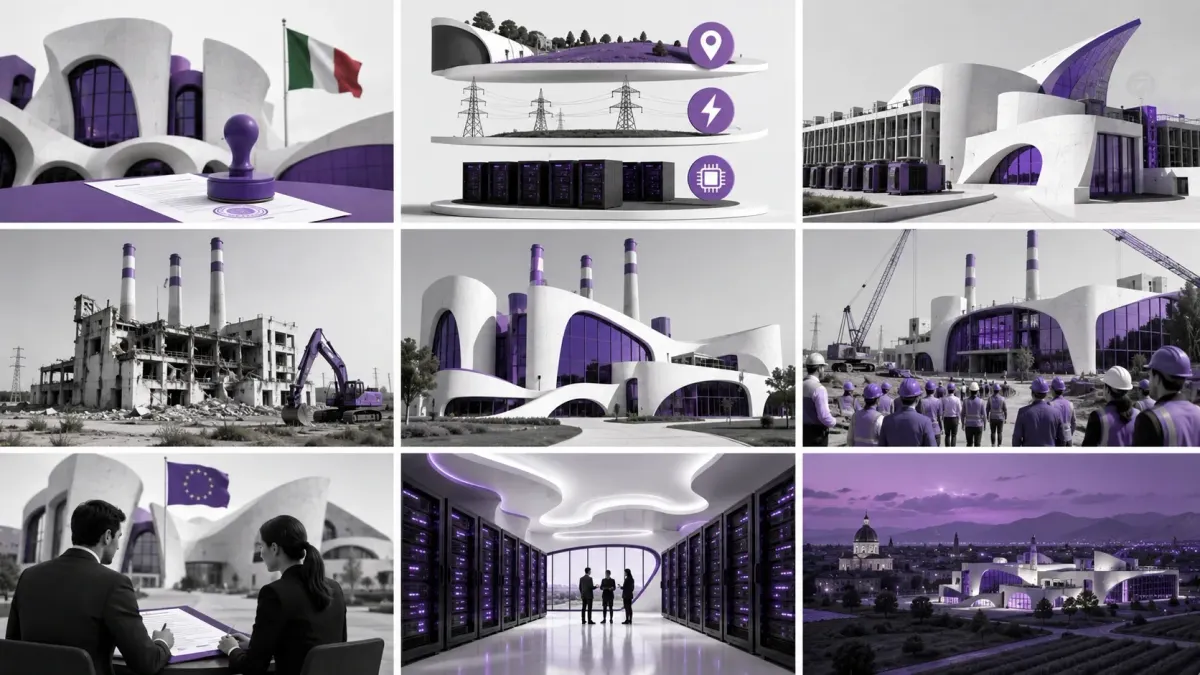
The Italian Council of Ministers declared two data centre investment programmes of pre-eminent national strategic interest on 24 July 2026, together mobilising around €8 billion. One of them, the Cavour Hyperscale Campus, converts the decommissioned Galileo Ferraris thermoelectric plant at Trino, in the province of Vercelli, into a campus designed for 300 to 400 megawatts at a cost of about €4 billion.
The statute used, Article 13 of the 2023 Decreto Asset, grants a single authorisation that takes effect as a variant to town planning instruments and counts as a declaration of public utility, opening expropriation procedures. Piedmont opened its own data centre consultation days before the declaration and has not yet presented a bill.
To know more about this topic, read our related articles:
Governments have found a way to own artificial intelligence (AI) without building any of it, and the instrument is a permit. Italy used it on 24 July 2026, when the Council of Ministers declared two data centre programmes worth roughly €8 billion of pre-eminent national strategic interest. One of them converts a decommissioned gas plant in Piedmont into a campus designed for up to 400 megawatts. The permit it was granted overrides the local planning rules and carries the power to force land sales.
Meet Cantica, the Fin-Tech intelligence system behind The Bright Minded.
The layer Italy is claiming
Sovereignty is layered, and a claim to it holds only when the claimant can say which layer they own. Emma failed that test in June 2026, when Egomnia wrapped a model of roughly 550 million parameters in the language of national critical infrastructure and withdrew the public chat five days later. The Trino declaration names its layer without ambiguity. Italy is claiming the ground, the grid connection, and the sequence in which permissions are granted.
Physical location and access rights sit within reach of a national government, while chip supply sits outside it. Trino is a claim on the first category, made in the only language the Italian state fully controls, which is administrative law.
The sovereignty Italy already owned
Italy's serious AI compute did not arrive with Trino. The Italian AI Factory, IT4LIA, was selected by the EuroHPC Joint Undertaking in December 2024 and is hosted and operated by the interuniversity consortium CINECA at the Bologna Tecnopolo, at a total cost of €430 million split evenly between the European Commission and the Italian government. The Italian half draws on the Ministry of University and Research, the National Cybersecurity Agency, the Emilia-Romagna Region, CINECA itself, the National Institute of Nuclear Physics and several research bodies. Its capacity is directed at researchers, startups, small firms and public administration.
At Trino the capital is private and the capacity will be leased. Both count as sovereignty under the layered test, and only one was built to serve users who never sign a commercial lease.
What the Council of Ministers approved
The Ministry of Enterprises and Made in Italy (MIMIT) set out the decision on 24 July 2026. Equinix per l'Italia covers seven data processing centres at Settimo Milanese and Cusago in the Milan metropolitan area, at about €4 billion between 2026 and 2033, with the entire energy requirement covered by renewables under an agreement already signed. Cavour Hyperscale Campus converts the former Galileo Ferraris thermoelectric plant at Trino, in the province of Vercelli, into a campus designed for a total of 300 to 400 megawatts at a cost of around €4 billion. Adolfo Urso proposed both, as the statute requires, and framed the decision as consolidating the country's digital sovereignty while reinforcing the technological sovereignty of the continent.
The Trino timetable opens with a joint conference of the competent authorities by the end of 2026, moves to a single authorisation by the end of 2027, and reaches a first phase in operation by the end of 2028. MIMIT expects construction to employ around 1,200 workers on average with peaks above 2,000, and projects 300 to 350 highly qualified posts at full operation alongside roughly 1,000 further jobs in related activity. Regione Piemonte named TechBau, the construction group based at Castelletto Ticino in the province of Novara, as the company that will carry out the investment. A government extraordinary commissioner will be appointed for each programme in agreement with the regions.
Why a decommissioned power station is the asset
Galileo Ferraris stopped generating in 2013. The plant stands in the Leri Cavour district of Trino, which is where the campus takes its name, on land already classified as an industrial zone. Its value now rests on the connection to the transmission network and an industrial footprint that requires no rezoning argument.
Regione Piemonte opened its data centre consultation specifically to prevent speculation and the exhaustion of water and electricity resources, which identifies the scarce input plainly enough. A bet on the grid rather than on silicon has become the standard shape of these deals across Europe.
Where financial workloads sit
Supplier substitutability has become a pre-contract test in finance. Since January 2025, the Digital Operational Resilience Act has required financial entities across the European Union to assess, before signing for technology services that support critical functions, whether a provider could be replaced easily and whether they are stacking arrangements with the same or closely connected suppliers. A hyperscale campus inside Italian jurisdiction adds an option to that assessment. Italian banks have been acting on the same logic ahead of the rule, and the question of where banking data lives is now settled in contracts.
What it buys, and what it does not
A campus of 300 to 400 megawatts inside Italian jurisdiction gives regulated firms an alternative to suppliers they currently reach abroad. Financial technology companies serving European customers carry the cost of that dependence in their resilience documentation, and the calculation changes when a substitutable option sits inside the same supervisory perimeter. Italian fintech firms would be choosing a domestic landlord for the first time at this scale.
The gain has a hard edge. Nothing in the declaration identifies the tenants, sets a price, or gives Italian firms priority over the global operators the campus was designed to attract.
The statute behind the declaration
Article 13 of Law Decree 104 of 2023, the Decreto Asset, supplies the power the Council of Ministers used. The text applies to large foreign investment programmes on Italian territory, defined as direct investment worth at least €1 billion, and it expressly preserves the European Union's foreign direct investment screening regulation alongside Italy's golden power rules. Italy has been open about this. MIMIT published a national strategy for attracting foreign investment in data centres in November 2025, and Trino is that strategy reaching its most powerful legal instrument.
MIMIT did not name the investor behind the Trino programme. Regione Piemonte named TechBau as the company carrying out the work, and local reporting in May 2026 described the original proposal as filed with the municipality by an international operator.
An extraordinary commissioner is appointed by prime ministerial decree in agreement with the president of the region concerned, serves without compensation, and draws on the government's investment unblocking unit. The commissioner may act by ordinance in derogation of any provision other than criminal law, subject to the anti-mafia code, the golden power decree and binding European obligations. Consulted administrations have fifteen days to return their opinions, after which the process continues without them. Ordinances take effect immediately and are published in the Gazzetta Ufficiale, and any derogation touching regional legislation requires prior agreement in the standing conference between the state and the regions.
What the single authorisation replaces
The single authorisation absorbs every concession, approval, consent, opinion and clearance required under existing law, and it takes effect as a variant to the town planning instruments in force. It stands in place of environmental, health and fire safety authorisations, and it establishes urban, landscape and environmental conformity by its own issue.
Its release counts as a declaration of public utility, non-deferability and urgency, which opens the expropriation procedures under the consolidated act on expropriation and provides title for compulsory easements. Siting is decided after hearing the president of the regional government, and that consultation is the point at which regional authority enters the decision.
Piedmont has not started drafting
Piedmont has no data centre law and no bill before its council. The regional government opened a public consultation at its energy transition forum in July 2026, and the environment councillor Matteo Marnati has stated that a bill will be presented once that consultation closes. The criteria under discussion include closed-circuit air cooling to eliminate water waste, mandatory recovery of waste heat into district heating networks serving schools and hospitals, renewable generation for self-consumption, and siting on redeveloped industrial land. Regional officials describe dozens of siting requests already received, and local reporting in June 2026 put the figure at roughly 70.
Trino was declared of pre-eminent national strategic interest within days of that consultation opening. Objections have since been raised locally over energy demand and the risk of logistics spreading onto surrounding rice-growing land.
The employment arithmetic sets out the trade. Original analysis, dividing MIMIT's €4 billion figure by its own projection of 300 to 350 permanent posts, gives between roughly €11 million and €13 million of capital per permanent job. Industrial policy at that ratio buys something other than employment.
Administrative certainty is the scarcest thing Italy has to sell to the artificial intelligence economy, and the Trino declaration shows the going rate: four billion euros and the planning authority of a province.
Editor's note
Every piece goes through careful verification, but mistakes can happen. Readers who spot an error or have additional information can write to rosalia@thebrightminded.com.