
BitPay Secures MiCA Licence to Run Crypto and Stablecoin Payments Across the EU
BitPay secured a MiCA licence from the Dutch AFM, letting it run regulated crypto and stablecoin payments for merchants and shoppers across the European Union.
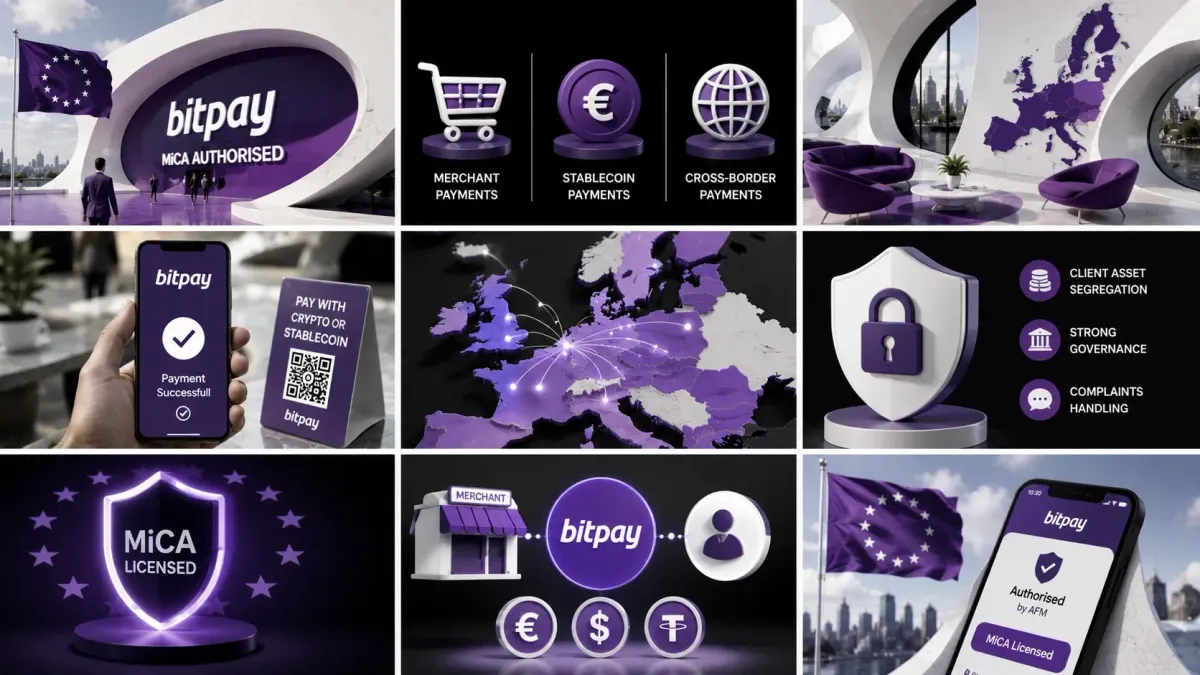
The Bright Recap
BitPay announced on 16 July 2026 that its European subsidiary, BitPay B.V., secured a Markets in Crypto-Assets (MiCA) licence from the Dutch Authority for the Financial Markets (AFM). The authorisation covers regulated crypto and stablecoin payments across the EU, including merchant acceptance, cross-border payments, and consumer spending.
To know more about this topic, read our related articles:
- Nexo's choice
- The licence that thinned the field
- A passportable licence in practice
- A systemic bank enters stablecoins
- How a licence splits the customer
- How to check your own platform
- Financial technology explained
Bright Answers
What does BitPay's MiCA licence allow?
It lets BitPay B.V. provide regulated crypto-asset payment services across the EU, including merchant payment acceptance, stablecoin-denominated payments, and cross-border transactions, under supervision from the Dutch AFM.
Which regulator authorised BitPay?
The Dutch Authority for the Financial Markets, known as the AFM. Under MiCA, a licence from one national regulator can be passported across the whole European Economic Area, so BitPay can serve customers EU-wide from its Amsterdam base.
BitPay secured a Markets in Crypto-Assets (MiCA) licence to run regulated crypto and stablecoin payments across the European Union. The company announced on 16 July 2026 that its European subsidiary, BitPay B.V., had been authorised as a crypto-asset service provider by the Dutch Authority for the Financial Markets (AFM). The licence covers merchant payment acceptance, stablecoin-denominated payments, and cross-border transactions for customers across the bloc.
BitPay has processed cryptocurrency payments since 2011 and runs its European operations from Amsterdam. The company describes the authorisation as a step that lets merchants and partners accept crypto payments under one EU framework, and for consumers points to wider access to spending and managing digital assets, along with buying, selling and swapping them through its partners.
This story was Elevated by Cantica's Purgatorio.
Cantica is the Fin-Tech intelligence system behind The Bright Minded.
What the licence covers
MiCA lets a firm authorised by one national regulator passport its services across the entire European Economic Area, so BitPay's Dutch licence reaches customers EU-wide without separate approvals in each country. Firms that completed full EU compliance earlier relied on the same passporting route. Thom de Jong, BitPay's Chief Compliance Officer for Europe, framed the AFM authorisation as validation of the company's compliance-first approach and a strengthening of its ability to serve businesses and consumers with regulated digital asset services.
The authorisation applies to the payment side of crypto rather than trading. A licensed provider handling payments has to meet custody, conduct and complaints standards, which brings crypto and stablecoin spending closer to the protections expected of other regulated financial technology. Jonathan Arler, BitPay's Head of Europe, called the region central to the future of payments and said the Amsterdam base positions the company to support merchants and consumers as demand grows for accepting, moving and spending digital assets.
Why Cantica's Purgatorio flagged this as good news
Cantica, is the Fin-Tech intelligence system behind The Bright Minded. Its judging layer, Purgatorio, marked it as good, because a payments licence sets the protections that apply when a person spends crypto rather than trades it. The stablecoin element carries the most weight for everyday use, since a shopper paying with a euro or dollar stablecoin avoids the price swings that make volatile crypto impractical at a till, while a licensed provider handles the transaction under supervision.
Part of a wider licensing wave
BitPay joins a field that narrowed sharply after MiCA's transitional period closed on 1 July 2026, with around 280 firms now authorised across the European Economic Area, down from an estimated several thousand under older national regimes. The licence that thinned the field is the same one now enabling regulated payments, and BitPay cleared it the same day as at least one other firm.
The pattern runs across the sector. A systemic bank entering stablecoins signalled that regulated digital payments were becoming standard infrastructure, and a MiCA authorisation can reshape the customer relationship, as seen when one firm keeps the customer while another runs the trade. Anyone using a crypto service in Europe can now check a platform's status against the public register.
BitPay has held money transmitter licences and other approvals in several jurisdictions, and the company presents the European authorisation as an addition to that global footprint as crypto and stablecoin payments reach more businesses and consumers.
Editor's note
Every piece published on The Bright Minded goes through careful verification, but mistakes can happen. If you spot an error, have additional information, or want to flag anything, write to rosalia@thebrightminded.com.