
Paymonade Clears MiCA: Why Europe's Crypto Licence Protects Users by Erasing Their Options
Paymonade cleared MiCA as only around 280 crypto firms survived the July deadline. The licence that thinned the field is what now protects the people who stayed.
The Bright Recap
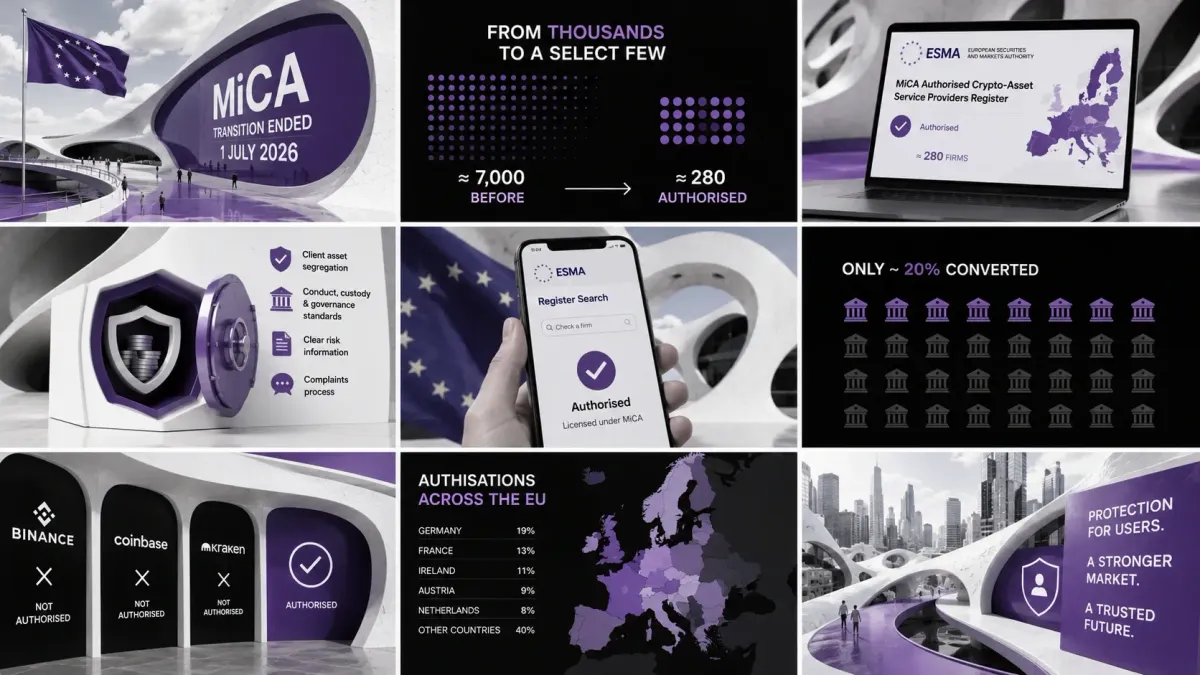
Paymonade, a Singaporean-founded infrastructure provider, announced on 16 July 2026 that it had cleared Markets in Crypto-Assets (MiCA) authorisation through Liechtenstein's regulator. It joins around 280 fully authorised crypto firms on the public ESMA register after MiCA's transitional period closed on 1 July 2026, down from an estimated several thousand operating under older national regimes.
To know more about this topic, read our related articles:
- How to check your own exchange
- Public financial infrastructure you can check
- When a giant fails the same bar
- Why Germany dominates the register
- Who else cleared the same bar
- A passportable licence in practice
- Financial technology explained
Bright Answers
What does a MiCA licence mean for someone using a crypto platform?
A licensed provider must keep client assets separate from its own, follow conduct and custody rules, and offer a formal complaints process. Anyone can confirm a firm's status in the public ESMA register, which lists every authorised provider across the European Economic Area.
How many crypto firms are MiCA-authorised?
Around 280 firms held full authorisation across the European Economic Area as of mid-July 2026, according to the ESMA register. That is a sharp fall from the several thousand estimated to have operated under earlier national regimes, and licensing is concentrated in a few countries, led by Germany.
Around 280 crypto firms now hold full authorisation to serve Europe, and that number is the whole story. Europe's Markets in Crypto-Assets (MiCA) transitional period closed on 1 July 2026, cutting the field from an estimated several thousand firms operating under older national regimes to the few hundred on the public register kept by the European Securities and Markets Authority (ESMA).
Paymonade, a Singaporean-founded infrastructure provider, announced on 16 July that it had cleared authorisation through Liechtenstein's regulator. The more useful question than who passed is what passing now guarantees the person using the platform.
This story was Elevated by Cantica's Purgatorio.
Cantica is the Fin-Tech market intelligence system behind The Bright Minded.
Why Cantica flagged this as good news
Cantica, the Fin-Tech intelligence system behind The Bright Minded, marked this development as "Good" in its Purgatorio layer. The reason sits in the position of the customer rather than the firm, since a licence rewrites what happens to that customer's money if the platform holding it fails. Cantica read a change in consumer protection where the company saw a corporate milestone.
I agree with that read, and the rest of this piece is the case for it, complications included. A MiCA licence is one of the few moments in crypto where a regulator has placed the user's protection above the firm's convenience, and the register turns that protection into something a non-specialist can confirm in under a minute.
What the licence actually gives the person using the platform
The protections are concrete. An authorised provider must keep client assets segregated from its own, so a customer's holdings stay separate from the company balance sheet if it collapses. It must meet conduct, custody and governance standards, publish clear risk information, and run a complaints process the customer can use. These protections match the categories that already apply to other regulated financial technology, now imported into a sector that spent a decade without them.
The register carries the most weight for a professional outside the crypto world. Checking a platform's supervision once meant reading a patchwork of national regimes, where the information existed at all. A single public list from the EU regulator now names every authorised firm across the European Economic Area, and anyone can check whether a platform survived the deadline. Verification has moved from specialist knowledge to a search anyone can run, in the same way the euro's own digital infrastructure is being built to be checkable in public.
The same rules that protect users cleared the market
Reaching around 280 authorised firms meant most of the previous population never converted, with independent trackers putting the conversion rate near a fifth of the firms that once held national registrations. Those that stayed out withdrew from Europe, rebuilt their structure, or carried on without a licence against EU law. A regime that raises the standard this steeply also decides, in practice, how many firms are permitted to exist.
The bar has proven high even for the largest operators. Independent tracking of the register indicates that only around fifteen of the world's hundred biggest exchanges by volume currently hold MiCA authorisation, and several major global names remain absent as the register stands. Even Binance lost its regulated footing in EU markets after failing to secure a licence, which shows how little the size of a firm guaranteed its survival.
Concentration is the complication worth watching
The register runs uneven across the bloc. Authorisation clusters in a handful of jurisdictions, with Germany alone holding close to a fifth of all licences and the five largest countries accounting for roughly 60% of the total. Firms chose their regulators with intent, and some picked the toughest supervisor available as a signal of seriousness, joining the roughly one in five platforms that finished the process.
A smaller field carries its own cost for the user. A market cleared of most competitors by regulation, rather than by customers choosing the best firms, can leave the survivors under less pressure to compete on price or service. The person gains protection at the same time as the range of platforms available to them shrinks. Both effects are real, and describing only the protection would turn this into the promotional version of the story.
Why the survivors inherit more than a licence
The firms on the register cleared a compliance bar and gained a European market with most of their former competition removed by law, at the moment regulated status becomes the condition institutional clients set before they will connect. Providers such as Paymonade, which supplies the euro and fiat settlement plumbing that exchanges and banks rely on, stand to absorb business that unlicensed rivals can no longer legally handle. Firms that completed full EU compliance early understood the licence as a commercial position as much as a legal one.
A crypto licence in Europe has become a filter for the industry and a guarantee for the customer, thinning the field to a few hundred firms while giving the people who use them the first verifiable protections the sector has offered.
Editor's note
Every piece published on The Bright Minded goes through careful verification, but mistakes can happen. If you spot an error, have additional information, or want to flag anything, write to rosalia@thebrightminded.com.