Anthropic Is Racing to an IPO While OpenAI Waits for Its Price
Anthropic is targeting an October IPO near a record valuation while OpenAI leans towards 2027, holding out for a $1 trillion listing. Both filed in June.
The Bright Recap
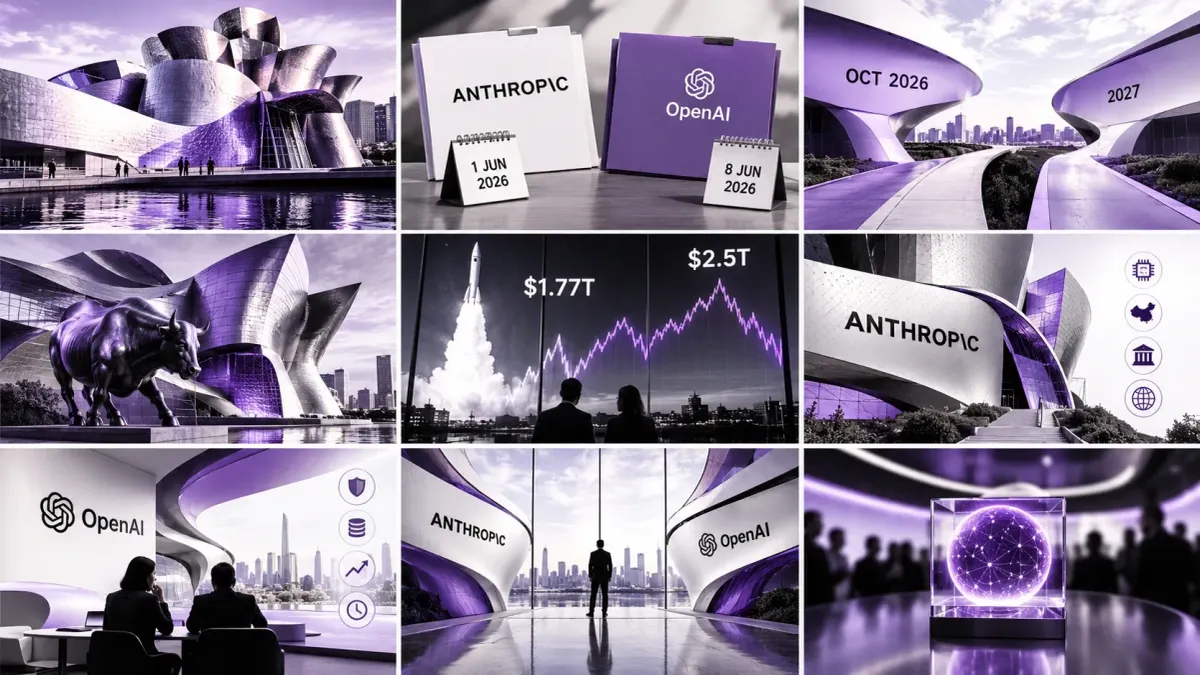
The most watched race in public markets has split. Anthropic is targeting an initial public offering (IPO) as early as October 2026 at a valuation reporting places in record territory, while OpenAI is leaning towards 2027 to protect a $1 trillion listing price. Both companies filed confidential paperwork a week apart in June.
The divergence turns on who sets the price. Whichever artificial intelligence (AI) company lists first becomes the public benchmark for every private valuation behind it, and SpaceX has already shown the danger, shedding close to a trillion dollars after its first earnings exposed its spending.
To know more about this topic, read our related articles:
- OpenAI says going public can wait
- SpaceX's $1.77 trillion market debut
- What an IPO filing reveals about AI's costs
- Financial technology explained
Bright Answers
Who will go public first, Anthropic or OpenAI?
Anthropic is currently expected to list first, with reporting pointing to an initial public offering as early as October 2026. OpenAI has signalled it is leaning towards 2027, holding out for a $1 trillion valuation.
Why does it matter which AI company lists first?
The first to go public sets the reference price for the sector, since its disclosed revenue and margins become the benchmark for every private AI valuation. SpaceX's sharp post-listing fall showed how severely public markets can reprice heavy AI spending.
Anthropic and OpenAI filed confidential paperwork for an initial public offering (IPO) within a week of each other in June 2026, and two months later they have chosen opposite paths. Anthropic is moving towards a listing as early as October, at a valuation that reporting suggests could set a record. OpenAI is leaning the other way, willing to wait until 2027 to protect the price it wants. The two companies looked at the same market and read it in contradictory ways.
Both can raise money without the public markets, and both have done so at valuations approaching a trillion dollars. What neither can control is how public investors will price them once earnings and margins are on the record. That verdict is the real subject of this split, and one recent listing has already shown how harsh it can be.
Two filings, a week apart
Anthropic submitted its confidential draft to the Securities and Exchange Commission (SEC) on 1 June 2026. OpenAI followed on 8 June and announced the step publicly, while signalling that going public can wait. Goldman Sachs and Morgan Stanley are working on both offerings, each reported to be seeking at least $60 billion. On paper the two companies start from a similar place: enormous private valuations, fast revenue growth and heavy spending on the computing power their models depend on.
The lesson SpaceX left behind
The warning came from SpaceX's record listing. It priced in June at $135 a share, a valuation of about $1.77 trillion, then climbed towards $2.5 trillion within days on a thin slice of freely traded stock. The shares fell back after its first public earnings exposed the scale of its spending on artificial intelligence (AI), wiping out close to a trillion dollars of that peak. The market repriced the company the moment it could see the numbers, and every AI business now heading for the exit watched it happen.
Why Anthropic is moving now
For Anthropic, going first carries a clear prize. The company was valued near $965 billion in its most recent private round, and reporting from the Financial Times says investors now expect an October debut approaching $2 trillion, which would be the largest IPO on record. Being first also means becoming the reference point that every other AI valuation is measured against, a position watched closely across financial technology and public markets. The risks are just as visible: competition from cheaper Chinese models, a leading model that reporting puts at roughly two and a half times the running cost of OpenAI's top product, a dispute with the United States government, and a temporary export restriction that slowed its revenue growth in June.
Why OpenAI is holding back
OpenAI's calculation runs the other way. Its chief financial officer, Sarah Friar, has reportedly argued for waiting until the company's accounts are ready for public scrutiny, while chief executive Sam Altman has treated any listing below $1 trillion as unacceptable. The company's annualised revenue has passed $40 billion, yet its cash burn remains heavy, and a public filing would put both figures under the same scrutiny of AI's hidden costs that its rivals now face. A move in 2027 lets OpenAI choose its own moment and avoid the market's first offer.
The number that matters has not been set by either company. It will be set by whichever lists first, because the earnings and gross margins in that prospectus become the yardstick for every private AI valuation still waiting behind it. Analysts have already pointed out that this single disclosure will reprice competitors and tell every business what it should expect to pay for intelligence in future. Anthropic and OpenAI read the same evidence and reached opposite conclusions, one moving to become that first public verdict, the other refusing to be priced until the market meets its number.
Editor's note
Every piece published on The Bright Minded goes through careful verification, but mistakes can happen. If you spot an error, have additional information, or want to flag anything, write to rosalia@thebrightminded.com.