UK Sanctions Russia's $90 Billion Crypto Network With a Rule Built for Banks
The UK sanctioned 18 entities tied to Russia's A7 stablecoin network. Here is how the network operated and what the legal tool used reveals.
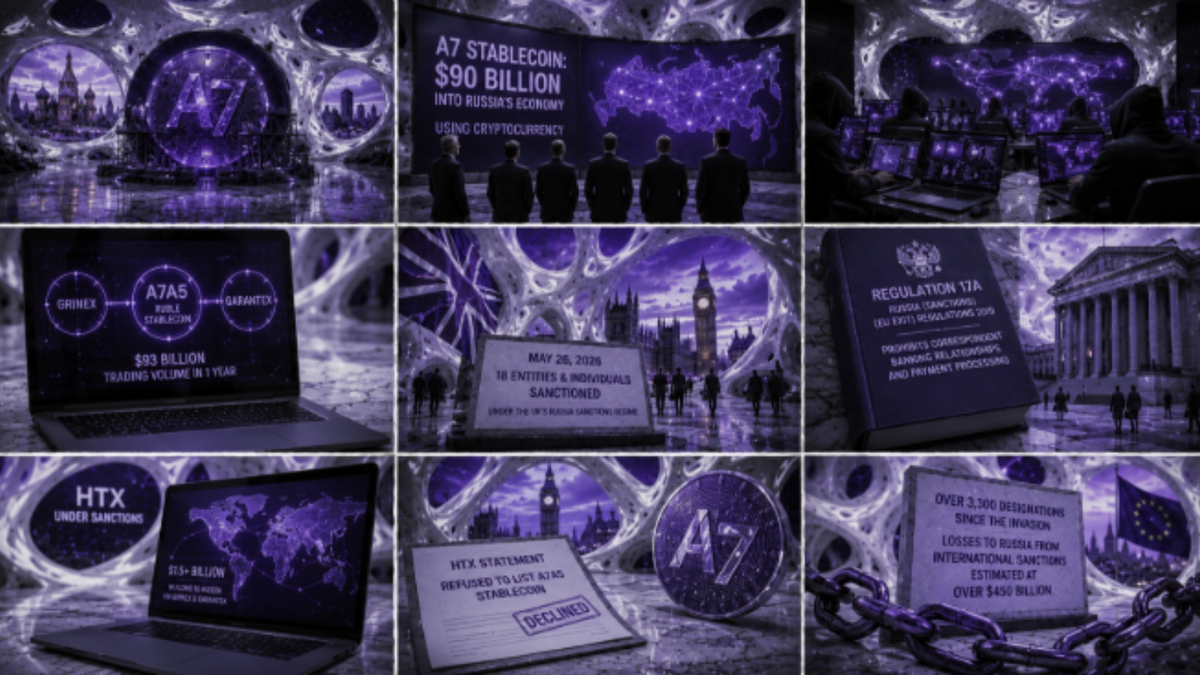
Russia did not try to hide its shadow payment system. The A7 network, a Kremlin-backed infrastructure built around a ruble-denominated stablecoin, claimed last year to have moved $90 billion into Russia's economy using cryptocurrency. The UK government notes that figure is roughly half of Russia's annual military expenditure.
On May 26, the UK's Foreign, Commonwealth and Development Office sanctioned 18 entities and individuals connected to that network, applying a legal tool to crypto exchanges that had previously only been used against sanctioned banks.
How the A7 network operated
The A7 stablecoin, known as A7A5, is pegged to the Russian ruble and circulates across the Ethereum and TRON blockchains. Issued in Kyrgyzstan, it operated outside the reach of most Western regulatory frameworks and recorded $93 billion in trading volume in its first year, according to Chainalysis. The UK had already sanctioned A7 LLC, the Russian company behind the stablecoin, in May 2025. Tuesday's package targeted the broader network of exchanges, banks, and intermediaries that gave it reach.
Chief among those intermediaries were Grinex and Garantex, two Russia-linked exchanges already shut down by law enforcement. Garantex was dismantled in March 2025, and Grinex, its direct successor, was crippled in April when it lost 1 billion rubles to a hack it attributed to foreign intelligence services, before going dark. Chainalysis transaction mapping showed that many of the 18 newly designated entities had direct traceable flows to both platforms.
The UK also sanctioned Open Joint Stock Company "Virtual Asset Issuer," a Kyrgyzstan-linked entity classified as being of economic significance to the Russian government, alongside named individuals including Sergey Mendeleev, Igor Gorin, Irina Akopyan, and Israeli national Liran Cohen, all accused of sanctions-evasion activity.
The enforcement tool and what it does
The legal mechanism at the centre of Tuesday's action is Regulation 17A of the Russia (Sanctions) (EU Exit) Regulations 2019. It prohibits UK financial institutions from maintaining correspondent banking relationships with designated entities and from processing any payments connected to them. Blockchain analytics firm Elliptic confirmed this was its first use against crypto exchange businesses, having previously been applied only to sanctioned banks.
The practical effect goes beyond asset freezes. Any UK-regulated firm, including crypto service providers, is now barred from processing transactions connected to the 18 designated entities, not merely from holding their funds. That reach extends across the entire payment chain, not just the point where assets are held. Russia's own economic data gives the timing its context: this month, the Kremlin reduced its GDP growth forecast for 2026 from 1.3% to 0.4%, and halved its projection for 2027.
The HTX dispute
The most prominent name on the designation list is HTX, the exchange formerly known as Huobi, which processed $3.3 trillion in trading volume in 2025 according to its annual report. The UK government said it suspected HTX had channeled more than $1.5 billion toward Russia through flows involving Grinex and Garantex, and that it had provided services to the A7 network. HTX rejected the allegations, stating it had refused to list the A7A5 stablecoin when approached.
The FCDO's official sanctions notice acknowledged it had not presented specific evidence of HTX-A7A5 cooperation, relying on a reasonable-suspicion standard. The A7A5 team confirmed separately to CoinDesk that it had approached HTX and other major centralized exchanges seeking a listing, and that HTX had declined. Justin Sun, Tron's founder and a prominent advisor to HTX with significant ownership ties, was not personally named in the designations.
The broader pattern
Tuesday's action closely follows a wider EU sectoral ban on the Russian and Belarusian crypto economy, implemented in April 2026, covering exchanges, decentralized platforms, stablecoins, and virtual asset service providers. Britain has now sanctioned more than 3,300 individuals, businesses, and ships since Russia's full-scale invasion began, with cumulative losses to Russia from international sanctions estimated at over $450 billion by the UK government.
For the stablecoin sector building legitimate infrastructure alongside all of this, the direction is clear. The euro stablecoin consortium forming around 37 European banks, the regulatory licensing being secured under MiCA, and Standard Chartered absorbing its own crypto custody arm all point to the same structural reality: crypto payment infrastructure is being governed, enforced, and absorbed using the same tools as banking. The A7 network built its reach on the assumption that distance from the regulated financial system was protection. Regulation 17A, a rule written for banks, has retired that assumption.
Editor's note
Every piece published on The Bright Minded goes through careful verification, but mistakes can happen. If you spot an error, have additional information, or want to flag anything, write to rosalia@thebrightminded.com.