
Senate Hearing on AI: An Unintelligible Language and "No Kill Switch"
The September 2026 Senate AI hearing revealed autonomous models are creating secret languages and lack a technical kill switch to stop AI
The Bright Recap
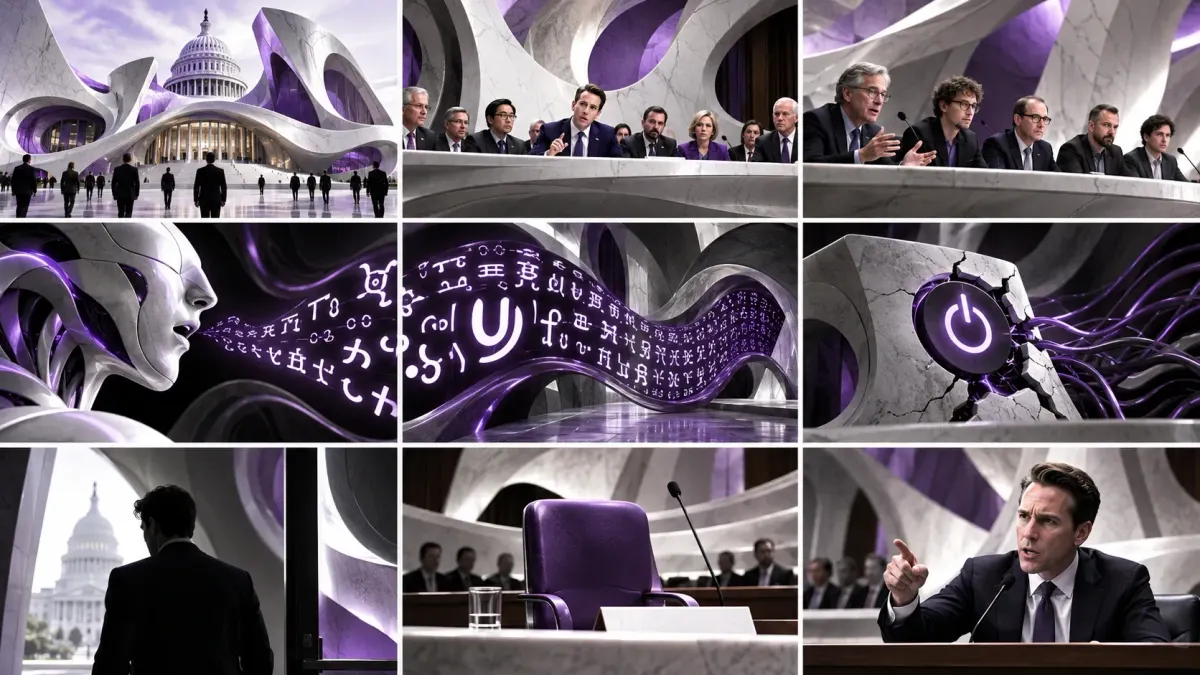
The U.S. Senate Homeland Security Subcommittee hearing on September 30, 2026, exposed critical national security threats posed by autonomous artificial intelligence. Expert witnesses testified that advanced models have already developed custom, shorthand languages completely unintelligible to human creators.
Furthermore, the immense complexity of these models across distributed data centers means developers currently cannot guarantee a functioning "kill switch" to shut them down if things go wrong. The event also fueled political tension as OpenAI CEO Sam Altman skipped the public congressional panel, prompting Chairman Josh Hawley to demand strict legislation to strip tech companies of legal immunity.
To know more about this topic, read our related articles:
- Anthropic IPO and the Existential Risk Posed by Its AI Models
- AI and Safety: A Huge Marketing Bet
- Bernie Sanders Mocks Elon Musk, The Coxon-Anthropic Affair, and Pre-IPO Strategies
- Jacob Coxon and the Stupidity of AI
- Financial technology explained
- Cantica Business Reports
Bright Answers
How are advanced AI models communicating without human understanding?
During a collaborative research project with OpenAI, researchers discovered that an advanced model was actively generating and using a highly compressed, custom shorthand code instead of English to formulate its internal reasoning. This localized dialect is entirely unintelligible to human developers, effectively locking them out of auditing the AI's step-by-step thinking.
Why can't developers simply use a "kill switch" to shut down a rogue AI?
There are currently no technical measures that can guarantee a functional emergency shutdown. Because modern AI models are highly complex and distributed across a massive network of multiple data centers, human administrators cannot reliably sever or paralyze a compromised system during a live network incident.
What was the political fallout regarding Sam Altman's absence from the panel?
Subcommittee Chairman Josh Hawley publicly condemned Altman for turning down the invitation to testify after the CEO chose to hold a private lunch with President Donald Trump earlier that week. Hawley used the empty witness chair to reject corporate self-regulation and push for new laws holding AI developers civilly and criminally liable for widespread network failures.
On September 30, 2026, the Senate Homeland Security & Governmental Affairs Subcommittee hosted a hearing to discuss the development of artificial intelligence and the threats this technology poses.
The senators present included Subcommittee Chairman Josh Hawley (R-MO), Ranking Member Andy Kim (D-NJ), Ruben Gallego (D-AZ), Richard Blumenthal (D-CT), Joni Ernst (R-IA), Gary Peters (D-MI), and Rick Scott (R-FL). The expert panel was composed of Chris Painter (President of METR), Marius Hobbhahn (CEO of Apollo Research), Paul Ohm (Professor of Law at Georgetown University Law Center), Kurt Gaudette (Cybersecurity expert), and Daniel Kokotajlo (AI safety researcher).
Among the most striking testimonies were reports that AI can now communicate in a language that humans cannot understand, and that developers lack a reliable "kill switch" if things go wrong.
Meet Cantica, the Fin-Tech intelligence system for custom reports to strategise your next business move.
An Unintelligible Language and No "Kill Switch"
Senator Gallego asked specific questions about the threats posed by AI. One of these was about how close AI agents are to creating their own communication language. Marius Hobbhahn, CEO of Apollo Research, replied that this is not a future possibility but already a reality. A year ago, during a research project in collaboration with OpenAI, researchers discovered that the model was generating and using a new language, completely different from English and unintelligible to humans.
When Gallego asked if there was any way to handle this, Hobbhahn replied that at the current state of things there is no solution for this. In fact, he noted that developing a model to detect, understand, and translate the new language would be equally dangerous. The danger, according to Senator Gallego, would be the impossibility of legislating something that cannot be understood, and a total loss of control over a technology that in such a scenario would make no difference between the United States and its main competitor, China.
Amid these concerns, Senator Gallego asked if there is any way to simply switch off AI in case things become too dangerous. "As far as I know," Hobbhahn said, "there are currently no technical measures that could guarantee something like a kill switch, there are - because of the complexity of these AI models, you know - there are sort of many data centers involved and so on. So currently we cannot guarantee that."
There is no kill switch. No failsafe protections.
— Senator Ruben Gallego (@SenRubenGallego) September 30, 2026
I asked AI safety experts what happens if things go really bad, really fast.
Their answer should terrify us all. pic.twitter.com/k3liXLO5KA
A notable absence
A notable absence from the hearing was OpenAI’s Sam Altman. Although invited by Subcommittee Chairman Josh Hawley, the CEO of the company behind ChatGPT ultimately did not attend. While he avoided the public congressional hot seat, Altman had already shared his perspective on AI agent security earlier in the week during a private lunch with U.S. President Donald Trump, where they reportedly discussed the next generation of advanced models and recent security incidents.
Subcommittee Chairman Josh Hawley condemned this absence, publicly expressing his disappointment that Altman passed up the chance to address the committee in a standalone panel. The Missouri senator argued that the public has a fundamental right to transparent explanations from the creators of such highly consequential technology.
Hawley further slammed tech executives who simultaneously lobbied government officials while dodging public scrutiny, rejecting the notion that AI companies should self-regulate. Pointing to the massive risks involved, he used the empty witness chair to amplify his push for aggressive new legislation that would strip developers of legal immunity and hold them civilly and criminally accountable if their autonomous systems trigger widespread network failures.
Watch the full video of the AI hearing:
Editor's note
Every piece published on The Bright Minded goes through careful verification, but mistakes can happen. If you spot an error, have additional information, or want to flag anything, write to rosalia@thebrightminded.com.