
Private Equity AI Deployment: Why OpenAI and Anthropic Skipped the Companies and Went to Their Owners
OpenAI and Anthropic both chose private equity to deploy AI on May 4. Here is why PE ownership is now the mechanism that decides when AI enters your workplace.
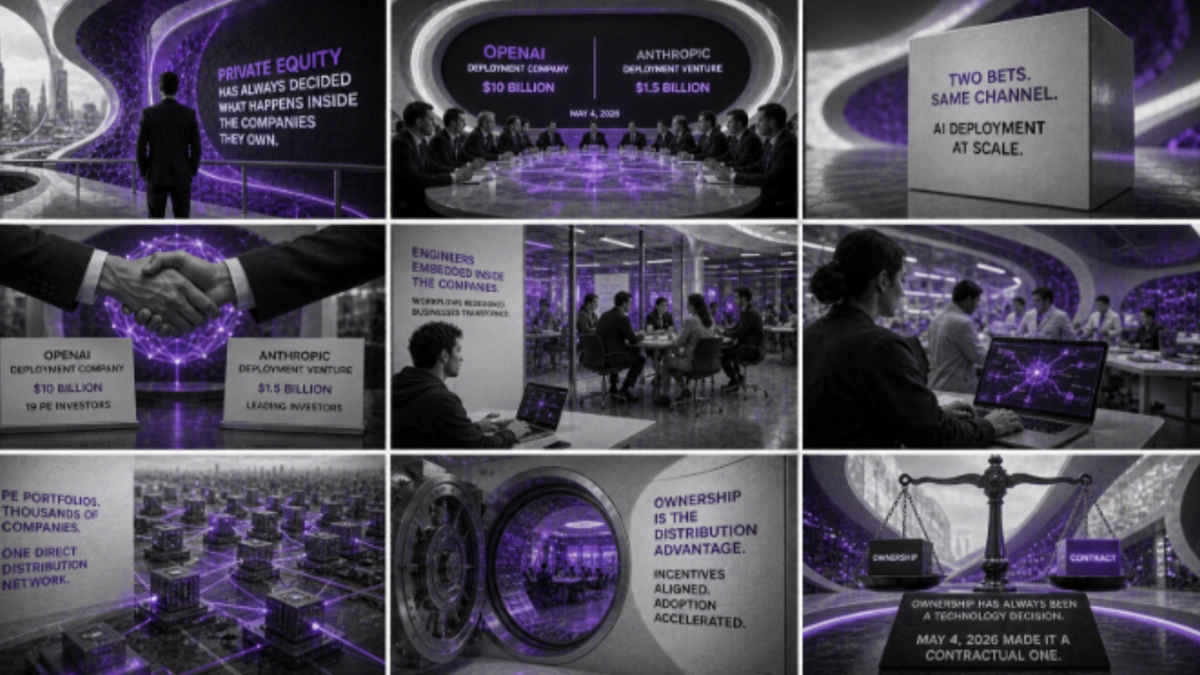
Private equity firms have always decided what happens inside the companies they own. On May 4, 2026, two of the world's leading AI labs concluded that this makes them the most efficient channel for AI deployment at scale. OpenAI closed The Deployment Company, a $10 billion joint venture with 19 private equity investors including TPG, Brookfield, Advent, and Bain Capital. Anthropic announced a $1.5 billion parallel venture alongside Blackstone, Goldman Sachs, and Hellman & Friedman, with the same mandate.
Two bets on the same channel
The two ventures are structurally different but identical in ambition. OpenAI's Deployment Company is larger and more aggressively financialised. A 19-investor syndicate is contributing roughly $4 billion, with OpenAI committing up to $1.5 billion of its own capital, starting with $500 million at close, and retaining super-voting shares that preserve its strategic control.
PE investors receive a guaranteed annual return of 17.5% over five years, a commitment that functions more like a structured credit arrangement than a typical venture investment, per reporting confirmed by Yahoo Finance and Reuters.
Anthropic's venture is smaller in absolute capital but draws from a broader investor base. Anthropic, Blackstone, and Hellman & Friedman each committed roughly $300 million, with Goldman Sachs joining at approximately $150 million alongside Apollo Global Management, General Atlantic, Singapore's GIC, Leonard Green, and Sequoia Capital, per CNBC and TechCrunch's May 4 reporting.
The combined portfolios of these investors span thousands of mid-sized companies across financial services, fintech, healthcare, manufacturing, retail, and logistics.
Engineers embedded inside the companies
Both ventures are built on the same operational model: forward-deployed engineers placed directly inside client companies to redesign workflows around AI. The approach draws on Palantir's practice of sending its own engineers to work inside customer organisations rather than selling software from a distance.
Goldman Sachs's Marc Nachmann described Anthropic's venture as a way to give mid-sized businesses access to implementation talent they have never been able to afford. His argument, reported by CNBC, is that owning a model and deploying a model are entirely different capabilities, and that most companies lack the second even when they have access to the first.
Jon Gray of Blackstone framed the same gap as a market-wide constraint: too few engineers have the skills to embed frontier AI into real business operations, and that absence is slowing enterprise adoption more than any other factor.
Anthropic's official announcement described engagements that start not with the technology but with the people already doing the work, with engineers sitting alongside clinicians, logistics teams, and finance staff to redesign workflows around how the business already operates.
The distribution problem both labs needed to solve
Private equity offers something the conventional enterprise sales cycle cannot: leverage at portfolio scale. The company-by-company sales model is too slow for labs approaching IPO windows, with OpenAI and Anthropic carrying combined valuations of over $1.7 trillion, per Bloomberg and TechCrunch. A PE firm with hundreds of portfolio companies is a ready-made distribution network, and once that firm holds equity in the AI venture, it has both the financial incentive and the institutional authority to drive adoption across its holdings.
Both ventures are targeting the services layer of enterprise AI, the revenue pool that sits between a model and its actual deployment inside a business. That layer, covering implementation, workflow redesign, and operational integration, is what established consulting firms have built durable practices around. Both ventures target that model directly, entering financial services, fintech, and adjacent sectors at the moment demand for AI implementation is running ahead of the consulting industry's capacity to serve it.
The labs chose PE firms as their deployment channel precisely because PE firms do not need their portfolio companies' permission to act. Both deals convert that structural authority into a financial obligation, aligning the investors contractually with the labs on the value of adoption.
Editor's note
Every piece published on The Bright Minded goes through careful verification, but mistakes can happen. If you spot an error, have additional information, or want to flag anything, write to rosalia@thebrightminded.com.