OpenAI Disrupted a Russian Influence Operation: When a Private Company Does a Government's Job
OpenAI detected, named and shut down a covert Russian influence operation on its platform. What it means when a private company does a government's job.
The Bright Recap
OpenAI detected a covert Russian influence operation on its platform, identified the operators, banned the accounts and published its own verdict on 25 August 2026, work that has always belonged to states.
To know more about this topic, read our related articles:
- OpenAI's model and the US government review
- How threat actors weaponise AI brands
- Cantica, real data & strategic Fin-Tech reports for businesses
- Financial technology explained
Bright Answers
What did OpenAI announce about the Russian influence operation?
OpenAI said on 25 August 2026 that it had detected a covert Russian influence campaign on its platform, identified the operators, banned the accounts, and published its findings, carrying out detection, attribution and disruption against a foreign state on its own authority.
Why does a private company disrupting foreign influence raise concerns?
The company that decides which operations to expose holds the evidence privately, faces no court or appeal, and is commercially and nationally tied to one government, which concentrates a state-level power in very few hands.
Accusing a foreign government of running a covert operation, proving who is behind it, and shutting it down has been the exclusive work of states and their intelligence services. OpenAI did all of it on 25 August 2026. The company found a Russian influence campaign running on its platform, identified the operators, banned the accounts, and published its own verdict, with no government in the room.
The campaign itself was small and clumsy, and it reached almost no one. The precedent is the story. A private company now holds the tools to police an information war between great powers, and it chooses, on its own, when and how to use them.
Cantica's Purgatorio flagged the OpenAI story as "Good" for its repercussions on people. Discover more about how The Bright Minded uses Cantica, the Fin-Tech intelligence system for bespoke intelligence reports.
A company just ran the intelligence cycle
Detection, attribution, disruption, disclosure. That sequence is what an intelligence service does, and OpenAI ran all four steps against a state actor. Its threat-intelligence team reads abuse of the model the way a bank reads card fraud, in behaviour rather than headlines, and it is the same team that traced the criminal side of the technology when threat actors turned AI brands into phishing lures. A company that can map a fraud ring can map a foreign operation, and OpenAI has shown it will publish the result under its own name.
The operation was small, and that is beside the point
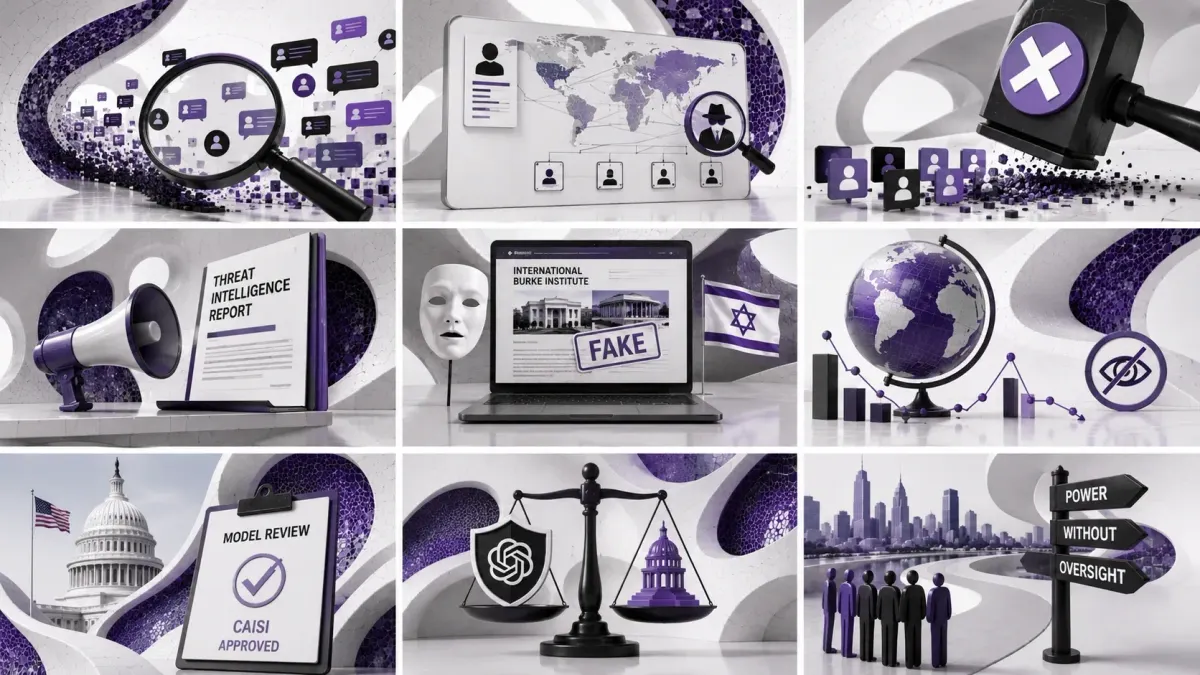
The campaign OpenAI took down was modest. Russian operators used ChatGPT to write social posts promoting a fake research group, the International Burke Institute, which claimed an Israeli address and filled its website with academic articles copied from real scholars and reattributed. The Israeli cover was the sharp move, because an argument for Russian strength and Western decline carries further when it seems to come from inside a United States ally rather than from Moscow. The posts flopped, a fabricated sovereignty index the group promoted did briefly circulate in a preprint and a policy blog, and the actor worth watching in the whole affair is OpenAI.
The referee has a home government
The company deciding which foreign operations to expose is not a neutral party in great-power politics. OpenAI released its GPT-5.6 model on 9 July 2026 only after a United States government review, run through the Commerce Department's Center for AI Standards and Innovation (CAISI), a process we covered at the time, and until that clearance the model sat behind a roster of partners the government had approved by name. A firm whose flagship ships on Washington's schedule is now also the body that names and judges a rival state's influence work. Its report is the only account of the operation that exists, and no outsider can check it against anything.
This is bigger than one takedown
A single takedown of a clumsy Russian campaign is easy to applaud. The pattern underneath it is harder. The power to decide what counts as foreign interference, to rule on it using evidence held privately, and to act without a warrant, a court or an appeal is moving to a small number of companies, and those same companies are becoming the arbiters of authenticity in money as well. Financial technology already leans on these firms to catch fraud, screen sanctions names and verify identity, which puts the judgement of what is real, in politics and in finance, into very few hands.
OpenAI did the naming, the proving and the punishing that democracies reserve for institutions a public can remove, and it did the job well. The same capability now decides what counts as foreign interference, on evidence held privately, inside a few firms that answer first to their investors and their government. Applauding the takedown and questioning the arrangement are the same act of good sense.
Editor's note
Every piece goes through careful verification, but mistakes can happen. Readers who spot an error or have additional information can write to rosalia@thebrightminded.com.